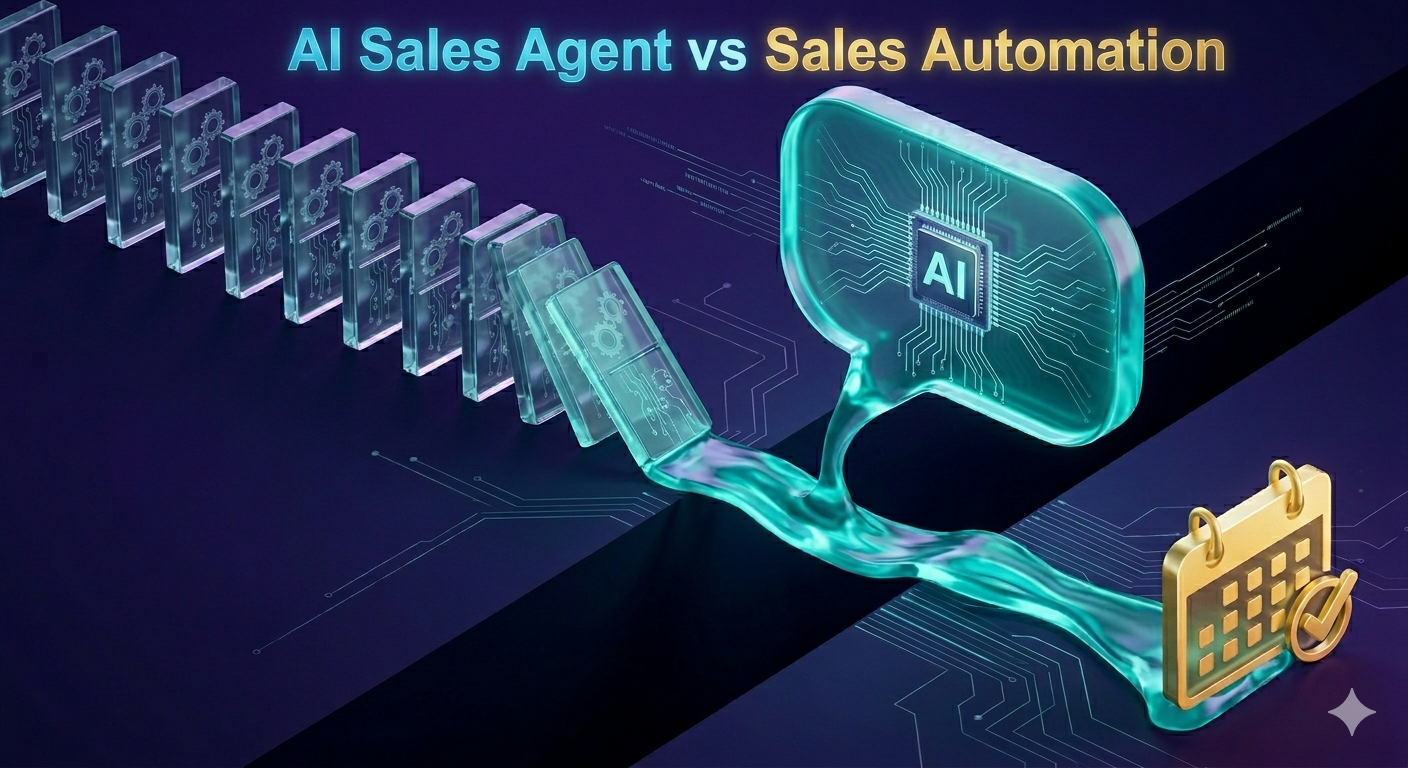
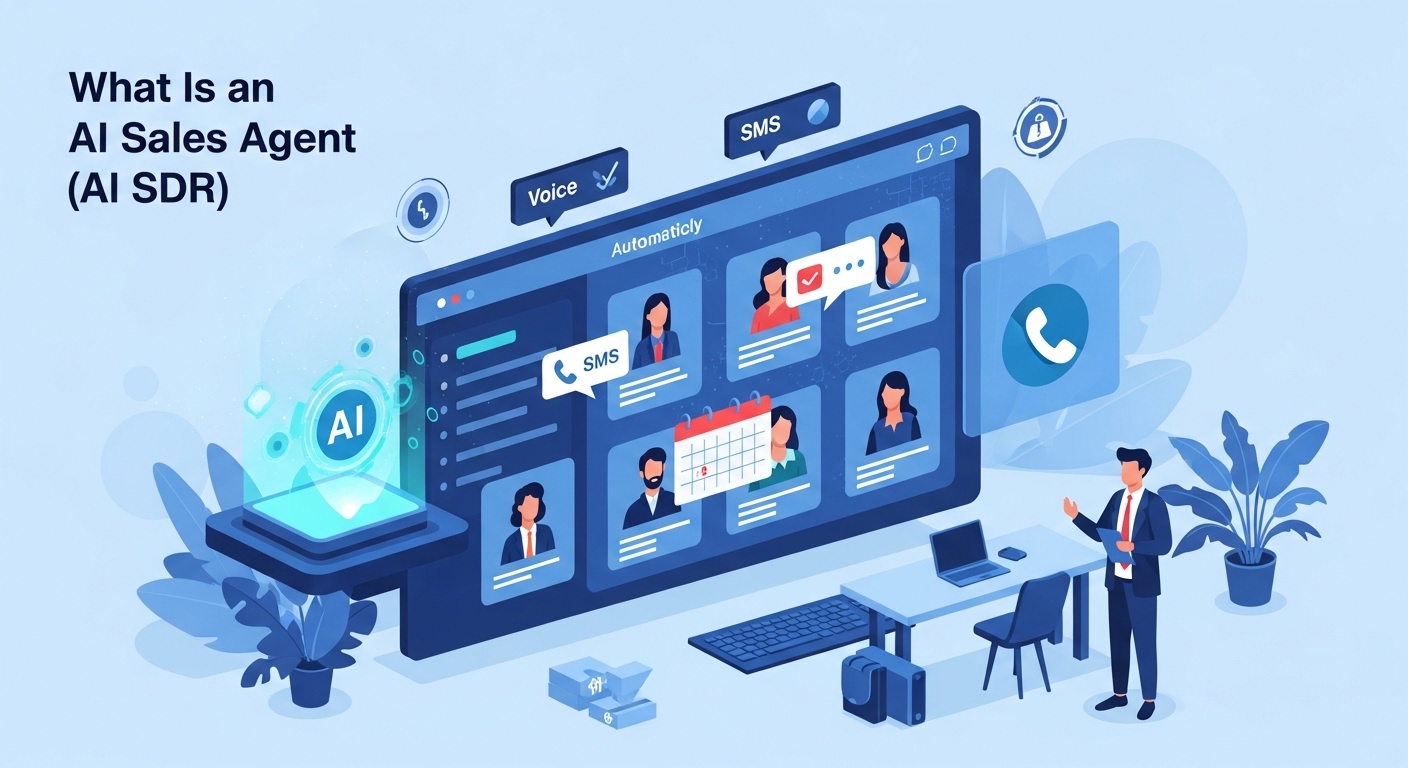
| Quick Answer An AI sales agent, also called an AI SDR (Sales Development Representative), is an automated system that contacts new leads, qualifies them through conversation, and books confirmed appointments without any human involvement. It works across voice calls, SMS, and email, responding to leads in under 5 seconds at any time of day. Unlike a human SDR, it handles hundreds of leads simultaneously, never needs time off, and logs everything to your CRM in real time. Most AI sales agents are live and operational within 30 minutes of setup. |
If you have ever missed a lead because no one was available to follow up in time, or watched a booked meeting become a no-show because reminders were not sent, you have experienced the problem that an AI sales agent is built to solve. Using an AI Appointment booking system ensures leads are captured and converted instantly.
The term AI sales agent, and its closely related alternative AI SDR, has become increasingly common in sales and marketing conversations. But for most business owners and team leaders, there is still real uncertainty about what it actually means, how it works in practice, and whether it is relevant to their specific situation. Many businesses compare tools through an AI vs Calendly comparison before implementing automation.
This guide answers all of those questions clearly and completely. By the end, you will understand exactly what an AI sales agent is, how it processes a lead from first contact to booked meeting, which communication channels it uses, and how quickly it can be deployed.
What Is an AI Sales Agent and What Does the Term AI SDR Actually Mean?
A traditional SDR, which stands for Sales Development Representative, is a person whose job is to contact new leads, start conversations, qualify them as potential customers, and hand off the warm, qualified ones to a closing salesperson. An SDR is typically the first human contact a lead has with a business after expressing initial interest.
An AI sales agent performs exactly the same function. It often works alongside an AI Phone Assistant to handle inbound and outbound communication, but it does it using artificial intelligence and automation rather than a human being. It contacts leads, runs conversations, asks qualifying questions, handles objections based on trained scripts, books appointments into a salesperson’s calendar, and logs the full interaction to a CRM. All of this happens automatically, without anyone from the business needing to be present.
The terms AI sales agent, AI SDR, and AI appointment setter are closely related and often used interchangeably. The key distinctions are subtle:
- AI SDR emphasizes the prospecting and qualification role. It maps directly to what a human SDR does, which is find and qualify leads before handing them to a closer.
- AI sales agent is a broader term that can include outbound prospecting, inbound response, qualification, booking, follow-up, and lead reactivation. It covers the full first-contact sales function.
- AI appointment setter emphasizes the booking outcome specifically. This is where an AI scheduling assistant plays a key role in managing availability. It describes an AI that qualifies leads and fills a calendar with confirmed meetings.
For most businesses, particularly those in services, healthcare, real estate, coaching, and agencies, all three terms describe the same practical solution: an AI that handles the first stage of sales automatically so that human staff can focus on closing.
How an AI Sales Agent Works: The Full Lead-to-Booking Flow Step by Step
Understanding how an AI sales agent works is easiest when you follow a single lead through the entire process. Businesses often combine this with AI appointment scheduling benefits strategies to maximize conversions. The five-stage flow below covers everything that happens from the moment a lead arrives to the moment a confirmed meeting appears in the salesperson’s calendar.
| Stage | 1. Lead Arrives | 2. Instant Contact | 3. Qualification | 4. Booking | 5. Hand-off |
| What happens | Lead enters via form, ad, call, webhook, or CSV upload | AI calls or texts the lead within seconds, 24/7 | AI asks qualifying questions on budget, timeline, and need | Qualified lead picks a slot; meeting added to calendar | Sales rep receives pre-qualified, confirmed appointment |
| Channel | Web, ads, phone, email, CRM | Voice call + SMS | Voice conversation or SMS | Calendar sync (Google / Outlook) | CRM + calendar notification |
| Time taken | Instant | Under 5 seconds | 2 to 5 minutes | Under 1 minute | Immediate |
| Human needed? | No | No | No | No | Yes (to close the deal) |
Stage 1: The Lead Arrives Through a Connected Source
An AI sales agent can receive leads from multiple sources simultaneously. The most common entry points are website contact forms connected via webhook, Facebook or Google Ads lead forms that sync directly to the AI system, inbound phone calls to the business number, CSV uploads of existing databases, and CRM records flagged for follow-up.
The moment a lead enters through any of these sources, the AI registers the contact and triggers an immediate outreach action. This process is typically powered by an automated call answering system. There is no queue, no delay, and no dependence on a human checking a notification. The process starts within seconds of the lead’s details arriving in the system.
Stage 2: The AI Makes First Contact in Under 5 Seconds
First contact speed is one of the most important variables in lead conversion. Research from InsideSales.com shows that the odds of successfully contacting a lead drop by 100 times if the first call is made 30 minutes after the enquiry rather than within the first 5 minutes. An AI sales agent does not wait 30 minutes. It acts in under 5 seconds.
The AI reaches out via voice call, SMS, or both simultaneously, depending on how it has been configured. A strong AI business phone system ensures consistent communication across channels. It introduces itself on behalf of your business using your business name, your offer details, and your tone. The lead hears a professional, natural-sounding voice that represents your brand accurately.
Stage 3: The AI Qualifies the Lead Through Natural Conversation
Qualification is the core intelligence function of an AI sales agent. Advanced systems use AI lead qualification logic to improve conversion rates. Rather than asking a lead to fill in a form, the AI has a real conversation. It asks targeted questions to understand the lead’s specific need, how urgently they need a solution, whether they have the budget for your service, and whether they are the right person to be speaking with.
The AI handles objections using response logic trained on your business’s most common scenarios. If a lead says they are not sure yet, the AI can offer relevant information to help them move forward. If a lead says they need to speak to a partner first, the AI can offer to schedule a joint call. The conversation adapts based on what the lead says rather than following a rigid script.
Leads that do not meet your qualification criteria are logged and either tagged for future follow-up or exited from the flow. No time is wasted on unqualified contacts, and no qualified lead is missed.
Stage 4: The AI Books a Confirmed Appointment
When a lead qualifies, the AI checks your live calendar availability in real time and offers two or three specific time slots. This is where AI booking automation becomes essential for scaling. The lead confirms their preferred time, and the AI creates a calendar event immediately. The event includes the lead’s name, contact details, and a summary of the qualification conversation so the salesperson walks into the meeting already informed.
The AI sends a confirmation message to the lead via SMS or email immediately after booking. Automated reminders follow at pre-set intervals, typically 24 hours before and again 2 hours before the appointment. These reminders help Reduce Appointment No Shows significantly. This reminder sequence is the primary reason AI-booked appointments show significantly lower no-show rates than manually booked ones.
Stage 5: The Qualified Meeting Is Handed Off to the Sales Team
The human sales team’s involvement begins at the closing call, not before. This model reflects the advantages shown in AI vs human setters comparisons. When the salesperson opens their calendar, they find a confirmed appointment with a pre-qualified lead who has already expressed specific interest, confirmed their budget range, and agreed to the meeting time. All qualification notes from the AI conversation are available in the CRM.
This hand-off model means salespeople spend their time on the activity that generates revenue: closing qualified conversations. They do not spend hours making first-contact calls, chasing cold leads, or following up on no-shows. The AI handles all of that upstream.
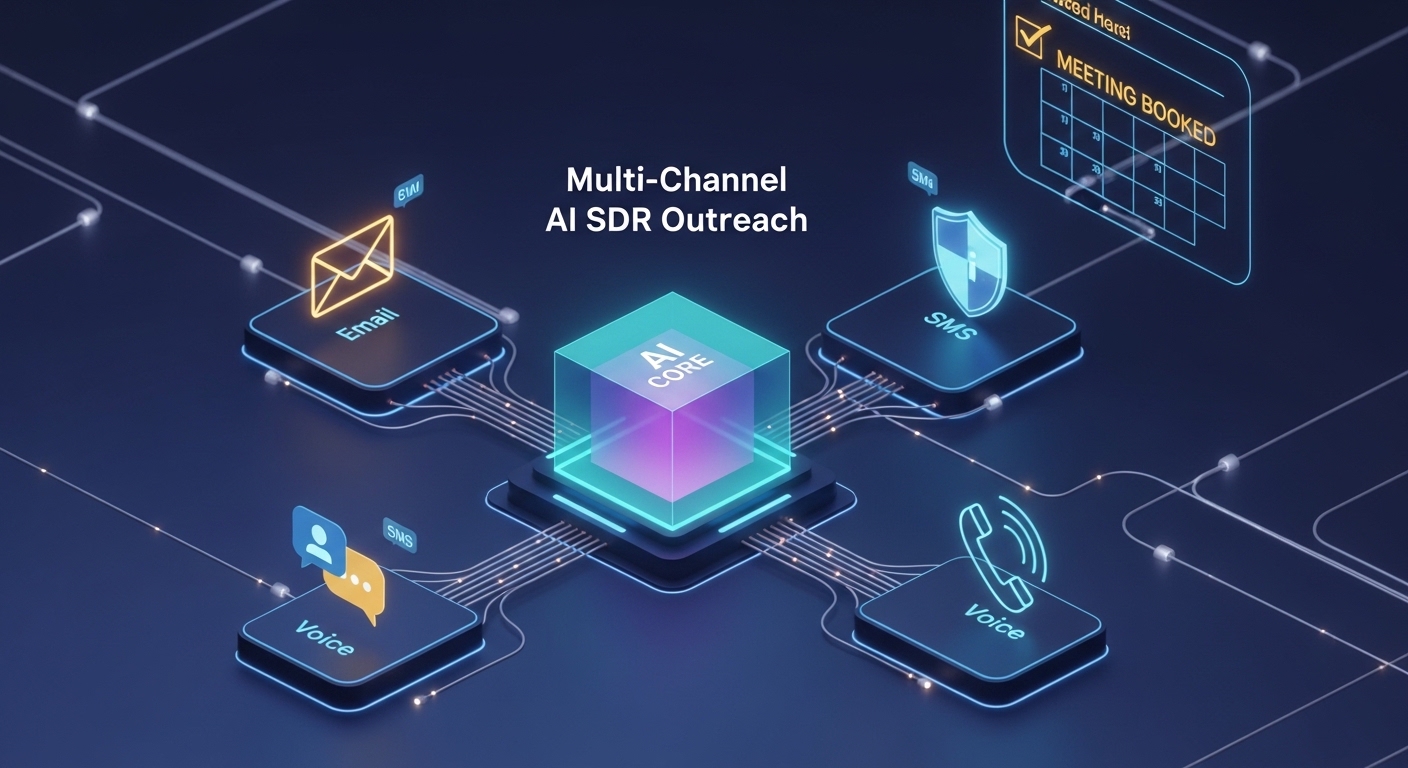
Which Communication Channels Does an AI Sales Agent Use and Why They Matter
A capable AI sales agent is not limited to one channel. Many businesses also integrate an online answering service for better coverage. It operates across multiple touchpoints to maximize the probability of reaching a lead and keeping the conversation moving. The channels used, and the reasons behind each one, are explained below.
Voice Calls: The Highest-Impact First-Contact Channel
Voice calls have the highest response and engagement rate of any outbound sales channel. This is why an Automated call routing system is often used. A phone call is immediate, personal, and difficult to ignore in the way that an email or SMS can be. An AI sales agent uses voice AI technology to make human-sounding calls that represent your business professionally. The conversation is dynamic, not pre-recorded. The AI listens and responds based on what the lead actually says.
Voice calls are particularly important for first contact with cold or warm leads because they create a sense of urgency and personal attention that digital messages cannot replicate. Businesses using AI voice agents as their primary outreach channel consistently report higher contact rates than those relying solely on email or SMS.
SMS and Text Messaging: High Open Rates and Instant Reach
SMS messages have an open rate of approximately 98%, compared to email open rates that typically sit between 20% and 30% for sales communications. Combined with an 24/7 call answering setup, response rates improve further. An AI sales agent uses SMS for initial outreach when a voice call does not connect, for appointment confirmations, and for the reminder sequence before each booked meeting.
SMS is also highly effective for lead reactivation. If a lead has gone quiet and is not answering calls, a short, personalised SMS from the AI often receives a response that restarts the conversation and opens a new booking opportunity.
Email: Supporting Follow-Up and Formal Confirmation
Email is less effective as a first-contact channel for immediate conversion, but it is valuable as a supporting channel. Many teams support this with an AI customer service strategy. The AI sends email confirmations after a booking is made, delivers pre-meeting information to leads, and can run drip sequences to nurture leads that are interested but not yet ready to book. Email works best as part of a multi-channel sequence rather than as the primary outreach method.
CRM Integration: The Central Data Channel
While not a communication channel in the traditional sense, CRM integration functions as the data backbone of an AI sales agent. This is where CRM integration automation becomes critical. Every lead interaction, qualification outcome, booking event, reminder sent, and no-show recorded is logged to the CRM in real time. This means the sales team always has complete, accurate, up-to-date information on every lead without any manual data entry.
AI sales agents commonly integrate with HubSpot, Salesforce, Pipedrive, GoHighLevel, and Zoho. Calendar integrations with Google Calendar and Microsoft Outlook are also standard.
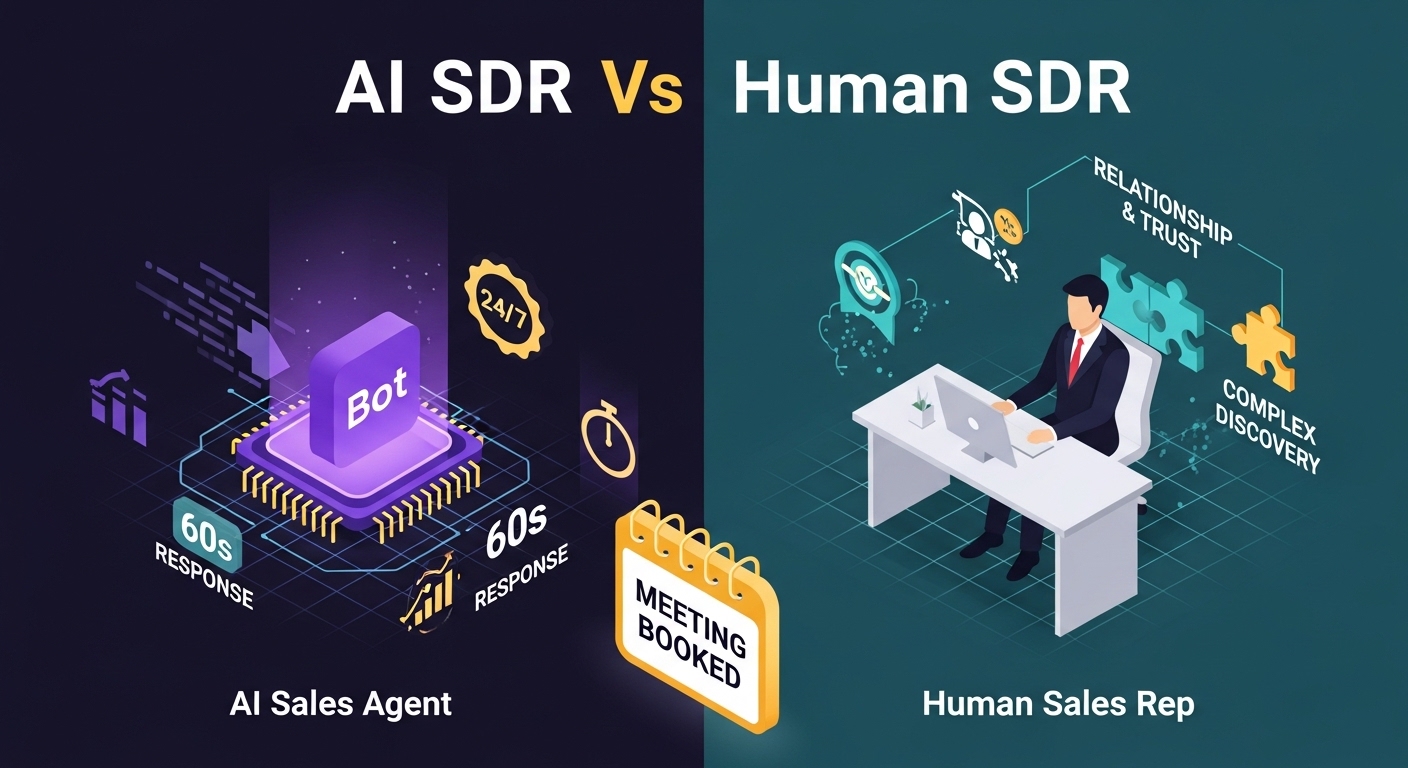
AI Sales Agent vs Human SDR: A Direct Comparison Across 12 Key Factors
Understanding the differences between an AI sales agent and a human SDR helps you decide how to use both effectively. Real-world AI appointment case studies highlight these differences clearly. This comparison is not about which is better overall. It is about understanding what each does well and where each belongs in your sales process.
| Factor | Human SDR | AI Sales Agent (AI SDR) |
| Response time to new lead | 5 minutes to several hours | Under 5 seconds, always |
| Working hours | Office hours only | 24 hours a day, 7 days a week |
| Leads handled simultaneously | 1 at a time | Hundreds or thousands at once |
| Consistency | Varies by mood, energy, and script adherence | 100% consistent every call |
| Cost | Salary + benefits + management overhead | Flat monthly platform cost |
| Lead qualification | Strong on nuanced conversations | Strong on structured criteria |
| Objection handling | High (human empathy and adaptability) | Good (trained on scripts and FAQs) |
| CRM data entry | Manual, often delayed or incomplete | Automatic, real-time, and enriched |
| No-show prevention | Depends on individual follow-up habit | Automated reminder sequences |
| Ramp-up time | 4 to 8 weeks for full productivity | Under 30 minutes to go live |
| Best for | Complex, high-context sales conversations | High-volume first-contact and qualification |
The practical conclusion from this comparison is not that one replaces the other entirely. The most effective setup for most businesses is an AI sales agent handling all first-contact outreach, qualification, and booking, with human salespeople stepping in at the confirmed meeting stage to close. This approach often includes a full AI receptionist services solution. This combination gives you the speed and consistency of AI at the top of the funnel and the adaptability and empathy of a human at the point of decision.
Which Types of Businesses Benefit Most From an AI Sales Agent
An AI sales agent delivers the strongest results for businesses that share three characteristics: they receive a meaningful volume of inbound leads, their sales process begins with a discovery or consultation call, and they currently experience delays in lead follow-up or high no-show rates. Many companies also benefit from AI receptionist benefits in lead handling. If your business matches all three, an AI sales agent will produce measurable results.
Marketing Agencies
Marketing agencies run campaigns that generate leads for clients, but conversion from lead to booked meeting often falls short because follow-up speed is not fast enough. An AI sales agent contacts every lead from every client campaign within seconds, qualifies them using client-specific criteria, and books meetings directly. The agency can package this as a performance add-on to client retainers and charge for it.
Real Estate and Property Businesses
Property leads have an extremely short window of interest. A buyer enquiring about a listing on Rightmove or Zillow will contact multiple agents and speak to the first one who responds. An AI sales agent ensures your agency is always first, contacting every new lead before competitors have even seen the notification.
Healthcare, Medical Spas, and Aesthetic Clinics
Clinics lose a significant portion of their ad spend because leads enquire and then receive no response until the following business day. An AI sales agent answers every call and form submission immediately, answers common questions about treatments and pricing, and books consultations around the clock. HIPAA-ready deployment options are available for practices handling sensitive patient data.
Coaches, Consultants, and Course Creators
High-ticket coaches rely on discovery calls to sell programmes worth thousands of pounds or dollars. When leads come from webinars, landing pages, or social media and are not followed up on within minutes, the conversion window closes. An AI sales agent responds instantly, qualifies the lead against the programme criteria, and books the discovery call before the lead has moved on.
Legal Services, Financial Practices, and Professional Services
Time-sensitive enquiries in legal and financial services have a narrow conversion window. A potential client who submits a form to three law firms will speak to whichever one calls back first. An AI sales agent places the first call within seconds, giving your firm the response-speed advantage that most competitors cannot match.
How Long Does It Take to Set Up an AI Sales Agent and Go Live?
One of the most common misconceptions about AI sales agents is that they require weeks of technical setup, developer involvement, or complex integrations. Modern platforms act as complete Virtual Receptionist Service systems. For modern done-for-you platforms like The DBT AI, this is not the case.
The Typical Setup Timeline for a Done-For-You AI Sales Agent Platform
- Account creation and initial configuration: 5 minutes. Sign up, add your business name, and set your primary time zone.
- Calendar and CRM connection: 5 to 10 minutes. Connect your Google Calendar or Microsoft Outlook via one-click OAuth. Connect your CRM if applicable.
- Availability rules and conflict handling: 5 minutes. Set your working hours, appointment duration, buffer time, and conflict handling preference.
- Agent script setup: 10 to 20 minutes. Either use an industry template from the library or write your own qualification questions, introduction, and objection responses.
- Lead source connection: 5 to 10 minutes. Connect your Facebook Ads lead form, website webhook, inbound phone number, or upload a CSV of existing leads.
- Reminder sequence activation: 5 minutes. Configure your SMS and voice reminder timing for before each appointment.
- Test booking: 5 minutes. Run a test call using your own number to confirm the end-to-end flow works correctly.
Total expected setup time: under 30 minutes for a standard single-agent setup. Businesses with multiple lead sources or complex qualification logic may take slightly longer, but the process remains accessible to any business owner without technical expertise.
For a custom-built AI SDR using separate tools such as Vapi, Make.com, and OpenAI, setup time is considerably longer, typically 5 to 20 hours depending on the complexity of the workflow and the developer’s experience. This approach offers more flexibility but requires ongoing maintenance that a managed platform does not.
Frequently Asked Questions About AI Sales Agents and AI SDRs
Is an AI sales agent the same thing as a chatbot?
No. A chatbot is a text-based response system that typically lives on a website or messaging app and responds to typed questions with pre-written answers. Unlike chatbots, a full AI receptionist system handles real conversations. It is passive, reactive, and limited to the channel it sits in. An AI sales agent is proactive and multi-channel. It initiates outbound voice calls, sends SMS messages, qualifies leads through real conversations, books appointments into live calendars, and syncs all data to your CRM. The two serve entirely different functions, and comparing them is like comparing a reception desk sign-in sheet to a full-time receptionist.
Does an AI sales agent replace my sales team?
No. An AI sales agent replaces the part of the sales process that happens before your sales team needs to be involved, which is first contact, qualification, and booking. Your salespeople still do what they are best at, which is having in-depth conversations with pre-qualified, confirmed prospects and closing deals. The AI simply ensures those salespeople are talking to the right people, at the right time, without wasting hours on cold outreach and no-shows. Most businesses that deploy an AI sales agent find that their human team’s close rate improves because they are spending more time on high-quality conversations.
What happens if a lead asks a question that the AI does not know how to answer?
Modern AI sales agents are trained on your business-specific information, including your FAQ document, your service details, your pricing structure, and your common objection responses. If a lead asks something outside the trained content, the AI is configured to handle gracefully, either by offering to have a team member follow up with that specific answer or by redirecting the conversation to scheduling a call where the question can be addressed properly. The goal is always to keep the conversation moving toward a booked meeting rather than losing the lead over an unanswered question.
Is an AI sales agent suitable for businesses in regulated industries like healthcare or law?
Yes, with appropriate configuration. Platforms that offer HIPAA-ready deployment options, such as The DBT AI, can be used by medical practices, dental clinics, and healthcare providers in a way that handles patient data in compliance with relevant regulations. For legal services, the AI is typically configured to capture the nature of the enquiry and book a consultation rather than attempting to provide legal information, which keeps the interaction clearly within appropriate boundaries. If you operate in a regulated industry, confirm that your chosen platform offers a data processing agreement and compliant data handling practices before deployment.
Can an AI sales agent follow up with old or cold leads?
Yes. AI sales agents are highly effective at lead reactivation. You can upload old lead lists (CSV or CRM data), and the AI will reach out via calls or SMS to restart conversations, qualify interest, and book new appointments. This often unlocks revenue from leads that were previously ignored or forgotten.
How customisable is an AI sales agent for my business?
Very customisable. You can define your own qualification questions, tone of voice, scripts, objection-handling logic, and booking rules. Most platforms also allow industry-specific templates, so the AI matches your exact sales process rather than using a generic script.
What happens if multiple leads come in at the same time?
An AI sales agent handles all of them simultaneously without delay. Unlike human SDRs who can only handle one conversation at a time, the AI can instantly contact, qualify, and book multiple leads in parallel, ensuring no opportunity is missed.
The Core Idea: What an AI Sales Agent Gives Your Business That Manual Follow-Up Cannot
An AI sales agent gives your business something that is genuinely difficult to achieve with human-only systems: the ability to respond to every lead, every time, within seconds, regardless of the time of day, the day of the week, or how many other leads arrive simultaneously.
The value is not in the technology itself. It is in the outcome. More leads contacted within the conversion window. More qualified conversations are reaching the sales team. More confirmed appointments in the calendar. Fewer no-shows. Less time spent on administrative follow-up. And a consistent, professional first impression is made with every person who expresses interest in your business. Choosing the best AI answering solution maximizes results.
For any business that runs on booked appointments and currently experiences any gap between a lead arriving and a human following up, an AI sales agent is the most direct solution available in 2026. It addresses the problem at the source rather than patching around it.
Ready to See the Difference?
Book a Live Demo with The DBT AI →
The DBT AI is an AI appointment setter built specifically for agencies, clinics, estate agents, coaches, and service businesses. It calls your leads within seconds, qualifies them through conversation, and books confirmed meetings directly to your calendar 24 hours a day, 7 days a week. No manual effort required.