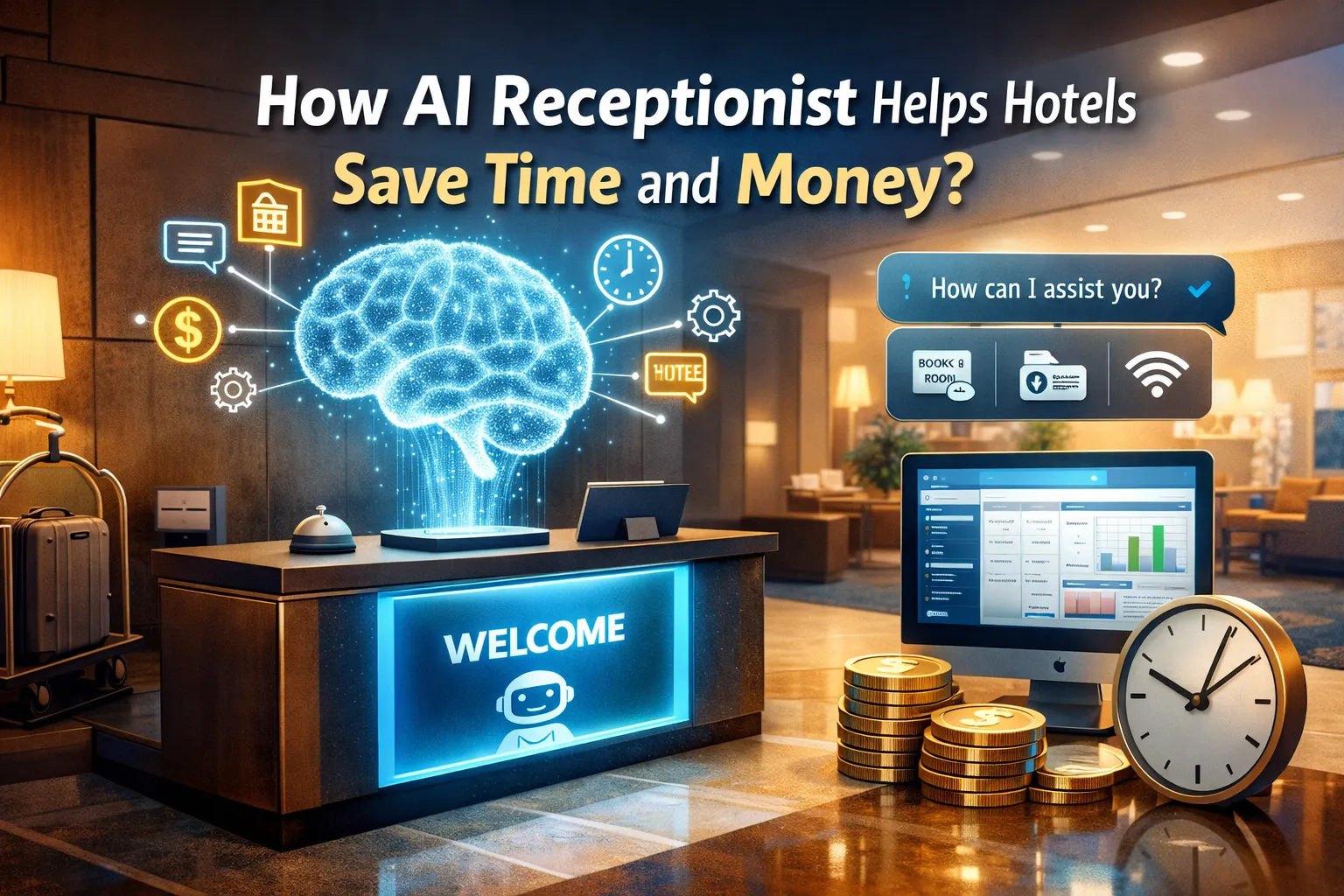
It is 11:30 PM. The night auditor is busy checking in a group of late arrivals, and the phone rings. It rings again. Eventually, it goes to voicemail. That call was a potential guest looking to book a suite for next weekend cover phones 24/7 results in high operational overhead and staff burnout. This is where an AI receptionist for hotels changes the operational landscape. By deploying conversational AI that can understand user intent and manage complex bookings, hotels stop losing leads to missed calls and start optimizing their bottom line.
What Is AI Receptionist Helps Hotels?
An AI receptionist for hotels is not a simple automated menu that asks callers to “press 1 for reservations.” It is a sophisticated voice AI solution driven by natural language processing (NLP) and large language models (LLMs). These systems act as a virtual front desk, capable of holding fluid, two-way conversations with guests just as a human concierge would.
Unlike static IVR systems, these agents utilize reservation system integration to access real-time room availability and pricing. They can modify bookings, answer FAQs about amenities, and execute guest check-in automation workflows without human intervention. The goal is to provide contactless guest services that feel personal and immediate, ensuring that every interaction is captured and actioned upon, regardless of the time of day or the volume of calls.
Components of Hotel AI Receptionist Technology
Effective AI receptionist solutions for hotels include these essential capabilities:
- Virtual Front Desk Operations: The system handles all standard front desk functions—availability checks, rate quotes, reservation modifications, and basic property information—without staff involvement.
- Guest Check-In Automation: Late arrivals receive automated confirmation, room assignments, and digital access credentials via SMS or email, eliminating front desk dependency.
- Intelligent Call Routing: Complex situations or frustrate to human agents with complete conversation history already captured, reducing resolutiond improving satisfaction.
- Automated Guest Communication: Confirmation emails, pre-arrival reminders, and post-stay follow-ups deploy automatically across voice, SMS, and email channels.
- Contactless Guest Services: Guests access information and services without physical interaction, supporting health protocols and convenience preferences.
AI Receptionist vs. Traditional Front Desk
To understand the ROI, we must compare the capabilities of hotel automation technology against traditional staffing models.
| Feature | Traditional Front Desk | AI Receptionist for Hotels |
|---|---|---|
| Availability | Limited by shift schedules & breaks | 24/7/365 instant availability |
| Concurrency | 1 call per staff member | Unlimited simultaneous calls |
| Response Time | High variance (hold times common) | Human-like latency (<1 second) |
| Cost Model | Hourly wages + Benefits + Training | Flat subscription or usage-based |
| Data Accuracy | Prone to manual entry errors | 100% accurate CRM sync |
| Scalability | Slow (hiring & training lag) | Instant (handle spikes immediately) |
15 Ways AI Receptionist Helps Hotels Save Time and Money?
The implementation of an AI receptionist for hotels offers a multi-faceted return on investment. Below are 15 distinct ways this technology reduces costs and drives efficiency.
1. Capturing Revenue from After-Hours Calls
The most immediate impact of an AI receptionist is the recovery of lost revenue. A significant portion of booking inquiries occurs outside of standard business hours or when the front desk is overwhelmed. By utilizing a 24/7 call answering service, hotels ensure that every potential guest is greeted immediately. If a boutique hotel misses just five booking calls a week at an average value of $200, that is $52,000 in lost annual revenue. AI eliminates this leakage entirely.
2. Reducing Labor Costs and Overtime
Staffing a front desk 24 hours a day is one of the largest expenses for a hotel. By offloading phone duties to a virtual receptionist service, management can reduce the number of staff required for night shifts or swing shifts. Instead of paying premium overtime rates for staff to simply sit by the phone, the AI handles the volume, allowing you to run a leaner, more efficient payroll without sacrificing service quality.
3. Eliminating OTA Commission Fees
When guests cannot reach the front desk, they often turn to Online Travel Agencies (OTAs) like Expedia or Booking.com to secure their room, costing the hotel 15% to 25% in commissions. An AI appointment booking system empowers guests to book directly over the phone instantly. By facilitating direct bookings, the AI keeps the full margin in-house, significantly improving the profitability of each reservation.
4. Streamlining Check-In Procedures
Friction during arrival sets a poor tone for a guest’s stay. Through guest check-in automation, an AI agent can verify identity, confirm reservation details, and even issue digital keys or entry codes via SMS before the guest walks through the door. This creates a digital concierge experience that bypasses the queue, saving staff time and impressing guests with efficiency.
5. Managing Peak Season Scalability
During holidays or local events, call volume can spike by 300% or more. Hiring temporary staff is expensive and requires training time you don’t have. An automated call answering service provides infinite scalability. Whether you receive 10 calls or 1,000 calls simultaneously, the AI handles them all with the same level of precision, ensuring no guest is ever put on hold due to high volume.
6. Filtering and Qualifying Leads
Not every call is a booking. Front desk staff often waste hours answering soliciting calls or general inquiries that do not generate revenue. AI acts as a filter, performing rigorous lead Qualification to distinguish between a vendor, a spam caller, and a high-value guest. This ensures that your human team only spends time on complex, high-value interactions that actually require their expertise.
7. Automating Routine FAQs
“What time is breakfast?” “Is the pool open?” “Do you have parking?” These repetitive questions distract staff from high-value tasks. An AI phone answering service can be programmed with your property’s specific knowledge base to answer these questions instantly. This reduces the mental load on your staff and ensures guests get accurate information immediately without waiting for a human to finish checking in another guest.
8. Enhancing Data Accuracy via CRM Integration
Manual data entry is the primary cause of booking errors. A misspelled name or a Reducing No-Shows with Automated Reminders No-shows are a sunk cost that cannot always be recovered. AI can proactively manage this by sending automated guest communication via SMS or voice calls to confirm upcoming arrivals. If a guest needs to cancel, the AI can immediately reopen that inventory in the system, increasing the chance of re-booking the room and mitigating total revenue loss.
10. Providing Multilingual Support
In a globalized travel market, language barriers can result in lost bookings. Hiring multilingual staff for every shift is impractical for most hotels. However, a bilingual AI receptionist can switch between languages fluently, catering to international travelers in their native tongue. This expands your market reach and ensures that non-native speakers feel welcome and understood from the very first interaction.
11. Intelligent Call Routing for Complex Issues
While AI handles the bulk of inquiries, some situations require a human touch. Features like intelligent call routing analyze the context of the conversation. If a guest is asking for a complex group booking negotiation or expressing dissatisfaction, the AI seamlessly transfers the call to a specific department or manager, passing along the transcript so the human agent is fully briefed.
12. Sentiment Analysis to Prevent Bad Reviews
Negative reviews can cripple a hotel’s reputation. Advanced AI utilizes sentiment analysis to detect frustration or anger in a caller’s voice. If the system detects a negative sentiment, it can prioritize the call for immediate human intervention or flag the interaction for management review. This proactive approach to customer experience (CX) helps resolve issues before they turn into one-star reviews on TripAdvisor.
13. Ensuring Data Privacy and Compliance
Handling credit card information and personal data requires strict adherence to security protocols. Human staff can inadvertently write down credit card numbers or mishandle data. An AI system operates within strict data privacy frameworks (like PCI-DSS and GDPR), ensuring that sensitive information is processed securely without human visibility, reducing liability risks for the hotel.
14. Consistent Brand Voice and Upselling
Humans have bad days; AI does not. An AI voice receptionist delivers a consistent, professional, and branded experience on every single call. Furthermore, it can be programmed to upsell on every interaction—offering room upgrades, spa packages, or late check-outs—consistently driving incremental revenue that human staff might forget to ask for during busy periods.
15. Reducing Training and Onboarding Costs
The hospitality industry faces high turnover rates. Every time a receptionist quits, the hotel loses money on recruitment and training. An AI auto attendant never quits, never gets sick, and retains all institutional knowledge perfectly. You stop spending money on retraining staff on basic phone scripts and PMS entry, as the AI retains this logic permanently.
What Industries Benefited By AI Receptionist?
While the impact on hotels is profound, the underlying technology of The DBT AI drives efficiency across various service-based sectors.
Med Spas & Aesthetic Clinics
High-ticket appointments require precise scheduling. Med spas & aesthetic clinics utilize AI to manage consultations and reduce no-shows. The AI can explain pre-procedure instructions and book follow-ups, ensuring the practitioner’s calendar is optimized for revenue.
Real Estate
Speed to lead is critical in property sales. Real estate agents benefit from AI that can field inquiries from Zillow or yard signs instantly, 24/7. The AI qualifies the buyer’s budget and timeline before scheduling a viewing, ensuring agents only meet with serious prospects.
Legal Services
Lawyers cannot answer phones while in court. Legal services & law firms use AI to screen potential clients. The AI performs an intake interview, gathering case details and conflict-of-interest information, allowing the attorney to review the case viability before returning the call.
Home Services
Plumbers, electricians, and HVAC technicians are often in the field and unable to answer the phone. Home services businesses use AI to capture emergency requests, quote basic pricing, and schedule dispatch times, ensuring they don’t lose jobs to competitors who answered the phone first.
Which AI Receptionist Provider Should You Choose?
Selecting the right provider is critical. You need a solution that goes beyond simple “chatbot” functionality and offers true voice intelligence. The ideal provider must offer bi-directional calendar sync to prevent double bookings and neural text-to-speech voices that sound indistinguishable from humans.
You should look for a platform that understands the specific nuances of hotel management software and visitor management. Avoid generic solutions that cannot handle the specific vocabulary of the hospitality industry (e.g., “. We focus on lead conversion and operational efficiency.
Our system provides instant lead response, ensuring your hotel never misses a revenue opportunity. We invite you to test the capability yourself. You can schedule a trial to hear the difference in latency and conversation quality. If you want to see how we handle real-time bookings, let us demonstrate The DBT Ai in a live environment tailored to your property’s needs.
Conclusion
The hospitality industry is evolving, and guest expectations for speed and convenience are at an all-time high. Implementing an AI receptionist for hotels is no longer just a futuristic concept; it is a necessary strategy for survival and growth. By automating the virtual front desk, hotels can slash operational overhead, capture 100% of leads, and allow human staff to return to what they do best: providing exceptional, face-to-face hospitality.
As conversational AI and LLMs continue to advance, the gap between hotels that automate and those that don’t will widen. The future belongs to properties that leverage hotel automation technology to create a seamless, efficient, and profitable guest experience.
If you are ready to transform your front desk operations, start your DBT AI free trial today and stop leaving revenue on the table.
Frequently Asked Questions (FAQS)
How much does an AI receptionist for hotels cost compared to human staff?
The cost of an AI receptionist is significantly lower than human labor. While a 24/7 human front desk requires at least 3-4 full-time salaries plus benefits, an AI solution typically operates on a monthly subscription or usage model. This can result in savings of up to 70% on communication-related labor costs while providing superior availability.
Can the AI receptionist integrate with my current Property Management System (PMS)?
Yes, modern AI business phone system solutions are designed for connectivity. They utilize APIs to integrate with major hotel management software and CRMs. This allows the AI to read live availability, input guest data directly into your system, and trigger workflows without manual data entry.
Will the AI voice sound robotic to my guests?
No. Leading platforms utilize neural text-to-speech technology and advanced voice AI to create voices that sound natural, empathetic, and human-like. The latency is minimized to ensure fluid conversation, making it difficult for many callers to distinguish between the AI and a human agent.
What happens if the AI cannot understand a guest’s request?
AI receptionists are equipped with intelligent call routing. If a guest asks a question that falls outside the AI’s training or requires complex human judgment, the system detects this and seamlessly transfers the call to a human staff member, passing along the context of the conversation so the guest doesn’t have to repeat themselves.
Is guest data secure with an AI receptionist?
Absolutely. Reputable providers prioritize data privacy and compliance with standards like GDPR and PCI-DSS. Calls are processed via encrypted channels, and sensitive information is handled with strict security protocols, often offering greater security than manual note-taking at a busy front desk.