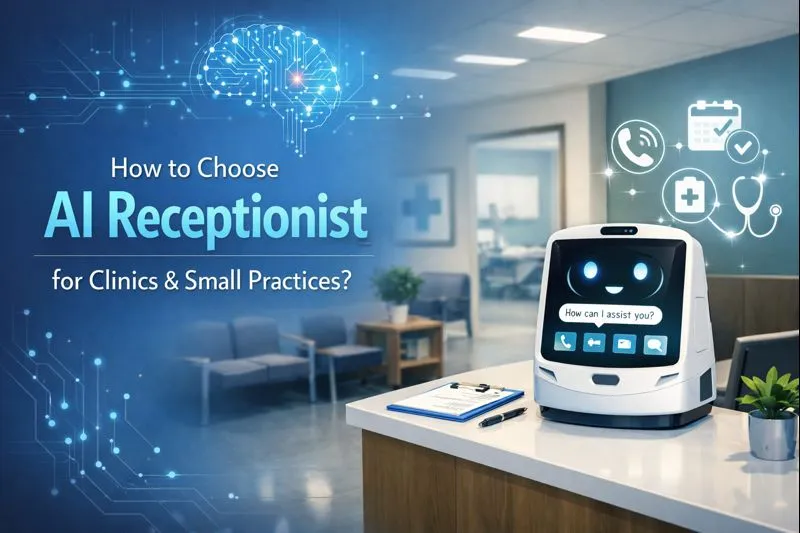
Clinics and small medical practices face a silent revenue killer: missed calls. Studies indicate that up to 60% of calls to medical practices go to voicemail, particularly after hours or during peak operational times. For a small practice, this operational overhead translates into thousands of dollars in lost revenue and frustrated patients who turn to competitors with better availability. Implementing an AI receptionist for clinics is no longer a futuristic luxury; it is a necessary evolution in healthcare customer service.
By deploying conversational AI, practices can stop bleeding revenue, ensure patient data security, and automate appointment management without expanding their administrative payroll.
What Is An AI Receptionist for Clinics?
An AI receptionist for clinics is a sophisticated software solution driven by natural language processing (NLP) and large language models (LLMs) designed to handle voice interactions exactly like a human front-desk agent. Unlike rigid, old-school phone trees (IVR), this technology understands user intent, context, and nuance.
It functions as a comprehensive patient check-in system and clinic scheduling software, capable of answering calls, answering complex queries, and executing appointment management tasks in real-time. By utilizing voice AI and voice recognition technology, the system manages inbound traffic, executes lead qualification, and integrates with your existing tech stack to maintain a fluid customer experience (CX).
For a deeper understanding of the technology, read about what is an ai receptionist.
AI Receptionist vs. Traditional Methods
Before examining specific selection criteria, it is vital to visualize the efficiency gap between human-only workflows and AI automation.
| Feature | Traditional Human Receptionist | AI Receptionist for Clinics |
|---|---|---|
| Availability | Limited to business hours (40 hours/week) | 24/7/365, zero downtime |
| Concurrency | One call at a time (busy signals common) | Unlimited simultaneous calls |
| Cost Efficiency | High salary, benefits, training costs | Fixed monthly cost, significantly lower overhead |
| Response Time | High latency, hold times, callbacks | Instant pick-up, zero hold time |
| Data Entry | Prone to manual error (approx. 10-15%) | >99% accuracy via direct integration |
| Scalability | Linear (hire more staff to scale) | Exponential (scales instantly with volume) |
12 Ways to Choose AI Receptionist for Clinics & Small Practices
Selecting the right automation partner is critical. Healthcare requires specific adherence to privacy and accuracy that general business tools often lack. Below are the twelve critical factors to consider when choosing an AI receptionist for clinics, ensuring you maximize ROI and maintain trust.
1. HIPAA and Data Privacy Compliance
In healthcare, data security is non-negotiable. The first question you must ask any vendor concerns their adherence to GDPR and HIPAA standards. An AI system handles sensitive patient health information (PHI) during telehealth integration or appointment setting. If the conversational AI stores recordings or transcripts insecurely, your practice risks massive fines.
The solution must offer end-to-end encryption and strict access controls. A robust AI receptionist system ensures that while the AI “learns,” it does not expose patient identities to public models. Always request documentation regarding their data handling protocols before testing the software.
2. Deep Integration with Clinic Scheduling Software
An AI that cannot write to your calendar is merely a fancy answering machine. The system must feature bi-directional calendar sync. This means when a patient books a slot via voice, it instantly reflects in your practice management software, and conversely, the AI knows immediately if a doctor blocks out time manually.
Effective app integration with platforms like Salesforce, HubSpot, or industry-specific EHRs prevents double-bookings. Without this, your staff will spend hours reconciling the AI’s promises with the actual schedule. You can review how The DBT AI handles app integration to understand the technical requirements for smooth data flow.
3. Human-Like Latency and Natural Voice Quality
Patients should not feel like they are talking to a robot. The hallmark of a modern system is neural text-to-speech combined with low latency. “Latency” refers to the pause between the user speaking and the AI responding. High latency creates awkward interruptions.
The best solutions utilize advanced voice AI to minimize this gap, creating a fluid conversation. If the voice sounds synthetic or the delay is noticeable, patients will hang up. Listening to a virtual receptionist service demo is essential to verify the prosody and tone of the AI voice before implementation.
4. Handling Concurrency and Call Volume
Small practices often experience call bursts—Monday mornings or after holidays. A human receptionist can only handle one line, forcing others to voicemail. A primary advantage of medical reception automation is concurrency; the ability to answer 5, 10, or 50 calls simultaneously.
When evaluating a vendor, ask about their capacity limits. A true 24/7 call answering service ensures that every caller receives an instant answer, regardless of how many other patients are calling at that exact second. This capability directly impacts your lead conversion rates.
5. Advanced Lead Qualification Capabilities
Not every call is an appointment request; some are solicitors, while others are general inquiries. The AI must possess logic for lead qualification. It should distinguish between a new patient worth $5,000 in dental work and a vendor trying to sell supplies.
By asking pre-set qualifying questions, the AI filters traffic. It can route high-value patients directly to booking while directing administrative queries to a voicemail or transcript for later review. This reduces operational overhead by ensuring your human staff only deals with tasks requiring high-level judgment.
6. Intelligent Call Routing and Escalation
While AI is powerful, it is not a doctor. There will be scenarios—emergencies or highly complex medical histories—where a human must intervene. The system needs intelligent call routing protocols.
If the AI detects user intent related to a medical emergency or a frustrated tone, it should transfer the call to a specific on-call mobile number or designated desk line immediately. An effective automated call routing system acts as a triage nurse, managing the flow of communication safely and efficiently.
7. Multilingual Support and Accessibility
Clinics serving diverse communities must break language barriers. A monolingual AI limits your market. Top-tier providers offer multilingual support, allowing the AI to detect the caller’s language and switch instantly.
Whether it is Spanish, Mandarin, or French, the voice recognition technology must maintain high accuracy across different accents and dialects. This inclusivity not only improves customer experience (CX) but also expands your potential patient base significantly. You can explore how can ai receptionists handle multiple languages effectively to see the technical nuance involved.
8. Sentiment Analysis for Better CX
Understanding words is different from understanding emotion. Sentiment analysis allows the AI to detect if a caller is anxious, angry, or happy. In healthcare, empathy is currency.
If a patient sounds distressed, the AI should adjust its tone or expedite the routing process. This capability moves the interaction from transactional to relational. Analyzing these sentiment trends over time also helps you audit your practice’s overall healthcare customer service quality.
9. Automated Appointment Reminders and Follow-ups
Booking the appointment is only half the battle; ensuring the patient shows up is the other. No-shows cost the healthcare industry billions. Your AI choice should include automated appointment reminders via SMS or outbound calls.
Data suggests automated reminders can reduce no-show rates by up to 27%. The system should trigger these reminders autonomously based on the calendar data, freeing your front desk from making manual confirmation calls. This feature is often found in a comprehensive AI appointment booking solution.
10. Cost Transparency and ROI
Pricing models vary wildly. Some charge per minute, others per booked appointment, and some offer flat licensing fees. For a small practice, predictable billing is vital. You must calculate the ROI based on operational overhead reduction and new revenue captured.
A basic formula to calculate ROI is:
ROI = ((Value of Saved Staff Hours + Value of Recovered Missed Calls – AI Cost) ÷ AI Cost) × 100
Make sure to avoid hidden setup fees when evaluating AI receptionist solutions.
Look for a cost-effective model that scales with your growth rather than penalizing you for it.
11. Customization and Brand Voice
Your clinic has a specific atmosphere—perhaps it is a high-end med spa or a family-oriented pediatric center. The AI should reflect this. You need the ability to customize the script, the voice persona, and the interaction style.
A generic “robot” voice damages your brand. The ability to tailor the opening greeting, the FAQs the AI can answer, and the tone (professional vs. warm) helps the AI phone assistant act as a true extension of your team.
12. Analytics and Reporting Dashboard
You cannot improve what you do not measure. A superior AI provider offers a granular dashboard showing call volume, peak times, conversion rates, and common rejection reasons.
These insights help you adjust your marketing and operations. For instance, if the analytics show a spike in calls at 7 AM, you know there is demand for early slots. Access to this data transforms your phone line from a cost center into a source of business intelligence. Reading about ai receptionist benefits can highlight what metrics matter most.
What Industries Benefited By AI Receptionist?
While clinics are a primary beneficiary, the underlying technology powers efficiency across several related sectors:
- Private Healthcare Clinics: Independent practices utilize private healthcare clinics automation to manage high-volume scheduling without hiring extra staff, significantly reducing overhead.
- Med Spas & Aesthetic Clinics: High-ticket service providers rely on med spas & aesthetic clinics solutions to capture leads filtering potential cases efficiently.
- Home Services: Contractors and service providers use home services AI agents to quote and schedule jobs while they are out in the field working.
Which AI Healthcare Receptionist Provider Should You Choose?
After evaluating the 12 criteria, the challenge is finding a provider that balances technical power with ease of use. The DBT AI is engineered specifically to meet these rigorous demands.
We differentiate ourselves through a focus on ROI and operational fluidity. The DBT AI utilizes advanced LLMs to ensure conversations are context-aware and empathetic, not robotic. Our platform offers CRM integration with major players like Salesforce, HubSpot, and GoHighLevel, ensuring your data remains synchronized across your entire tech stack.
Crucially, The DBT AI prioritizes compliance and reliability. With bi-directional calendar sync and robust lead qualification logic, we act as a true partner in your growth. Whether you need a virtual receptionist for law firms or a dedicated clinic assistant, our infrastructure supports high concurrency and instant lead response.
By choosing The DBT AI, you are not just installing software; you are deploying a best AI answering service capable of transforming your patient intake process.
Conclusion
The adoption of an AI receptionist for clinics is a strategic move to secure the future of your practice. As technology evolves, we will see even deeper integrations with predictive analytics and telehealth integration, further reducing the administrative burden on healthcare providers.
Small practices that adopt this technology today position themselves to capture more market share, reduce operational overhead, and provide a superior patient experience. Do not let another patient go to voicemail.
Let us demonstrate The DBT Ai and show you how we can automate your booking process and increase your revenue.
Frequently Asked Questions (FAQs)
How much money can an AI receptionist save a clinic?
An AI receptionist significantly reduces costs compared to hiring full-time staff. While human receptionists cost thousands in salary and benefits, an AI solution costs a fraction of that monthly. Most clinics report a 40-60% reduction in operational costs related to call handling.
Is AI receptionist software HIPAA compliant?
Top-tier providers prioritize data security. Solutions like The DBT AI are designed with data privacy frameworks that adhere to GDPR and HIPAA standards, ensuring that patient health information (PHI) remains encrypted and secure.
Can the AI handle complex medical questions?
AI receptionists are designed to handle scheduling, FAQs, and lead qualification. For complex medical advice or emergencies, the system uses intelligent call routing to transfer the call to a qualified medical professional immediately.
Does the AI integrate with my existing dental or medical software?
Yes, modern AI receptionists offer app integration with popular CRMs and practice management systems. This ensures bi-directional calendar sync, preventing double bookings and keeping patient records up to date automatically.
What happens if the AI doesn’t understand the caller?
Advanced natural language processing (NLP) allows the AI to understand various accents and phrasing. However, if a caller is unintelligible or the query is outside the AI’s training, the system will politely escalate the call to a human staff member or take a detailed message.