The Real Difference Between AI SDRs and Outreach Tools
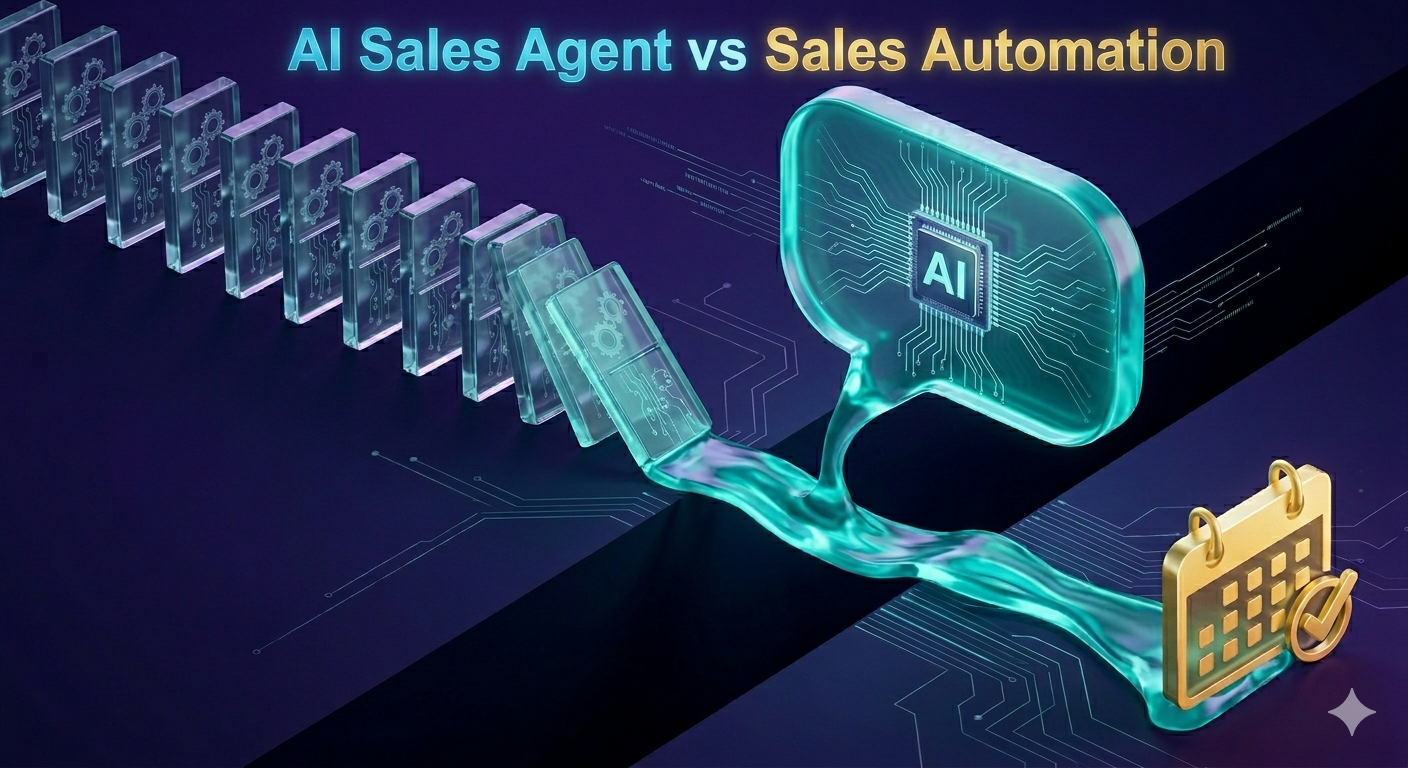
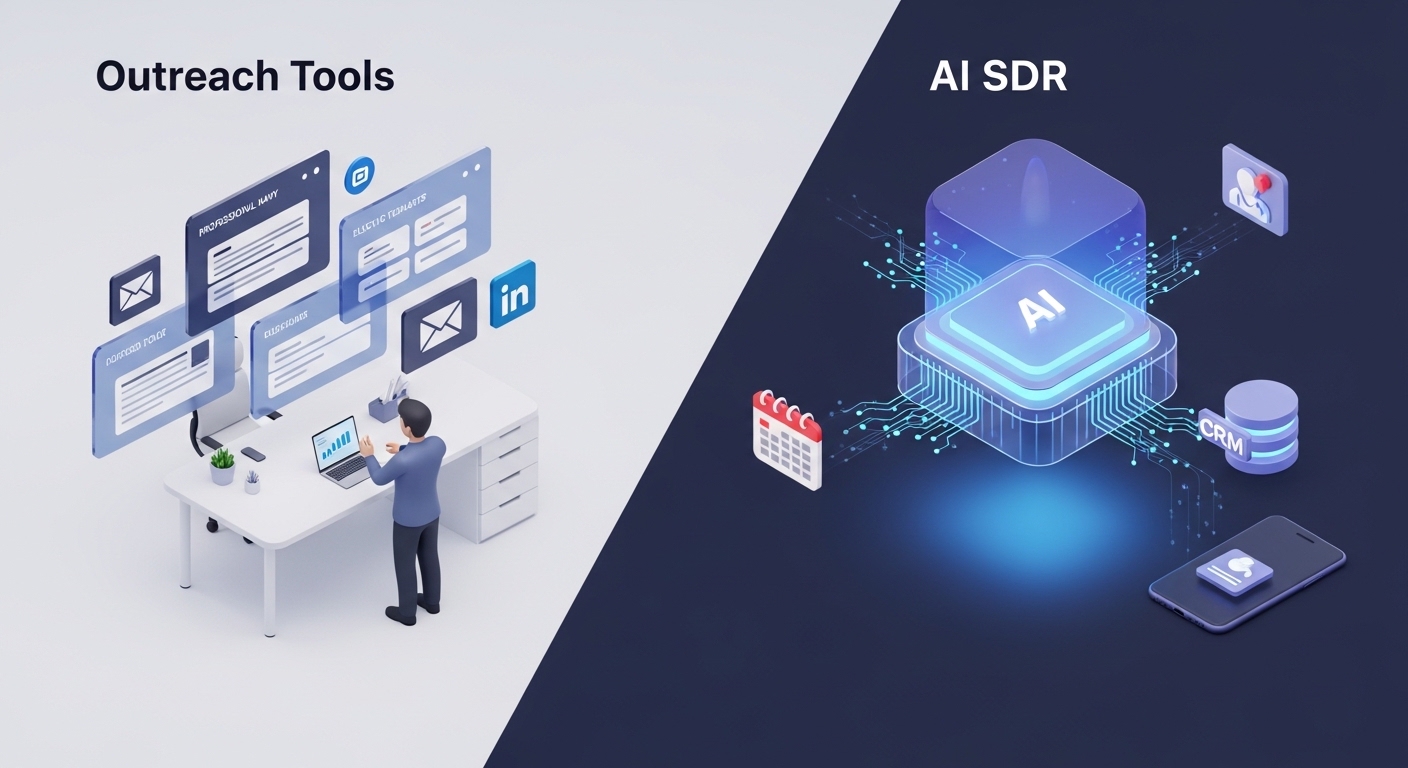
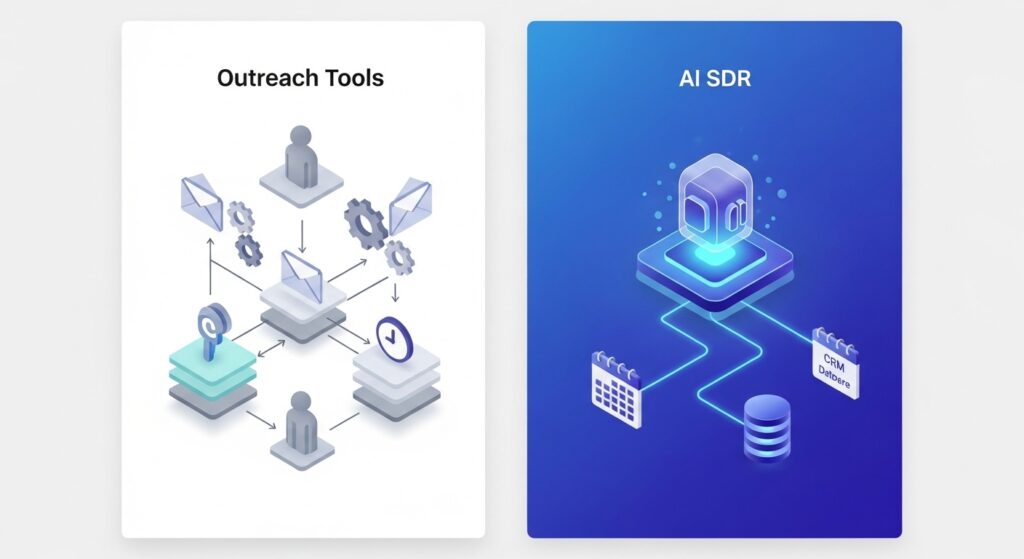
Many sales teams assume that tools like Outreach.io and Reply.io do the same job as an AI SDR. They do not. They automate parts of the outreach process. An AI SDR automates the entire process, including the decision-making, personalisation, responses, and booking. This approach is explained in detail in AI sales agent systems.
Understanding the difference matters because the right choice depends on what your team actually needs. Many businesses validate this using AI SDR benefits data. If you have human SDRs who need a better system to manage their sequences, an outreach tool may be sufficient. If you want to replace or supplement the human SDR function with automation, an AI SDR platform is the appropriate category of tool.
This article compares both options directly across four dimensions that determine outreach quality: messaging personalisation, live-call capability, booking outcomes, and CRM update automation. By the end, you will know which model fits your pipeline and team structure.
What Are Outreach Tools?

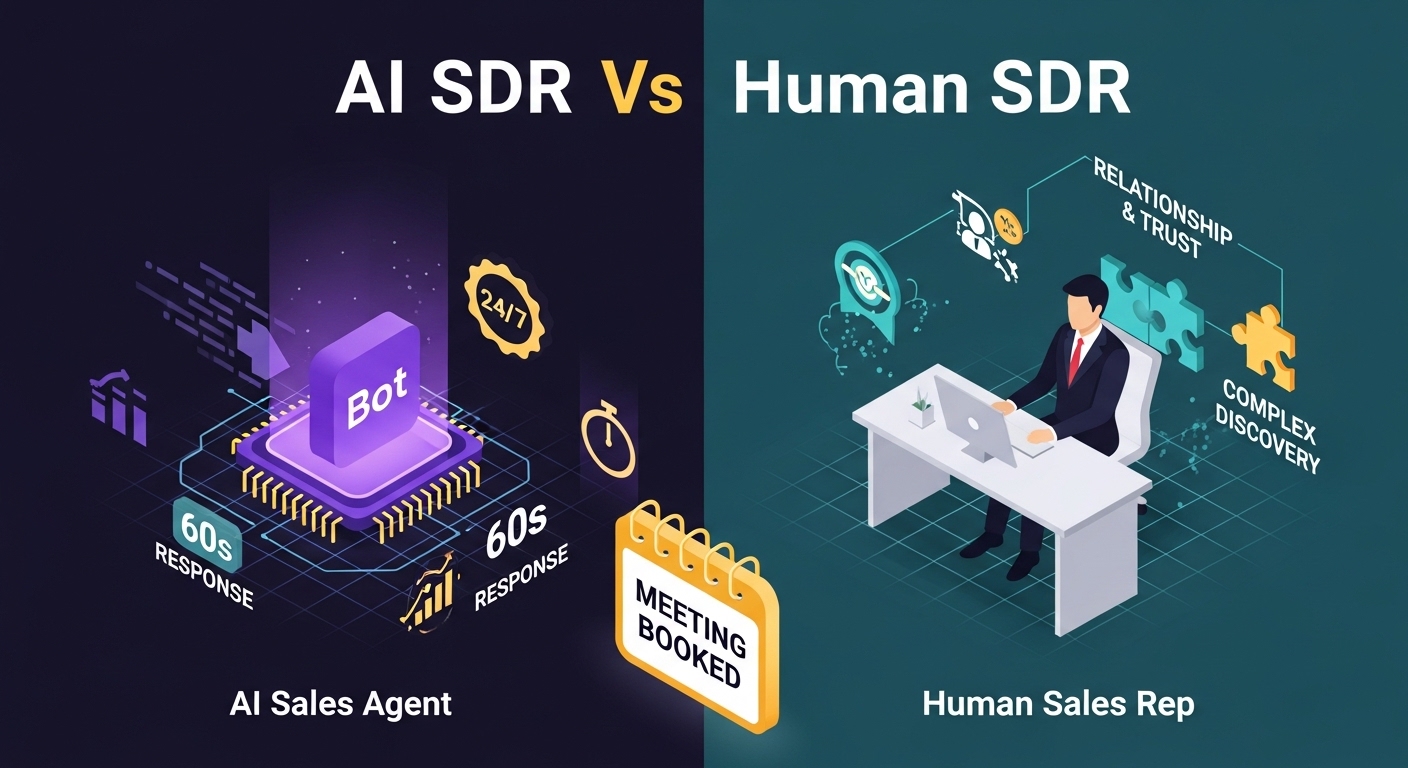
Outreach tools, also called sales engagement platforms, are software systems designed to help human sales representatives manage, automate, and track multi-step outreach sequences. These are often compared in AI vs human SDR discussions. Leading platforms in this category include Outreach.io, Reply.io, Salesloft, Apollo, and Lemlist.
These platforms handle the delivery mechanics of outreach: scheduling emails, tracking opens and clicks, managing LinkedIn sequences, A/B testing subject lines, and syncing activity to CRM. The human SDR writes the messages, makes the calls, and decides how to respond when a prospect replies. This differs from AI lead qualification systems.
Outreach tools make human SDRs more organised and more consistent. They do not replace the human element. The SDR still needs to be hired, trained, managed, and retained.
What Is an AI SDR?
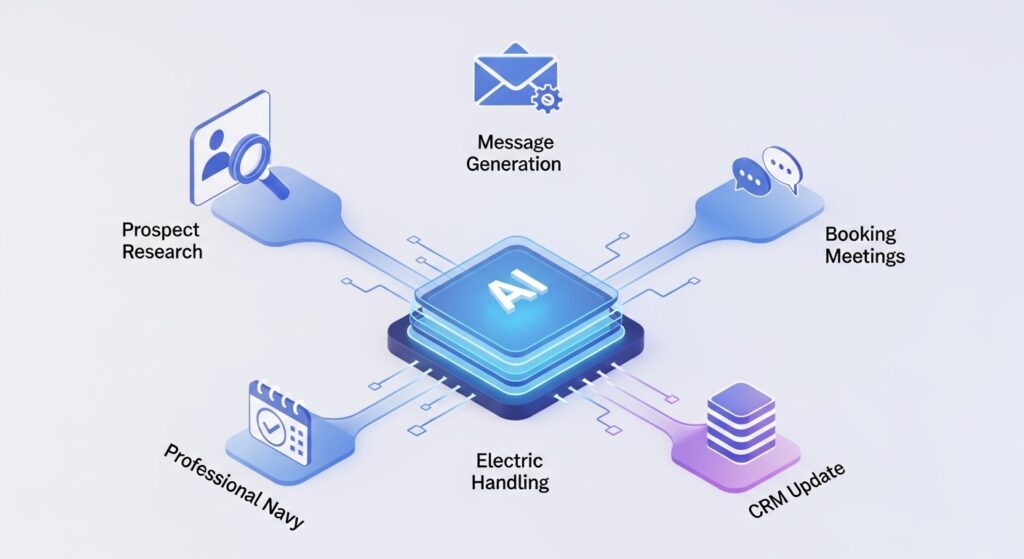
An AI SDR is a software system that performs the full scope of sales development tasks autonomously. These systems are part of multi-channel AI SDR strategies. It does not just send messages on a schedule. It researches prospects, generates personalised messages based on real-time data signals, responds to replies, qualifies leads through conversation, books meetings, and updates the CRM, all without a human initiating each step.
Leading AI SDR platforms include Artisan, 11x.ai, Salesforge, and similar tools. The AI SDR functions as an autonomous agent rather than a tool that assists a human agent.
The key distinction is this: outreach tools give human SDRs better infrastructure. Similar differences are shown in AI vs automation tools comparisons. AI SDRs operate as independent SDRs themselves.
Comparison: AI SDR vs Outreach Tools
| Dimension | AI SDR | Outreach Tool (Outreach, Reply.io) |
| Who writes the messages | AI, automatically | Human SDR manually |
| Personalisation depth | Signal-based, dynamic | Template-based, variable fields |
| Responds to replies | Yes, automatically | No, human SDR must respond |
| Live-call capability | Some platforms include AI voice | No (routes to human SDR) |
| Booking meetings | Autonomous, direct to calendar | Human SDR books after reply |
| CRM updates | Automatic, real-time | Automatic (synced via integration) |
| Handles simultaneous leads | Unlimited | Limited to SDR capacity |
| Operating hours | 24 hours a day, 7 days a week | During SDR working hours |
| Ramp-up time | Days | Weeks (SDR training + tool setup) |
| Monthly cost | $500 to $2,000 (platform only) | $100 to $200 per seat (tool only) |
| Human SDR required | No | Yes |
| Total cost (tool plus SDR) | $500 to $2,000 | $6,000 to $10,000+ per month |
Messaging Personalisation: Dynamic AI vs Template Variables
Personalisation is the single most important factor in outreach conversion rates. This is one of the core AI appointment benefits. Research from Salesforce shows that personalised emails generate six times higher transaction rates than non-personalised messages.
How Outreach Tools Personalise
Outreach tools use variable fields inserted into templates: first name, company name, job title, industry. Many teams improve this with AI sales automation tools. The human SDR writes the base message and the tool swaps in the variable for each contact. More advanced platforms allow custom variable fields, but the SDR must still populate these manually or through a connected data provider.
This approach produces messages that feel personalised but often read as obvious templates to experienced buyers. A message that opens with “Hi Sarah, I noticed [Company Name] is in the SaaS space” does not feel researched.
How AI SDRs Personalise
AI SDRs use enrichment signals from LinkedIn, Crunchbase, news APIs, and tech stack databases to generate context-specific message openings that vary per prospect. Similar techniques are used in AI lead qualification systems. A well-configured AI SDR might open one message with a reference to a funding round, another with a comment about a LinkedIn post, and another with an observation about a company’s recent hiring activity.
The personalisation logic adapts automatically based on whatever relevant signal exists for that prospect. No human SDR needs to research each contact individually.
A B2B SaaS company using an AI SDR reported that changing from template-based outreach to signal-driven AI personalisation increased their email reply rate from 4.2% to 9.7% across the same target account list. The only variable that changed was the personalisation approach.
Verdict on Personalisation
AI SDRs produce consistently deeper, more relevant personalisation than outreach tools used by human SDRs. The quality advantage grows at scale: an AI SDR personalises the 500th message with the same precision as the first. A human SDR managing 500 contacts in parallel inevitably cuts corners.
Live-Call Capability: Who Can Actually Pick Up the Phone?
Outreach Tools and Calls
Outreach tools include built-in dialers that allow human SDRs to make calls directly from the platform. These often connect with an AI business phone system. The dialler logs call outcomes to the CRM, records calls for review, and tracks connection rates. Some platforms include power diallers that cycle through lists automatically.
The human SDR still makes every call. The tool is infrastructure, not the caller.
AI SDRs and Calls
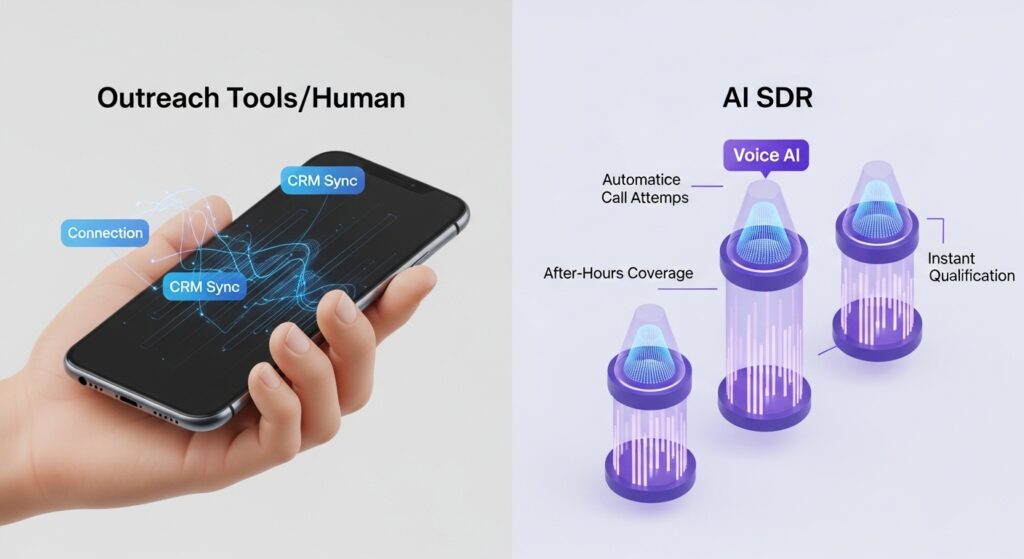
Some AI SDR platforms now include AI voice calling capabilities. This is powered by Automated call answering. These systems can initiate outbound calls, deliver a brief personalised introduction, handle simple qualification questions through voice AI, and either book a meeting directly or transfer the call to a human SDR when the prospect expresses genuine interest.
Current AI voice capabilities are effective for:
- High-volume outbound call campaigns where a brief introduction and qualification is the goal
- Warm lead follow-up calls triggered by engagement signals such as an opened email or a clicked link
- After-hours call attempts where a human SDR would not be available
Current AI voice capabilities are limited in:
- Extended discovery conversations that require nuanced back-and-forth
- Complex objection handling that requires improvisation and empathy
- Enterprise accounts where the buyer expects a personalised, human-led conversation from the first touch
Platforms like 11x.ai and Synthflow are advancing AI voice quality rapidly, but in 2026, the most effective live-call strategy remains AI for initial high-volume attempts with human SDR handling for prospects who convert past the introduction stage.
Verdict on Live-Call Capability
Outreach tools paired with human SDRs currently produce better discovery call quality. AI SDRs are cost-effective for initial cold call volume and after-hours coverage. For businesses that want full call coverage without human SDRs, AI voice is viable for qualification. For businesses where the call quality is critical to conversion, human SDRs remain superior.
Booking Outcomes: Meetings on the Calendar
The ultimate measure of any SDR function is how many qualified meetings end up on an account executive’s calendar. This is where AI appointment booking becomes critical.
How Outreach Tools Book Meetings
Outreach tools support meeting booking through integrations with Calendly or native booking links embedded in email sequences. Many businesses compare this with AI vs Calendly comparison. When a prospect replies expressing interest, the human SDR manually follows up, proposes times, and waits for confirmation. The entire process from reply to confirmed meeting can take 24 to 72 hours across multiple messages.
The bottleneck is human response time and availability. If a prospect replies at 9pm on a Friday, the meeting booking does not happen until Monday morning. By then, the prospect’s intent has often cooled.
How AI SDRs Book Meetings
AI SDRs book meetings autonomously. Supported by AI scheduling assistant systems. When a prospect expresses interest in any form, the AI immediately proposes available times based on the account executive’s live calendar and confirms the meeting without any human involvement. This happens in under five minutes, regardless of when the prospect responds.
Platforms like Artisan and Salesforge report that autonomous booking capability reduces the time from prospect reply to confirmed meeting from an average of 47 hours (human-managed) to under 10 minutes (AI-managed). This speed difference directly affects show rates, as research consistently shows that the sooner a meeting is confirmed after a prospect expresses interest, the more likely they are to attend.
Verdict on Booking Outcomes
AI SDRs book meetings faster and with higher show rates due to instant confirmation. Outreach tools depend on human SDR response speed, which introduces delay and drop-off. For businesses where speed-to-booking is a conversion lever, AI SDRs have a measurable advantage.
CRM Update Automation: Clean Data Without Manual Entry
Outreach Tools and CRM Sync
Outreach tools sync sequence activity to CRM platforms such as HubSpot, Salesforce, and Pipedrive through native integrations. These setups often rely on CRM integration automation. Email sends, opens, clicks, and replies are logged automatically. Call recordings and outcomes can be logged with the right configuration.
However, when the human SDR adds personal notes, updates deal stages manually, or changes contact data, the accuracy of the CRM depends on their discipline. Missed updates, delayed logging, and inconsistent note-taking are common problems in SDR teams using outreach tools.
AI SDRs and CRM Updates
AI SDRs update CRM records in real time without human input. Similar behaviour is seen in AI receptionist system workflows. Every touchpoint, every reply, every engagement signal, and every meeting booking is logged the moment it occurs. Lead scores are updated based on behaviour. Deal stages advance automatically when specific conditions are met.
Because no human is responsible for updating the CRM, the data quality is consistent. A revenue operations team working with an AI SDR has a complete, accurate activity log for every prospect in the system.
Verdict on CRM Automation
Both tools offer CRM sync, but AI SDRs produce more complete and consistent records because human error and discipline are removed from the process. For organisations where CRM data quality is a strategic priority, AI SDRs have a clear advantage.
Which Should You Choose?
The right answer depends on your current team structure and your primary goal. Many teams also review AI appointment case studies.
| Business Situation | Recommended Tool | Reason |
| Have human SDRs, want better sequence management | Outreach tool | SDRs handle personalisation and calls; tool improves consistency |
| Want to replace or reduce human SDR headcount | AI SDR | Autonomous operation covers high-volume prospecting |
| Need 24/7 lead follow-up and booking | AI SDR | Human SDRs cannot operate outside business hours |
| Selling to enterprise with complex buying processes | Outreach tool plus human SDR | Relationship quality and discovery depth matter more than speed |
| Early-stage startup with tight budget | AI SDR | Lower total cost; no need to hire and manage SDR team |
| Scaling quickly with high inbound lead volume | AI SDR or hybrid | AI handles volume; human SDRs focus on high-value accounts |
Frequently Asked Questions
What is the difference between an AI SDR and an outreach tool?
An outreach tool helps human SDRs send, track, and manage email and LinkedIn sequences more efficiently. An AI SDR replaces or supplements the human SDR entirely by autonomously generating personalised messages, responding to replies, booking meetings, and updating the CRM without human involvement at each step.
Which converts more leads: AI SDRs or outreach tools?
It depends on what you measure. Many businesses improve results using reduce appointment no shows strategies. AI SDRs typically produce higher outreach-to-meeting conversion rates for high-volume, top-of-funnel prospecting because of faster response times and more consistent follow-up. Outreach tools paired with experienced human SDRs often produce higher meeting-to-opportunity conversion rates because human discovery quality is stronger.
Can an AI SDR make live phone calls?
Some AI SDR platforms include AI voice calling capabilities that can make initial outbound calls, deliver personalised introductions, and handle basic qualification. This is enhanced with Automated call routing. Current AI voice quality is effective for high-volume call campaigns and after-hours follow-up. For complex discovery conversations, human SDRs still outperform AI voice tools.
Do outreach tools update the CRM automatically?
Yes. Most leading outreach tools sync email sends, opens, clicks, replies, and call logs to connected CRMs. However, manual SDR activities such as personal notes, deal stage updates, and contact data changes still require human input and are subject to inconsistency and delays.
How much does an AI SDR cost compared to an outreach tool?
An outreach tool costs $100 to $200 per seat per month. However, the tool requires human SDRs to operate it, making the total monthly cost $6,000 to $10,000 or more per SDR when salary, benefits, and tools are included. An AI SDR platform costs $500 to $2,000 per month total, with no additional headcount required.
Conclusion: Choose Based on What You Want to Automate
The choice between an AI SDR and an outreach tool is not about which technology is better. It is about which part of your sales development process you want to automate.
If you have human SDRs and want to make them more organised, consistent, and data-driven, an outreach tool is the right investment. It amplifies what they can already do.
If you want to automate the SDR function itself and free your team to focus entirely on closing rather than prospecting, an AI SDR agent is the right choice. It is not a tool for your SDRs. Many teams adopt AI receptionist services for full automation. It is an SDR itself.
Many high-performing teams run both: an SDR managing the top-of-funnel volume and outreach tools supporting human SDRs on high-value accounts where relationship depth determines the outcome.
Ready to Move Beyond Outreach Tools?
This AI SDR handles the entire sales development process from personalised outreach and real-time responses to lead qualification and instant meeting booking.
Instead of relying on manual follow-ups and delayed responses, your pipeline runs automatically 24/7, turning conversations into confirmed meetings without human effort.