The Question Every Sales Leader Is Asking
Should your business hire more human sales development representatives, deploy an AI SDR, or run a combination of both?
This is not a philosophical debate about technology replacing people. Many businesses explore this shift through AI SDR benefits data before making decisions. It is a practical business decision with measurable outcomes. AI SDRs and human SDRs have different strengths, different cost structures, and different performance profiles depending on the use case, team size, and stage of the sales cycle.
This article gives you a side-by-side comparison of both models across the dimensions that matter most: response time, cost per meeting booked, conversion rates, coverage hours, and how to build a hybrid team that gets the best from each. Understanding how an AI sales agent works helps clarify these differences.
What Is an AI SDR and What Is a Human SDR?
Before comparing the two, it is important to be clear about what each one actually does.
Defining an AI SDR
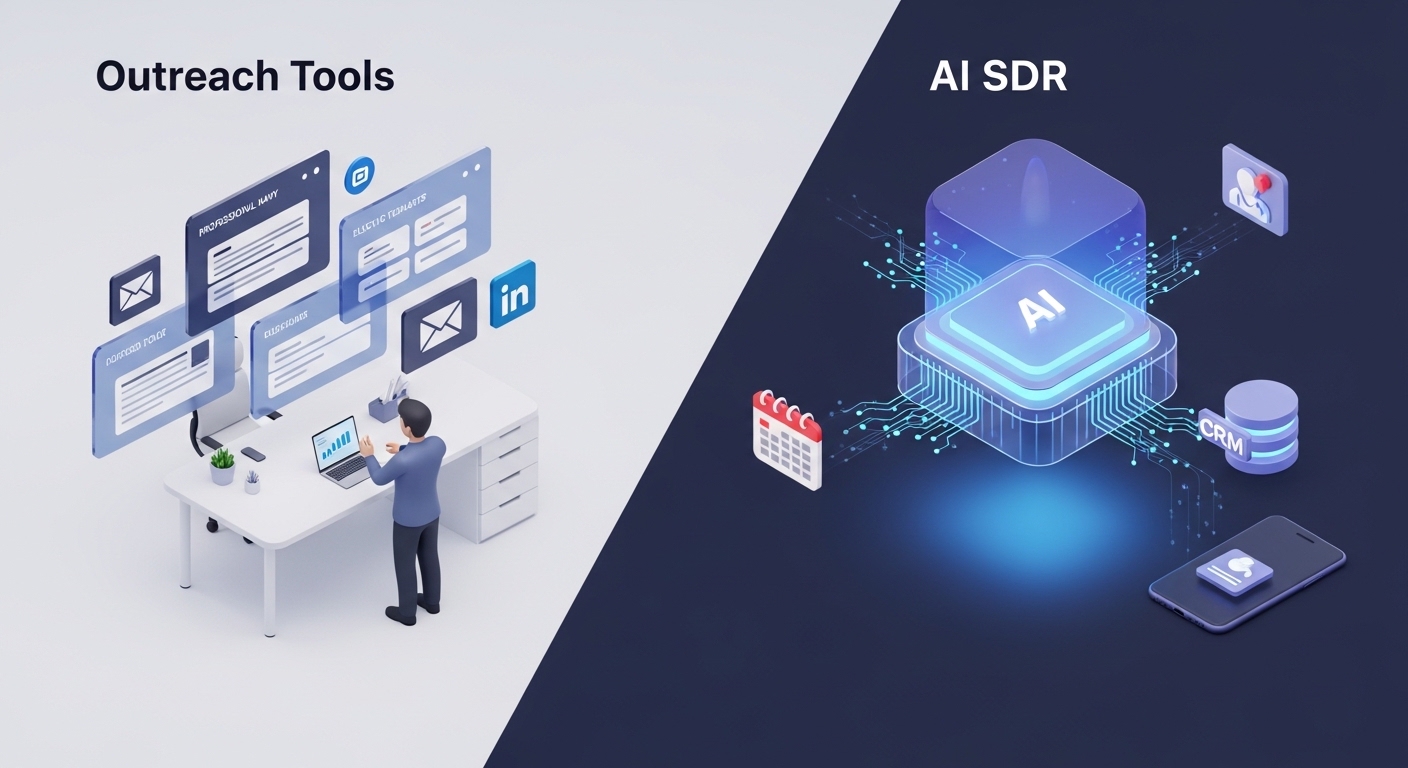
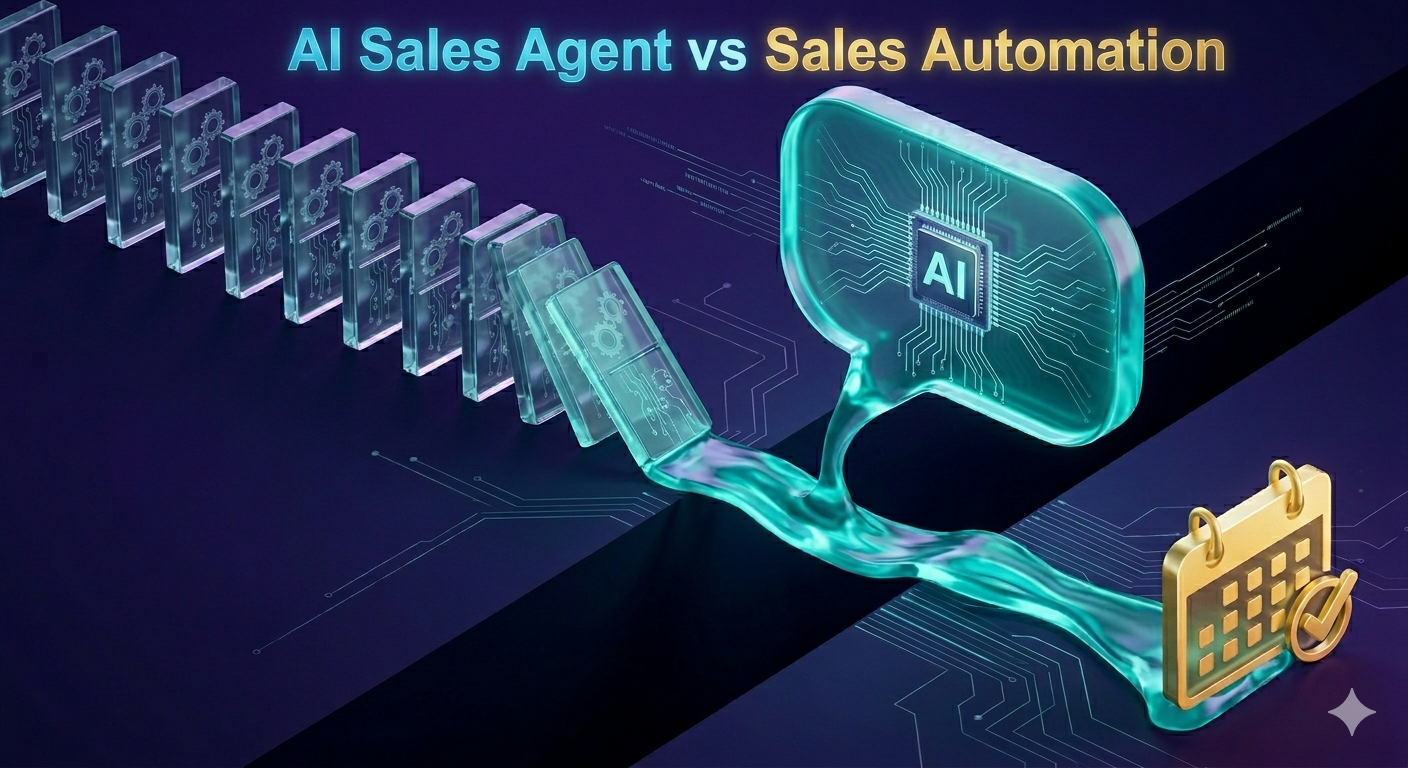
An AI SDR is software that performs sales development tasks automatically. Many of these systems integrate with AI appointment booking for scheduling. It researches prospects, writes and sends personalised outreach messages across multiple channels, follows up based on engagement signals, qualifies leads through conversation or form flows, and books meetings directly into a salesperson’s calendar. This process is often handled by an AI scheduling assistant.
Modern AI SDR platforms include tools like Artisan, Salesforge, and 11x.ai. These platforms can handle email, LinkedIn, SMS, and in some cases, AI-powered voice calls. They operate without breaks, do not need onboarding or management in the traditional sense, and can run campaigns across thousands of prospects simultaneously.
Defining a Human SDR
A human SDR is a full-time or part-time employee whose job is to prospect, reach out to potential customers, qualify their interest and needs, and book meetings for account executives or senior salespeople. This difference is highlighted in AI vs human setters comparisons.
Human SDRs build relationships, read emotional cues, handle complex objections, adapt their communication style on the fly, and bring genuine empathy to conversations. They are typically junior to mid-level salespeople developing their skills toward an account executive role.
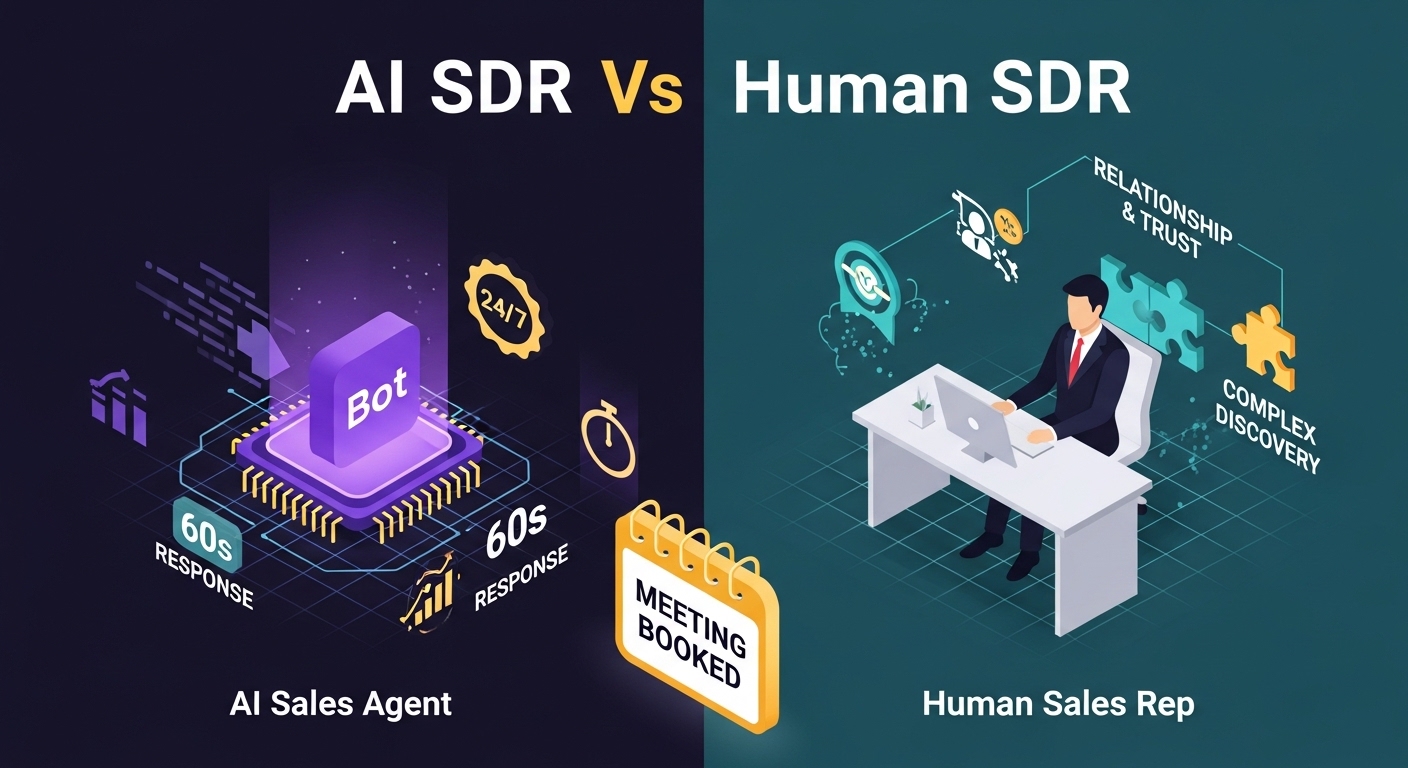
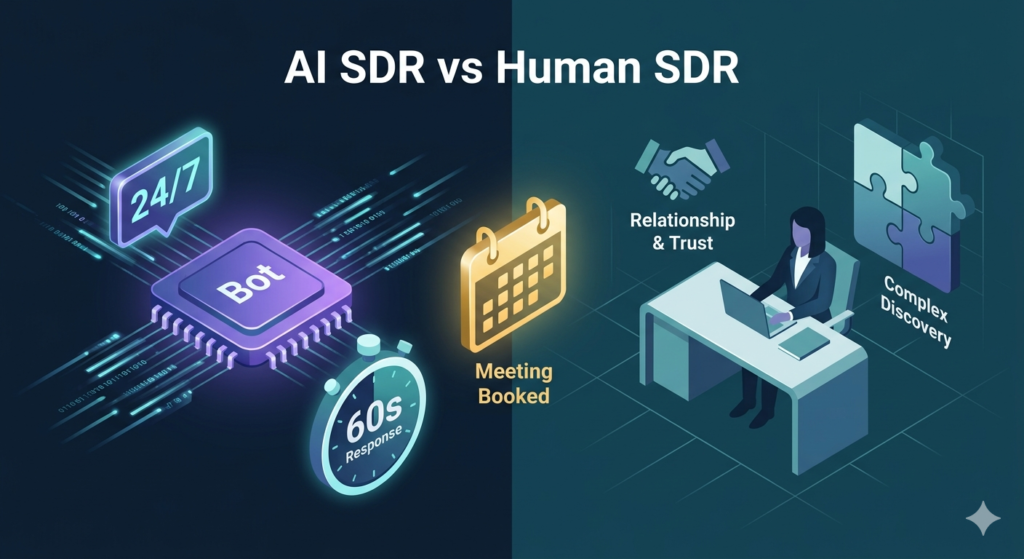
Side-by-Side Comparison: AI SDR vs Human SDR
| Dimension | AI SDR | Human SDR |
| First response time | Under 60 seconds, 24/7 | 2 to 8 hours during business hours |
| Monthly cost (US, all-in) | $500 to $2,000 | $5,000 to $8,500 (salary, benefits, tools) |
| Annual cost | $6,000 to $24,000 | $60,000 to $100,000+ |
| Operating hours | 24 hours a day, 7 days a week | 8 hours a day, 5 days a week |
| Leads handled simultaneously | Unlimited | 1 at a time |
| Personalisation | Data-driven, signal-based | Instinctive, relationship-driven |
| Complex objection handling | Limited to scripted responses | Strong, adapts in real time |
| Consistency across sequences | 100% consistent | Varies by mood, energy, and experience |
| Ramp-up time | Hours to days | 2 to 4 months |
| Emotional intelligence | Not applicable | High |
| Scalability | Instant, no additional cost | Requires hiring and training |
| Best for | High-volume, top-of-funnel prospecting | Complex deals, relationship-driven sales |
Response Time: Where AI SDR Has an Undeniable Advantage
Speed to first contact is one of the most well-documented predictors of lead conversion in B2B sales. Faster response is one of the key AI appointment benefits. Research from InsideSales found that leads contacted within five minutes of submitting an enquiry are 21 times more likely to convert than leads contacted after 30 minutes.
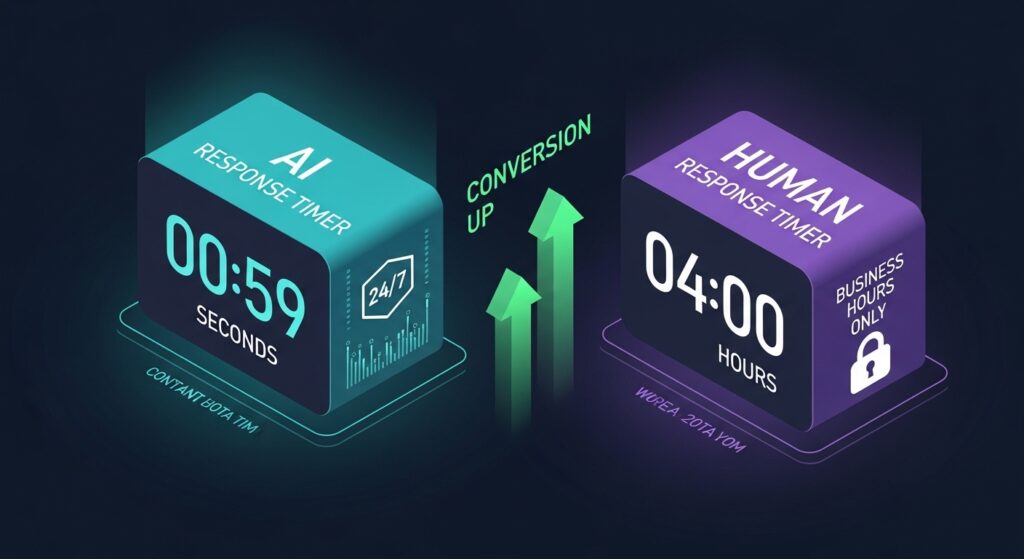
The average human SDR team responds to inbound leads in 2 to 8 hours during working hours, and not at all outside of them. An AI SDR responds in under 60 seconds, regardless of the time zone, time of day, or volume of simultaneous enquiries. This is typically powered by Automated call answering systems.
This single difference in response speed has a direct and measurable impact on the pipeline. A SaaS company that receives 200 inbound demo requests per month and responds with a human SDR team during business hours is losing a significant portion of after-hours leads to competitors who respond faster. An AI SDR eliminates this gap entirely.
For outbound prospecting, the speed advantage shifts. Human SDRs who research a prospect thoroughly before reaching out can build more relevant first touches. AI SDRs can send at volume and adapt quickly to engagement signals, but the initial contact quality depends heavily on how the AI enrichment and personalization tools are configured.
Cost Per Meeting Booked: The Numbers That Change the Conversation
The most significant practical difference between AI SDRs and human SDRs is the cost per meeting booked. Cost reductions are supported by AI appointment case studies. Here is how the maths typically works out.
Human SDR Cost Per Meeting
A mid-level SDR in the United States earns $50,000 to $70,000 per year in base salary, with on-target earnings including commission, typically bringing the total compensation to $70,000 to $90,000. Add employer taxes (approximately 15% in the US), benefits, tools (CRM, sales engagement platform, data providers), and management overhead, and the fully-loaded annual cost of a single human SDR is typically $85,000 to $110,000.
An experienced human SDR books approximately 15 to 25 meetings per month in most B2B environments. At $100,000 per year and 20 meetings per month, the cost per meeting booked is approximately $417.
AI SDR Cost Per Meeting
An AI SDR platform costs $500 to $2,000 per month at current market pricing for most mid-market tools. Many businesses pair this with an AI business phone system. At $1,200 per month and the same volume of 20 meetings per month, the cost per meeting is approximately $60.
This comparison needs context. AI SDRs are most effective at the top of the funnel for high-volume, lower-complexity lead qualification. Human SDRs outperform AI on enterprise accounts, complex sales cycles, and situations requiring genuine relationship-building. The real comparison is not AI vs human in absolute terms but AI vs human for specific pipeline segments.
The Hybrid Cost Model
Many teams find that the highest ROI comes from using AI SDRs to handle volume at the top of the funnel while human SDRs focus on high-value accounts and a pipeline that has already been warmed by AI outreach. This approach aligns with AI lead qualification strategies. In this model, the AI SDR generates and qualifies the bulk of inbound and outbound leads, and the human SDR takes over when a prospect is ready for a real conversation.
This reduces the number of human SDRs required while maintaining or improving total meeting volume.
Conversion Rates: Where Each Model Performs
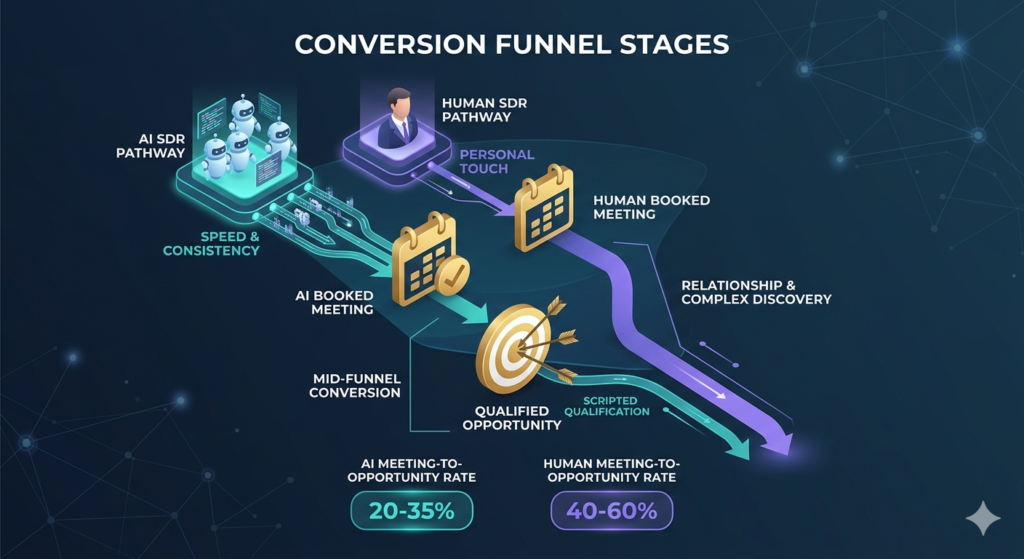
Conversion rates in SDR work are measured across two stages: the rate at which outreach converts to meetings booked, and the rate at which meetings convert to qualified sales opportunities. Tools like AI booking automation improve these metrics.
Top-of-Funnel Conversion (Outreach to Meeting)
AI SDRs consistently produce higher outreach-to-meeting rates than human SDRs in high-volume, standard B2B prospecting contexts. This is supported by AI lead qualification systems. This is largely because AI SDRs respond faster to inbound enquiries, never miss a follow-up, and maintain perfect consistency across every touchpoint.
Research from Artisan and similar platforms reports that AI SDR-driven outbound sequences generate meeting-booked rates of 5 to 12% of prospects entered into a sequence, compared to human SDR industry averages of 2 to 5% across a comparable population of cold prospects.
The AI advantage is strongest for:
- Inbound lead follow-up at speed
- High-volume cold outbound to well-targeted prospect lists
- Re-engagement of dormant or previously cold leads
- Any scenario where consistency and response speed drive the outcome
Mid-Funnel Conversion (Meeting to Qualified Opportunity)
Human SDRs significantly outperform AI SDRs in converting a first meeting into a qualified sales opportunity. This is where a Virtual receptionist service can support early stages. This is where emotional intelligence, active listening, and adaptive questioning produce results that current AI tools cannot match.
A human SDR who has a discovery conversation with a prospect can identify unstated pain points, build rapport that influences the prospect’s perception of your company, navigate budget objections with creativity, and set up the account executive for a higher-quality next conversation.
Current AI voice tools can handle scripted qualification calls but fall short on complex objection handling and nuanced discovery. The meeting-to-opportunity conversion rate for human-led discovery is typically 40 to 60%, compared to 20 to 35% for AI-led qualification flows on equivalent leads.
24/7 Coverage: The Competitive Advantage Most Businesses Ignore
Most B2B sales teams operate five days a week, eight to ten hours a day. The remaining 128 hours of every week are a window during which leads go unanswered and prospects move on to competitors who respond faster.
AI SDRs operate continuously. Similar to 24/7 call answering systems. They respond to midnight enquiries, follow up with US prospects while a European team sleeps, and handle weekend inbound requests from regions with different working week structures. Businesses using Online answering service tools benefit greatly. This matters most for:
- Global businesses with prospects across multiple time zones
- Companies running paid advertising campaigns that generate leads outside business hours
- Industries with high after-hours enquiry volume, such as real estate, e-commerce, legal services, and healthcare
A practical illustration: a UK-based SaaS company targeting US enterprise prospects generates the majority of its inbound demo requests between 6 pm and 10 pm UK time. Without an AI SDR, those leads go to voicemail or wait until the next morning. With an AI SDR, they receive a personalised response and a meeting booking link within 60 seconds.
The Hybrid Team Model: Getting the Best From Both
The most effective sales development teams in 2026 are not choosing between AI and humans. These setups often include automated call routing systems. They are defining clear roles for each based on what the stage of the prospect relationship demands.
How the Handoff Works in Practice
A well-designed hybrid SDR model operates with the following structure:
AI SDR handles:
- All inbound leads follow up within 60 seconds, regardless of time or volume
- First three to five touchpoints of cold outbound sequences (email, LinkedIn, initial SMS)
- Lead scoring and qualification based on engagement signals and response quality
- Calendar booking and confirmation messaging
- Re-engagement campaigns for prospects who have gone cold
Human SDR handles:
- All conversations with prospects who have expressed genuine interest or asked specific questions
- Discovery calls with high-value accounts or complex buying scenarios
- Objection handling that requires creative, empathetic responses
- Enterprise accounts where relationship quality influences the outcome
- Any prospect who has been flagged by the AI as a high-score, high-priority lead
Defining the Handoff Trigger
The handoff trigger is the specific condition that moves a prospect from AI management to human follow-up. This logic reflects AI receptionist system workflows. The most effective triggers are:
- The prospect replies to any AI message with a substantive question (not just a request to unsubscribe)
- The prospect clicks a meeting booking link or directly requests a call
- The lead score reaches a pre-defined threshold based on engagement volume and recency
- The deal size or account value exceeds a set threshold, where human attention is clearly justified
When a handoff is triggered, the human SDR receives a summary of all prior AI interactions, including which messages were sent, which were opened, and what the prospect replied. This context ensures the human does not ask questions the prospect has already answered.
When to Choose AI SDR, Human SDR, or Both
The right model depends on four variables: your average deal size, your monthly lead volume, your sales cycle complexity, and your current team capacity. Many teams analyse this using CRM integration automation.
| Business Profile | Recommended Model | Reason |
| High volume, transactional, short sales cycle | AI SDR | Speed and consistency outweigh relationship quality at this stage |
| Low volume, enterprise, complex sales cycle | Human SDR | Relationship and discovery quality drive conversion more than speed |
| Mixed volume with varying deal sizes | Hybrid model | AI handles volume and speed; humans focus on high-value opportunities |
| Early-stage startup with limited budget | AI SDR first | Lower cost, faster ramp, generates data to inform hiring decisions |
| Scaling team with capacity constraints | Hybrid model | AI extends team capacity without proportional headcount increase |
| Global business with multiple time zones | AI SDR or hybrid | 24/7 coverage requirement cannot be met by a single human team |
Common Mistakes When Implementing AI SDRs
While AI SDRs can significantly improve speed, efficiency, and cost per meeting, many businesses fail to see results because of poor implementation. Performance also depends on the quality of AI sales automation tools. The technology itself is not the problem—execution is. Without the right strategy, even the most advanced AI SDR tools can produce low-quality leads, poor engagement, and wasted budget.
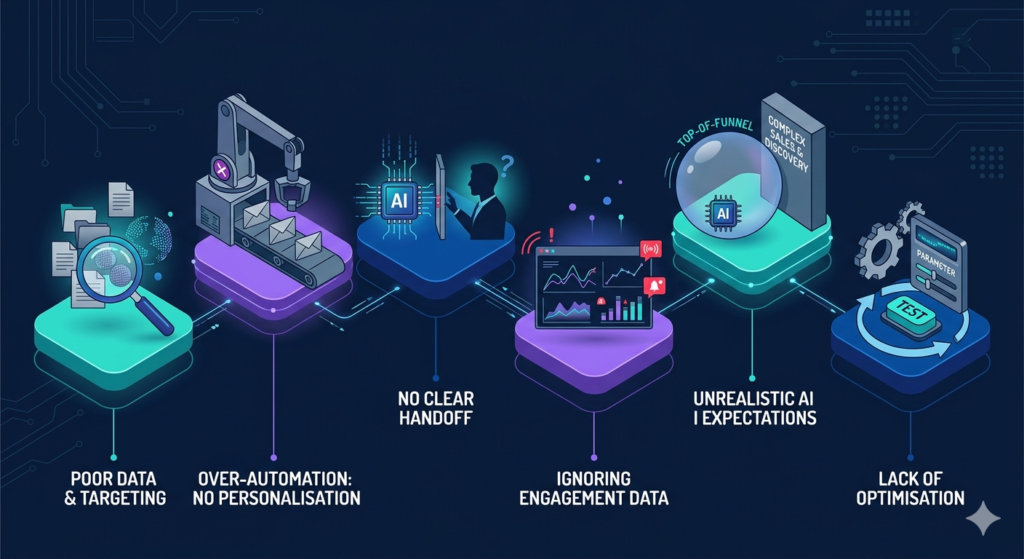
Understanding these common mistakes can help you avoid performance gaps and unlock the full potential of AI-driven sales development.
The most common mistakes include:
- Poor targeting and data quality
This directly impacts AI customer service outcomes. AI SDRs are only as good as the data they work with. If your prospect lists are outdated, unqualified, or too broad, your outreach will miss the mark. High-quality targeting and accurate data enrichment are essential for meaningful engagement. - Over-automation without personalization
Sending generic, templated messages at scale reduces response rates and can damage your brand. AI SDRs must be configured to personalize outreach based on industry, role, intent signals, and behaviour to feel relevant and human. - No clear handoff to human SDRs
One of the biggest mistakes is failing to define when and how leads should be passed to a human. Without a clear handoff strategy, qualified prospects may receive delayed or inappropriate follow-ups, leading to lost opportunities. - Ignoring response signals and engagement data
AI SDRs generate valuable insights such as email opens, replies, and click behaviour. Businesses that fail to act on this data miss opportunities to prioritise high-intent leads and optimise campaigns. - Unrealistic expectations from AI
AI SDRs are highly effective at top-of-funnel activities, but they are not a complete replacement for human interaction in complex sales. Expecting AI to close deals or handle deep discovery calls often leads to disappointment. - Lack of continuous optimisation
Many teams set up AI SDR campaigns once and leave them running without refinement. High-performing teams continuously test messaging, targeting, and sequences to improve conversion rates over time.
By avoiding these mistakes and combining AI efficiency with human oversight, businesses can create a scalable and high-performing sales development system that drives consistent pipeline growth.
Frequently Asked Questions About AI SDR vs Human SDR
Can an AI SDR fully replace a human SDR?
Not in most B2B contexts. AI SDRs handle volume, speed, and top-of-funnel qualification exceptionally well. Human SDRs bring emotional intelligence, complex objection handling, and relationship-building capability that current AI cannot replicate. For most businesses, the optimal model is a hybrid where AI handles the high-volume, repetitive work and humans focus on conversations that require genuine judgment.
How much does an AI SDR cost compared to a human SDR?
The fully-loaded annual cost of a human SDR in the US is typically $85,000 to $110,000. An AI SDR platform costs $6,000 to $24,000 per year, depending on the provider and usage volume. The cost per meeting booked is typically five to seven times lower with an AI SDR for equivalent lead populations, though AI underperforms humans on meeting-to-opportunity conversion for complex deals.
How long does it take to deploy an AI SDR?
Most AI SDR platforms can be configured to produce outreach within days to two weeks, depending on the complexity of the sequence setup and the number of integrations required. A human SDR typically takes two to four months to ramp up to full productivity, including hiring, onboarding, training, and sequence building.
What metrics should I use to compare AI SDR and human SDR performance?
Track these five metrics for both models: first response time (target under 5 minutes for AI, under 2 hours for human during business hours), meeting booked rate per 100 prospects (AI target 5 to 12%, human target 3 to 7%), cost per meeting booked, meeting-to-opportunity conversion rate, and total pipeline generated per month per dollar spent
What is the best handoff strategy between an AI SDR and a human SDR?
The handoff should be triggered by specific signals: a prospect reply that goes beyond an unsubscribe request, a direct meeting request, a lead score threshold reached, or an account value above a set threshold. When the handoff occurs, the human SDR receives a summary of all prior AI interactions so no context is lost. The transition should feel seamless to the prospect.
Conclusion: The Answer Is Not Either/Or
The question of AI SDR vs human SDR does not have a universal answer because the right model depends on your specific pipeline, deal complexity, budget, and team structure. Choosing the best AI answering solution improves results.
For high-volume, top-of-funnel prospecting where speed and consistency drive conversion, AI SDRs deliver measurably better results at significantly lower cost. For complex, relationship-driven sales where discovery quality and human judgment determine outcomes, human SDRs remain superior.
The hybrid model, where AI handles the volume, and humans handle the value, consistently outperforms either approach alone when the handoff strategy is clearly defined and the data flows between systems without friction.
Measure both models against the same KPIs, run the maths on cost per meeting and pipeline generated per dollar, and let the numbers guide the allocation.
Ready to See the Difference?
Book a Live Demo of an AI SDR in Action →
Discover how an AI SDR can respond to leads in seconds, qualify prospects automatically, and book meetings directly into your calendar 24/7. Scale your pipeline without increasing headcount.