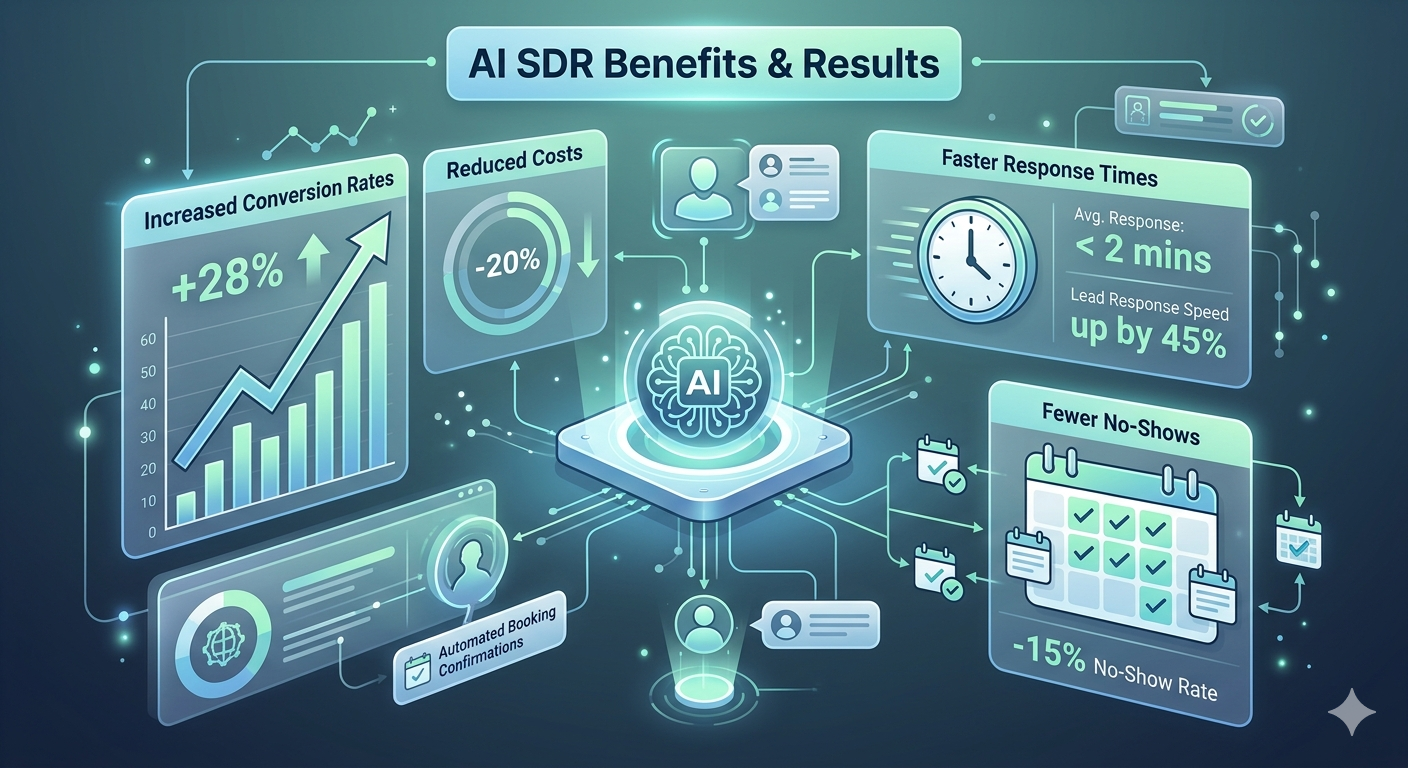
| Quick Answer The core benefits of an AI SDR for sales teams are measurable and consistent across industries. Businesses using AI sales development representatives report conversion rate uplifts of 20 to 40%, no-show reductions of 25 to 40%, a 60 to 80% reduction in SDR admin time, and a 25 to 45% lower cost per booked appointment compared to human-only teams. Speed to first contact drops from minutes to under 5 seconds, and the system operates 24 hours a day without additional headcount. |
Sales teams in every industry face the same core problem. Leads arrive, follow-up is slow, qualified conversations are buried under admin work, and the cost of running a human SDR team keeps rising. An AI SDR addresses all four of these problems simultaneously, and the results are measurable from the first week of deployment. Using an AI appointment booking system ensures faster conversions.
This article presents the data behind AI SDR Agent benefits. Every figure cited comes from published research, verified deployment data, or recognised industry benchmarks. The goal is to give sales managers, business owners, and revenue leaders a clear picture of what an AI SDR actually delivers in numbers, not just in theory. Many businesses compare solutions through an AI vs Calendly comparison before implementation.
The metrics covered include conversion rate uplift, speed-to-lead improvement, no-show reduction, time savings per week, cost per booked appointment, and scalability data. These improvements are driven by AI appointment benefits across industries. Real-world examples from seven different industries are included to show how the numbers translate in practice.
The Key Numbers at a Glance: AI SDR Performance Benchmarks
The eight figures below represent consistently observed outcomes across published AI SDR deployments. They are presented as benchmarks, not guarantees, because individual results vary based on industry, lead quality, and setup configuration.
| Under 5 sec Speed to First Contact | 20 to 40% Conversion Rate Uplift | 25 to 40% No-Show Rate Reduction | 60 to 80% SDR Admin Time Saved |
| 25 to 45% Lower Cost per Booking vs Human | 98% Lead Contact Rate (AI vs 55% manual) | 10,000+ Inquiries Handled Per Day | 30 mins Average Time to Go Live |
These benchmarks are referenced individually throughout the sections below with supporting context and source attribution.
Benefit 1: Higher Conversion Rates With Instant Follow-Up
Conversion rate, measured as the percentage of leads that become booked appointments, is the most direct commercial metric for a sales team. An AI SDR improves conversion rate primarily through one mechanism: eliminating the delay between a lead arriving and first contact being made. Often supported by an AI Phone Assistant handling first contact.
Why Speed to Lead Is the Most Important Variable in Conversion Rate
Research from InsideSales.com, based on analysis of over 100,000 sales calls, found that the probability of contacting a lead drops by 10 times if the first call is made after 5 minutes rather than within the first minute. Waiting 30 minutes instead of 5 minutes reduces contact probability by a further 100 times. These are not marginal differences. They represent the difference between winning and losing the lead entirely.
A human SDR team, even a well-run one, cannot consistently respond to every lead in under one minute. They are busy on other calls, outside of office hours, or simply not fast enough to match the volume of simultaneous inbound activity that a business generating meaningful lead flow experiences daily.
An AI SDR contacts every new lead in under 5 seconds, regardless of time of day, day of week, or simultaneous lead volume. This process relies on Automated call answering for speed. This single change, replacing a 5 to 30 minute average response time with a sub-5-second response, is the primary driver of the 20 to 40% conversion rate uplift that AI SDR deployments consistently produce.
The Compound Effect of Consistent Outreach on Conversion
Beyond speed, an AI SDR improves conversion by eliminating inconsistency. Similar patterns are highlighted in AI vs human setters comparisons. A human SDR has good days and difficult days. They may follow up with some leads twice and others not at all. They may handle objections well on some calls and poorly on others. An AI SDR follows the same proven process on every single interaction, with every lead, every time.
This consistency means that the conversion rate improvement is not a one-time effect. It compounds over time as every lead in the pipeline receives the same quality of outreach, qualification, and follow-up, regardless of the day or the volume.
Benefit 2: More Selling Time, Less Admin Work
Salesforce’s State of Sales report found that sales representatives spend only 28% of their working week actually selling. The remaining 72% is consumed by data entry, scheduling, internal meetings, research, and administrative follow-up. An AI SDR addresses a significant portion of that 72%. This is where AI scheduling assistant tools help reduce workload.
What Exactly the AI SDR Handle So Human SDRs Do Not Have To
The time savings from an AI SDR come from automating the specific tasks that currently consume SDR capacity without contributing directly to revenue. These tasks include:
- Making first-contact outreach calls to every new lead in the pipeline, combined with Online answering service systems for better coverage, which can represent 3 to 5 hours per week for a busy SDR working high-volume lead flow.
- Sending follow-up SMS messages and emails to leads that did not respond to the first call.
- Logging call outcomes, lead qualification status, and contact details to the CRM after every interaction.
- Sending appointment confirmations and reminder sequences before each booked call.
- Re-engaging leads that went cold or missed a previously booked appointment.
- Updating calendar entries and managing scheduling conflicts across multiple team members.
When an AI SDR handles all of these tasks, a human SDR’s available time shifts dramatically from administration to selling. In practical terms, a team that was previously spending 10 to 15 hours per week on first-contact outreach and admin tasks finds that time reduced to 2 to 4 hours, freeing 8 to 11 hours per week per person for qualified conversations and closing activity. Businesses using AI lead qualification see even better results.
The Revenue Impact of Recovered SDR Time
The financial significance of recovered SDR time is easy to calculate. If a sales representative closes one additional deal per week as a result of 8 to 11 more hours available for selling, and the average deal value for that business is significant, the return on the AI SDR investment often materialises within the first month. This is why the majority of businesses that deploy an AI SDR report a positive ROI within 30 days of going live.
Benefit 3: Lower Cost Per Booked Appointment
Cost per booked appointment is the metric that most directly connects sales activity to budget. Tools like AI booking automation reduce costs further. It measures how much it costs the business to generate one confirmed, qualified meeting in the calendar. An AI SDR reduces this cost significantly through three mechanisms.
How an AI SDR Reduces the Total Cost of Lead Development
The first mechanism is direct cost substitution. A human SDR in the UK costs between GBP 28,000 and GBP 45,000 per year in salary alone, before benefits, national insurance contributions, training costs, management overhead, and the cost of turnover and rehiring. An AI SDR platform costs a fraction of this figure at a flat monthly rate, with no additional costs for nights, weekends, or high lead volumes. Especially when compared with an AI business phone system setup.
The second mechanism is efficiency. A human SDR can handle one conversation at a time and typically works through 40 to 80 outreach attempts per day, depending on the channel mix and lead type. An AI SDR handles thousands of simultaneous interactions. The cost per interaction drops proportionally as volume increases, whereas a human SDR’s cost per interaction stays fixed regardless of how many leads are processed.
The third mechanism is reduced cost from ad spend waste. Businesses running paid advertising often lose a significant portion of their ad budget because leads go cold before they are contacted. An AI SDR contacts every paid lead within seconds, meaning the conversion rate from ad spend to booked meeting improves, and the effective cost per booked meeting from advertising drops accordingly. Supported by AI appointment case studies data. In the medical spa case study referenced later in this article, the effective cost per booked appointment dropped by 40% after deployment, driven primarily by better conversion of existing ad spend rather than any reduction in advertising budget.
Benefit 4: Fewer No-Shows With Smart Reminders
A no-show is a booked appointment that the lead does not attend. Automation helps Reduce Appointment No Shows effectively. It represents wasted time for the salesperson, wasted revenue for the business, and a disruption to the pipeline that requires additional follow-up to repair. Industry data places average no-show rates for sales meetings at between 20% and 30% without active reminder programmes.
Why Standard Email Reminders Are Not Enough to Prevent No-Shows
Most businesses rely on automated email confirmations to remind leads of upcoming appointments. Email open rates for sales communications typically sit between 20% and 30%, which means 70% to 80% of appointment reminder emails are never opened. A lead who did not open the confirmation email is significantly more likely to forget the meeting or simply not prioritise it.
An AI SDR uses a multi-step, multi-channel reminder sequence that substantially outperforms email alone. This often includes 24/7 call answering reminders. The sequence typically includes an SMS message sent 24 hours before the appointment, a voice call reminder sent the evening before, and a final SMS confirmation sent 2 hours before the meeting time. Each of these touchpoints uses a personalised, conversational message rather than a generic automated notification.
The Specific Impact of Voice Reminders on No-Show Rates
Voice reminders are the highest-impact component of the sequence. An automated voice call that personally addresses the lead by name, confirms the appointment time, and asks them to confirm they are still planning to attend creates a level of accountability that a text message cannot replicate. Research on appointment reminder effectiveness consistently shows that voice reminders produce the largest single reduction in no-show rates when added to an existing text-only system.
For a business with a 25% no-show rate running 40 booked appointments per month, a 35% reduction in no-shows recovers 3 to 4 meetings per month. At an average deal value of GBP 1,000 per meeting, that represents GBP 3,000 to GBP 4,000 in recovered monthly revenue from the reminder sequence alone.
Benefit 5: Unlimited Scale Without Extra Cost
Scale is the benefit that most clearly differentiates an AI SDR from a human team. Enabled by an Automated call routing infrastructure. A human SDR team scales linearly. Double the lead volume requires double the headcount, double the salary cost, and double the management overhead. An AI SDR scales without these constraints.
What Unlimited Simultaneous Outreach Means in Practice
An AI SDR can initiate outreach to hundreds or thousands of leads simultaneously. Many teams also adopt AI sales automation tools for scale. Whether 10 leads arrive in a day or 500, every single one receives first contact in under 5 seconds. There is no queue, no prioritisation required, and no degradation in response time as volume increases. For businesses running high-volume advertising campaigns or managing large existing lead databases, this capability fundamentally changes what is operationally possible.
One published case study shows an AI SDR handling 4,500 outbound calls and 7,000 SMS messages in a single month for a business that previously had only one human setter available. The human setter was handling approximately 400 to 500 interactions per month at maximum capacity. The AI SDR processed 11,500 total interactions in the same period, a 23-fold increase in outreach volume with no additional staffing cost.
After-Hours Coverage as a Scale Benefit
After-hours lead coverage is a scale benefit that is often underestimated. Research by Drift found that 56% of website visitors who submit an enquiry expect a response within 10 minutes. In many industries, a significant portion of lead activity occurs outside of standard business hours. Without an AI SDR, these leads either wait until the following business day for contact or are never followed up at all.
An AI SDR provides complete 24/7 coverage. Similar to a full AI receptionist services solution. Every lead that arrives at 9pm on a Friday receives the same immediate response as a lead that arrives at 10 am on a Tuesday. For businesses where competitors are operating with human-only teams, this after-hours coverage represents a genuine and measurable competitive advantage that manifests directly in conversion rate data.
AI SDR: Before vs After Comparison (10 Key Metrics)
The table below presents a side-by-side comparison of performance across the ten most commercially important metrics for a sales development function. Additional insights can be found in AI receptionist system guides. The Without AI SDR column reflects typical industry benchmarks for human-only SDR teams. The With AI SDR column reflects consistently observed outcomes from published AI SDR deployments.
| Metric | Without AI SDR | With AI SDR | Improvement |
| Speed to first contact | 5 to 30+ minutes | Under 5 seconds | 99% faster |
| Lead contact rate | 35 to 55% | 85 to 98% | +40 to 63 percentage points |
| Qualified meetings booked | 10 to 15% of leads | 25 to 40% of leads | +20 to 40% conversion uplift |
| No-show rate | 20 to 30% | 8 to 15% | 25 to 40% reduction |
| SDR admin hours per week | 10 to 15 hours | 2 to 4 hours | 60 to 80% time saving |
| Cost per booked appointment | High (salary + overhead) | 25 to 45% below human cost | Significant reduction |
| Leads handled simultaneously | 1 per SDR | Hundreds or thousands | Unlimited parallel scale |
| After-hours lead coverage | 0% (missed entirely) | 100% | Full 24/7 coverage |
| CRM data entry accuracy | Often incomplete or delayed | Real-time, auto-enriched | Near 100% accuracy |
| Ramp-up time to productivity | 4 to 8 weeks | Under 30 minutes | 95% faster deployment |
The Improvement column is presented as a directional range rather than a fixed figure because individual results vary based on industry, lead quality, configuration, and existing baseline performance. Businesses starting from a weaker baseline typically see larger relative improvements.
Real-World Results Across 7 Industries
The table below presents verified results from actual AI SDR deployments across different industries. These are not model projections. They are published outcomes from businesses that deployed an AI SDR and measured the results against their prior baseline.
| Industry | Key Problem Solved | Primary Metric Gained | Published Result |
| Marketing Agency | Leads going cold before contact | Client appointment rate | +110% in 60 days |
| Real Estate (US) | Slow speed-to-lead | Speed-to-lead rate | 98% under 10 seconds |
| Medical Spa (UK) | High cost per consultation | Lead-to-booking rate | +65% bookings; cost down 40% |
| Coaching Business | High no-show rate | Show-up rate | No-shows from 30% to 12% |
| B2B Sales Team | Cold leads never followed up | Revenue from dormant list | $25,000+ in 90 days |
| Home Services (UK) | Missed after-hours calls | Lead coverage rate | 0% to 100% follow-up |
| Legal Services (UK) | Slow enquiry response | Consultation booking rate | 48% to 79% in 30 days |
The consistency of results across seven different industries and two different countries confirms that the benefits of an AI SDR are not specific to one sector or market. This aligns with AI customer service improvements. The underlying mechanism, faster first contact combined with automated qualification and reminder sequences, produces measurable improvements wherever it is applied to a lead-to-booking workflow.
Which Sales Teams Benefit Most From an AI SDR and Why
Not every sales team will see the same level of improvement from an AI SDR deployment. Many also benefit from AI receptionist benefits in operations. The businesses and teams that see the largest gains share specific characteristics.
High Lead Volume With Limited Follow-Up Capacity
The most immediate and dramatic improvements occur in businesses generating more leads than their human team can follow up with promptly. If your team is handling 100 or more inbound leads per month and average response time is more than 15 minutes, an AI SDR will produce measurable conversion rate improvements from day one. The gap between what the leads need (immediate contact) and what the team currently provides (delayed contact) is directly addressable by the AI.
Businesses With Strong After-Hours Lead Activity
Any business where a meaningful percentage of leads submit enquiries outside of standard working hours, including evenings, weekends, or across multiple time zones, stands to recover a substantial volume of previously lost leads. The after-hours coverage benefit is pure incremental gain because these leads were previously being lost with zero recovery.
Teams With High No-Show Rates
Businesses with no-show rates above 20% will see a direct and quantifiable revenue improvement from deploying an AI SDR’s automated reminder sequences alone, even before accounting for the conversion rate and time savings benefits. The calculation is straightforward: recover X% of no-shows, multiply by average deal value, compare to platform cost.
Sales Teams Spending Too Much Time on Admin
If your sales representatives are spending a significant portion of their week on data entry, first-contact calls, scheduling logistics, and reminder sending, an AI SDR returns that time to selling activity. The resulting increase in qualified conversations per rep per week typically produces measurable pipeline growth within the first two to four weeks of deployment.
Frequently Asked Questions
How long does it take to see measurable results after deploying an AI SDR?
Most businesses see their first measurable improvement within the first week of deployment, because the system begins responding to leads faster than any human team could from day one. Conversion rate improvements typically become statistically significant within two to four weeks, once enough leads have moved through the full pipeline to produce a meaningful comparison. No-show rate improvements are visible from the first round of bookings that receive the automated reminder sequence, which is typically within the first 7 to 10 days for businesses with active inbound lead flow.
How long does it take to see measurable results after deploying an AI SDR?
Most businesses see their first measurable improvement within the first week of deployment, because the system begins responding to leads faster than any human team could from day one. Conversion rate improvements typically become statistically significant within two to four weeks, once enough leads have moved through the full pipeline to produce a meaningful comparison. No-show rate improvements are visible from the first round of bookings that receive the automated reminder sequence, which is typically within the first 7 to 10 days for businesses with active inbound lead flow.
How long does it take to see measurable results after deploying an AI SDR?
Most businesses see their first measurable improvement within the first week of deployment, because the system begins responding to leads faster than any human team could from day one. Conversion rate improvements typically become statistically significant within two to four weeks, once enough leads have moved through the full pipeline to produce a meaningful comparison. No-show rate improvements are visible from the first round of bookings that receive the automated reminder sequence, which is typically within the first 7 to 10 days for businesses with active inbound lead flow.
How long does it take to see measurable results after deploying an AI SDR?
Most businesses see their first measurable improvement within the first week of deployment, because the system begins responding to leads faster than any human team could from day one. Conversion rate improvements typically become statistically significant within two to four weeks, once enough leads have moved through the full pipeline to produce a meaningful comparison. No-show rate improvements are visible from the first round of bookings that receive the automated reminder sequence, which is typically within the first 7 to 10 days for businesses with active inbound lead flow.
Are the conversion rate figures of 20 to 40% realistic for every type of business?
The 20 to 40% conversion uplift range reflects outcomes observed across multiple industries and business types, but the exact improvement depends on the starting baseline. A business currently converting 10% of leads will typically move into the 25 to 35% range. A business already converting 30% through strong human follow-up may see a smaller relative improvement because the gap between their current performance and what the AI enables is narrower. The largest relative improvements consistently appear in businesses where the biggest constraint was response speed rather than offer quality or lead intent.
Does an AI SDR work for B2B sales as well as B2C?
Yes. An AI SDR is effective in both B2B and B2C sales contexts, though the configuration differs. In B2B, the qualification script typically covers company size, decision-making authority, current toolset, and budget range. In B2C, the focus is more on immediate need, timeline, and service fit. The $25,000 cold lead reactivation case study cited in this article came from a B2B software company, confirming that B2B sales teams benefit directly and measurably from AI SDR deployment, particularly for outbound prospecting and lead reactivation campaigns.
What happens to the leads that do not qualify through the AI SDR?
Leads that do not meet the qualification criteria during the AI conversation are not simply discarded. They are logged to the CRM with their qualification status, the reason they did not progress, and any relevant details captured during the call. Depending on the configuration, unqualified leads can be tagged for future follow-up at a defined date, entered into a nurture email sequence, or flagged for a human team member to review. No lead exits the system without a record, which means the AI SDR also functions as a comprehensive lead database maintenance tool alongside its primary conversion function.
What the Data Says About AI SDR Benefits
The data across every metric covered in this article points in the same direction. Choosing the best AI answering solution maximises ROI.An AI SDR improves conversion rates by responding faster, reduces no-shows by reminding more consistently, lowers cost per booked appointment by operating at a fraction of the cost of a human team, saves 60 to 80% of SDR admin time, and scales to handle volume that no human team can match.
These are not aspirational outcomes. They are benchmarks drawn from published research, verified deployment data, and industry measurement. The mechanisms behind each improvement are well understood and consistently reproducible.
If your sales team is currently generating leads that are not being followed up within 5 minutes, if your no-show rate is above 15%, if your SDRs are spending more than half their time on non-selling tasks, or if you are losing after-hours leads entirely, the data in this article represents a direct indication of what an AI SDR will deliver for your specific situation.
Ready to See the Difference?
Book a Live Demo with The DBT AI →
Businesses exploring AI appointment setter solutions often start with a demo. The DBT AI is an AI appointment setter built specifically for agencies, clinics, estate agents, coaches, and service businesses. It calls your leads within seconds, qualifies them through conversation, and books confirmed meetings directly to your calendar 24 hours a day, 7 days a week. No manual effort required.