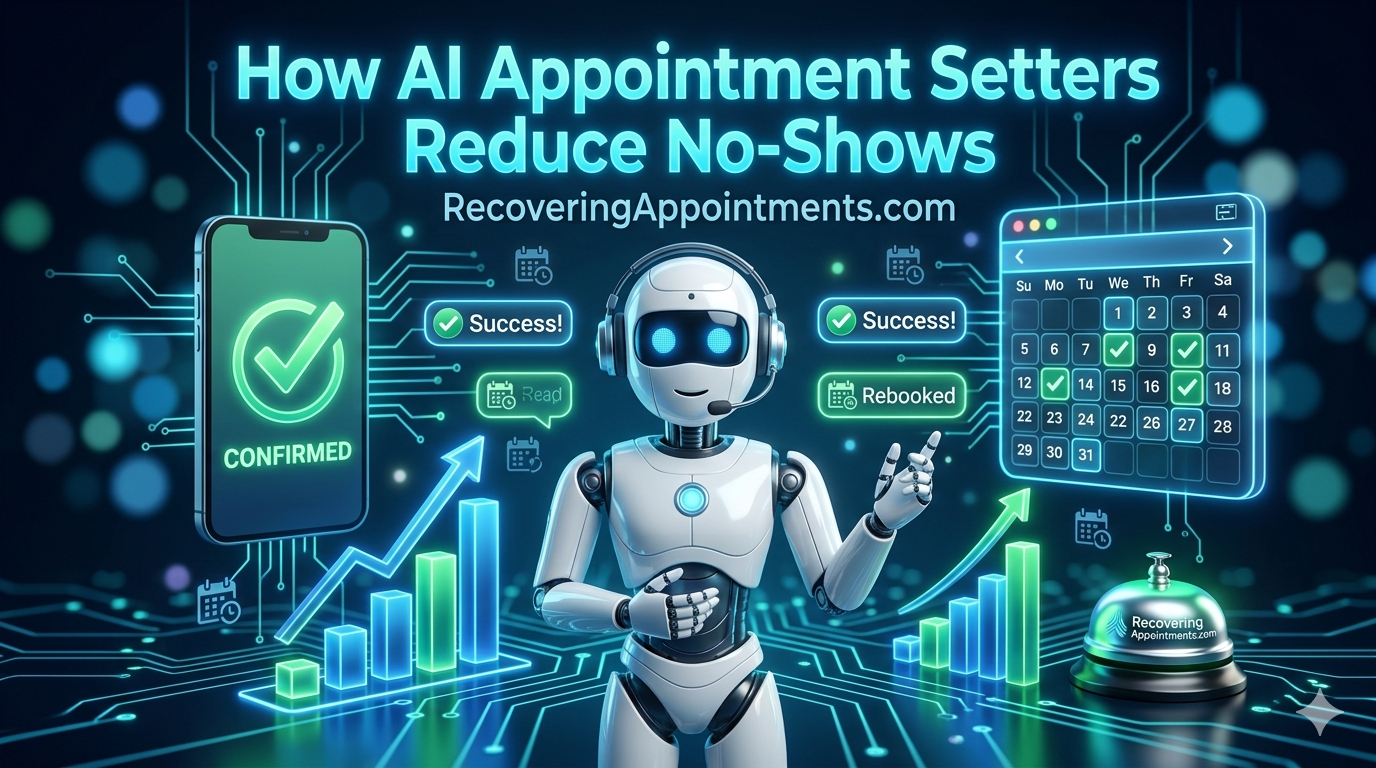
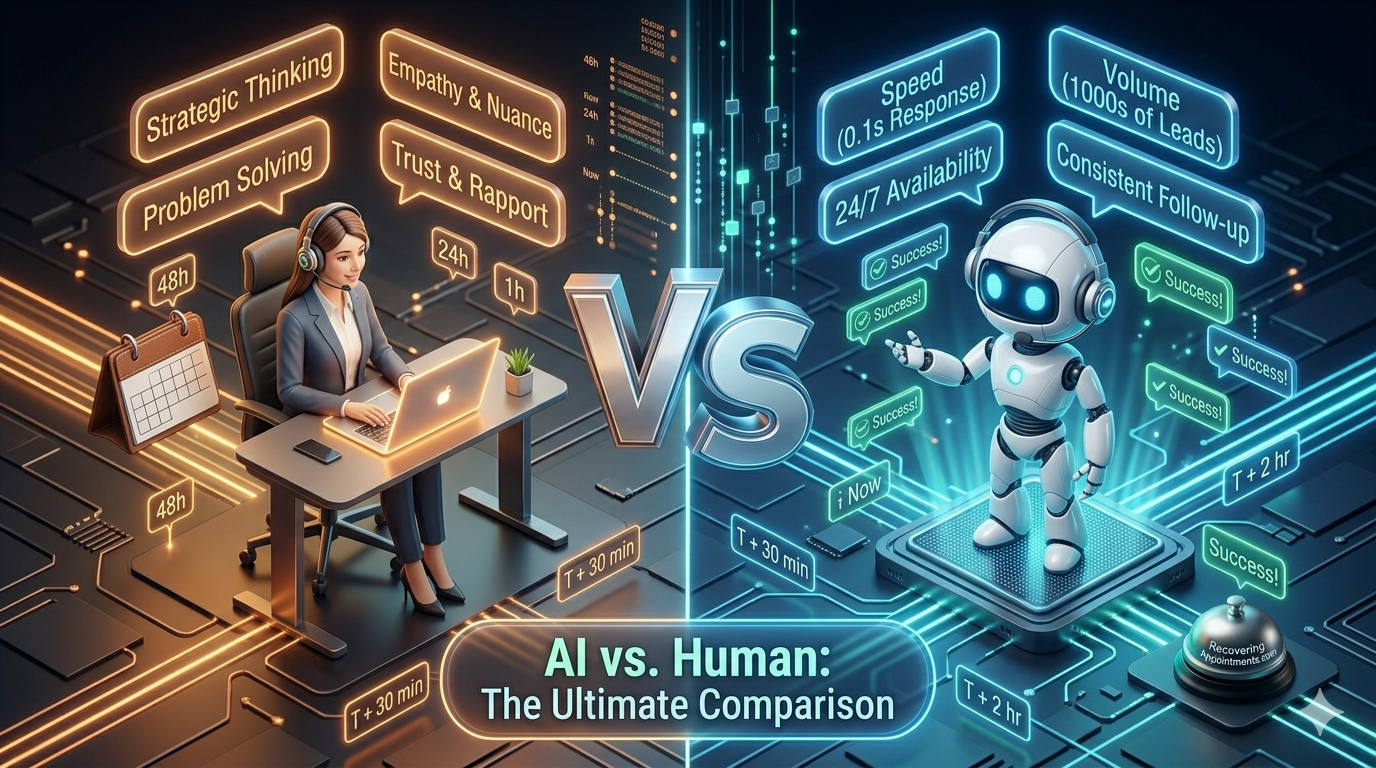
Every business that relies on booked appointments faces the same challenge: getting leads to show up, qualify, and convert without burning through budget or staff time. Many businesses solving this challenge use AI appointment booking to automate lead conversion. For UK businesses in 2026, there are now two main approaches: hiring a human sales development representative (SDR) or appointment setter, or using an AI appointment setter to handle outreach, qualification, and booking automatically.
Both options can work effectively, but they also come with real limitations. The right choice depends on your business type, deal value, and lead volume, not on which option seems more modern or appealing.
This guide provides an honest, unbiased comparison tailored for UK businesses, covering costs in pounds, GDPR considerations, industry-specific factors, and a clear decision framework to help you choose with confidence. A complete AI Receptionist System ensures no lead is missed.
What Each Type of Setter Actually Does
What an AI Appointment Setter Does
An AI appointment setter is software that automatically contacts leads, qualifies them through conversation, and books appointments directly into a calendar without human involvement for most interactions. Most businesses rely on an AI Phone Assistant to handle conversations.
Modern AI setters use natural language processing to send and receive messages via SMS, email, WhatsApp, or phone. These systems often include Automated Call Answering for consistency. They respond to inbound leads in under 5 seconds, follow up automatically across multiple days and channels, and handle unlimited simultaneous conversations without fatigue or inconsistency.
Advanced platforms also apply predictive modelling, adjusting follow-up frequency and channel based on each lead’s response behaviour and risk profile. Many also use AI Scheduling Assistant for booking automation.
What a Human Appointment Setter Does
A human appointment setter, sometimes called an SDR or booking agent, manually contacts leads by phone, email, or message. They engage in real conversation, handle objections, gauge emotional tone, and build rapport in a way that feels personal and flexible.
Human setters are particularly effective for complex, high-value sales where the buyer needs to feel understood before agreeing to a meeting. They adapt in real time to unexpected responses, change tack based on tone of voice, and offer genuine empathy during sensitive conversations. Some also evaluate B2B AI setters for high-ticket sales.
Side-by-Side Comparison: AI vs. Human Appointment Setter
| Dimension | AI Appointment Setter | Human Appointment Setter |
| First response time | Under 5 seconds, 24/7 | 5 minutes to 24+ hours, business hours |
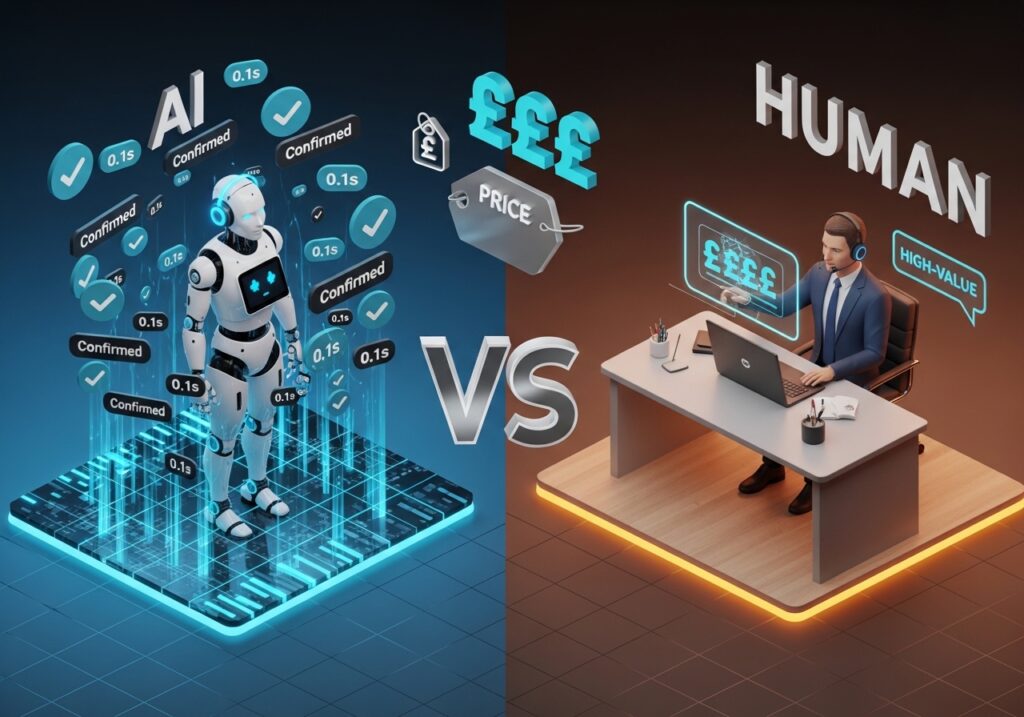
| Monthly cost (UK, all-in) | £500–£1,500/month | £2,900–£3,800/month (salary + NI + pension) |
| Annual cost (24/7 coverage) | £6,000–£18,000 | £85,000–£120,000 (3 staff for shifts) |
| Scalability | Handles 10,000+ enquiries/day | 40–60 contacts per person per day |
| Consistency | Scripted, limited to nuanced responses | Varies by mood, fatigue, and time of day |
| Objection handling | Scripted, limited to nuanced responses | Strong adapts in real time |
| Emotional intelligence | Limited | High |
| GDPR / PECR compliance | Requires explicit consent for outbound AI calls | No automated calling rules apply |
| Best for | High-volume, transactional, B2C bookings | High-ticket, consultative, complex B2B sales |
The True Cost of Each Option for UK Businesses
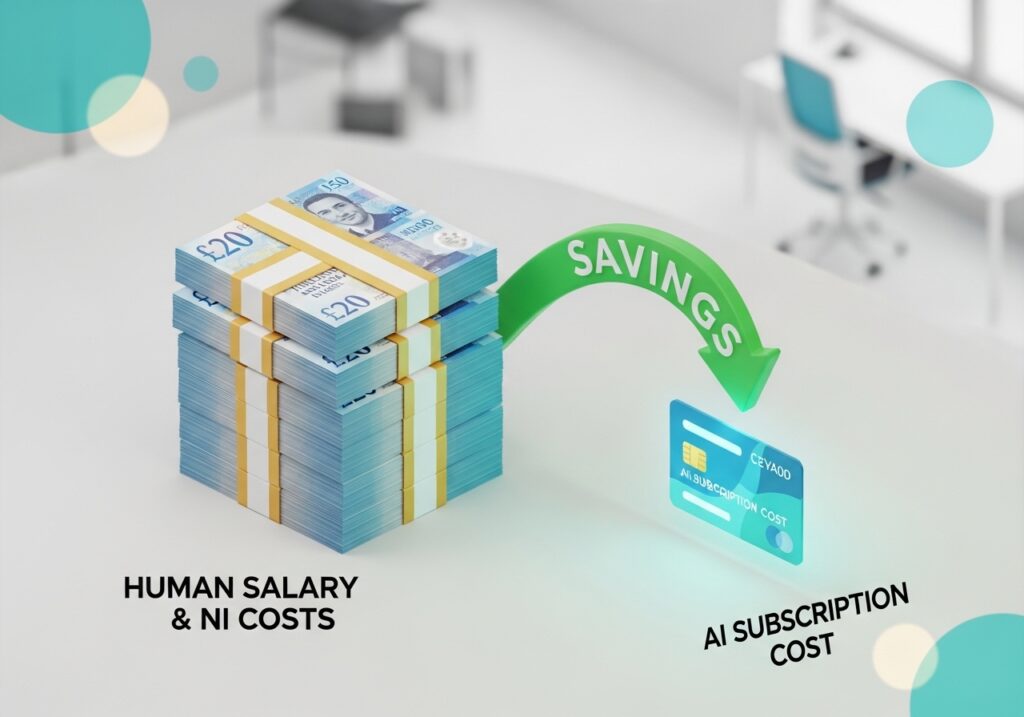
This is where most competitor articles fail; they use US dollar figures that bear no resemblance to UK employment costs. Many companies compare pricing using AI Cost Savings insights. Here is what hiring a human appointment setter actually costs a UK business.
Full UK Employer Cost of a Human Setter (Annual)
| Cost Line | Annual Amount (£) |
| Base salary (mid-level setter) | £26,000–£30,000 |
| Employers’ National Insurance (13.8%) | £3,588–£4,140 |
| Auto-enrolment pension (3% employer) | £780–£900 |
| Statutory holiday (28 days, ~10.8%) | £2,808–£3,240 |
| Recruitment cost (one-time, annualised) | £1,500–£2,500 |
| Management and training overhead | £1,200–£2,000 |
| Total annual cost (business hours only) | £35,876–£42,780 |
To match AI’s 24/7 coverage, you need a minimum of 3 full-time setters across day, evening, and weekend shifts. That pushes the annual cost to approximately £107,000–£128,000. Others use AI ROI Calculator to measure returns.
Most AI appointment setting platforms in the UK market cost between £500 and £1,500 per month or £6,000 to £18,000 per year for unlimited availability. Businesses also review AI Pricing Plans before deciding. The cost difference is not marginal. It is transformational for most small and medium-sized UK businesses.
Where AI Appointment Setters Win
Speed to Lead: The Most Lopsided Advantage
Research shows that responding to a lead within one hour makes you almost 7 times more likely to have a meaningful conversation than waiting longer. Responding within 5 minutes increases that advantage to over 100 times compared to a 30-minute delay.
The average UK small business, however, responds to a web enquiry in 6 to 8 hours. This delay creates a major gap, and that’s exactly where AI delivers its most measurable return on investment.
An AI appointment setter responds in under 5 seconds, every single time, including late at night, on weekends, or during bank holidays. In competitive markets where the first response often wins the booking, this speed advantage alone makes AI a powerful and practical investment. Many businesses achieve this using AI customer support systems.
Scalability Without Proportional Cost
When a UK roofing company runs a radio ad and receives 80 enquiries on a Monday morning, an AI setter handles all 80 simultaneously. A team of two human setters can handle perhaps 8 at once. The other 72 go to voicemail or wait, and many will have booked elsewhere by the time they are called back.
AI scales as your lead volume grows without requiring additional headcount, training cycles, or management overhead. Many businesses scale using AI Business Phone platforms. The cost per booking falls as volume increases. With human setters, the cost per booking stays constant or rises as you need more staff.
Consistency Across Every Interaction
A human setter on their 45th call of a Friday afternoon delivers a measurably different quality of conversation than they did on their third call on Tuesday morning. Fatigue, distraction, and cumulative emotional load are real and unavoidable.
AI delivers the same qualification quality, the same follow-up cadence, and the same tone on interaction number 10,000 as on interaction number one, for businesses where compliance and consistency matter, such as financial services, insurance, or healthcare, this reliability removes significant operational risk. Consistency is achieved through the Best AI Answering solutions.
Where Human Appointment Setters Win
Complex Objection Handling and High-Ticket Sales
When a prospect says “we had a terrible experience with a similar service two years ago” or “I am not convinced this is right for our team,” a skilled human setter can hear the hesitation, acknowledge it genuinely, and adapt the conversation in real time. They can reference a relevant case study unprompted, match the prospect’s communication style, or simply slow down and listen.
AI handles scripted objections well. It struggles with the unpredictable, emotionally loaded, or genuinely novel responses that appear frequently in high-value B2B sales. For deals above £5,000 where trust and rapport drive the buying decision, a human first touch typically delivers higher conversion rates. Businesses in sensitive industries often rely on legal AI solutions carefully.
Regulated and Sensitive Sectors
In sectors such as legal services, mental health, personal injury, and financial advice, the first interaction is not just a booking conversation; it is the beginning of a trust relationship. Clients in these sectors often have high levels of anxiety, have suffered loss, or are navigating complex personal situations. Some also use law Firm Receptionist systems.
A human setter who genuinely listens, responds with empathy, and makes the person feel understood converts at a fundamentally higher rate than an AI in these contexts. More importantly, it is often the right approach regardless of conversion rate.
GDPR and PECR: A Critical UK Consideration
Under the Privacy and Electronic Communications Regulations (PECR), automated calling systems used for direct marketing to UK consumers require explicit prior consent from the recipient. This is a harder standard than the legitimate interest basis that applies to human-led outbound calls.
If you are considering using AI for outbound cold calling in the UK, you must confirm that your leads have consented to receive automated calls. Using an AI setter without this consent exposes your business to ICO enforcement and financial penalties. Businesses should also review AI compliance guide for data protection insights.
Human-led outbound calls can be made to existing customers and to business numbers under legitimate interest, with a softer consent requirement. For cold outreach to consumer lists, this compliance difference is significant.
Always review current guidance at ico.org.uk before configuring any AI outbound calling system.
The Hybrid Model: Getting the Best of Both
The highest-performing appointment setting operations in 2026 are not choosing between AI and humans. They are using both deliberately, with clear rules about what each handles.

How a Hybrid Model Works in Practice
A well-structured hybrid setup operates as follows:
- AI handles first response: Every inbound lead receives a reply in under 5 seconds, regardless of time or volume. The AI qualifies the lead, answers common questions, and books routine appointments automatically.
- Handoff triggers are pre-configured: When a prospect uses specific objection phrases, mentions a deal value above a set threshold, or expresses emotional distress, the system flags the conversation and routes it to a human setter for follow-up. These setups rely on AI System Integration for smooth workflows.
- Humans focus on high-value conversations: Rather than spending 70% of their time on routine follow-ups that AI can handle, human setters focus exclusively on complex discovery calls, enterprise prospects, and emotionally sensitive situations.
- AI covers after-hours and overflow: When the human team is unavailable or overwhelmed, AI ensures no lead goes unanswered.
Businesses using this structure consistently report higher total booked appointments than AI-only or human-only teams, because AI captures the volume and humans convert the complexity.
Decision Framework: Which Model Is Right for Your UK Business?
| Business Profile | Recommended Model | Reason |
| High lead volume (100+/month), transactional bookings | AI | Speed and scale outweigh nuance at this volume |
| Low volume (under 30/month), high-ticket B2B | Human | Relationship quality drives conversion more than speed |
| Mixed volume, varying deal complexity | Hybrid | AI handles routine; humans handle complex |
| Regulated sector (financial, legal, healthcare) | Human or Hybrid | GDPR/FCA requirements and sensitivity demand human involvement |
| Sole trader or micro-business, no reception staff | AI | Provides 24/7 coverage a single person cannot maintain |
| Agency managing multiple client pipelines | AI + Hybrid | Scale is essential; human escalation for key accounts |
Industry-Specific Guidance for UK Businesses
Healthcare and Private Clinics
AI appointment setters work well for routine booking of GP referrals, physiotherapy, and dental check-ups. Healthcare providers benefit from Dental AI Solutions. For mental health, addiction services, or oncology, human setters are appropriate due to the emotional sensitivity involved. Ensure any AI platform used for patient data is UK GDPR-compliant with a signed Data Processing Agreement.
Legal Services and Solicitors
Initial consultations for standard services (conveyancing, wills, employment disputes) can be handled by AI efficiently. Complex matters involving trauma, criminal proceedings, or immigration require human empathy from the first contact. Many UK law firms use AI for after-hours capture with a human follow-up the next morning.
Trades and Home Services
This is the clearest AI use case in the UK market. Plumbers, electricians, and HVAC companies lose significant revenue simply because they cannot answer their phone while on a job. Trades businesses use Home Services Automation. An AI setter that captures the enquiry, qualifies the job type, and books a site visit automatically recovers the majority of those missed opportunities.
B2B Agencies and SaaS
For inbound B2B leads, hybrid is almost always the right answer. AI handles immediate response and basic qualification. A human SDR takes over for discovery and demo booking when the lead meets a defined value threshold. Real estate firms adopt Real Estate AI tools.
4 KPIs to Measure Your Setter’s Performance
Whether you use AI, humans, or both, these are the four metrics every UK business should track monthly. Performance tracking improves with AI Platform Features.
- Contact rate: Percentage of leads successfully reached. Benchmark: 60–80% for AI; 40–60% for human teams
- Set rate: Percentage of contacts who book an appointment. Benchmark: 20–35% depending on sector
- Show rate: Percentage of booked appointments that actually attend. Benchmark: 70–85% with reminders; 50–65% without
- Close rate: Percentage of appointments that result in a sale. This is where human closers matter most
A drop in any of these metrics signals where the process needs attention. If the show rate is low, your reminder cadence needs work. If the set rate is low, your qualification script needs refining. Businesses optimise using AI system workflow.
How to Transition From Human to AI Appointment Setting
If you currently use human setters and want to move toward AI, a phased transition avoids disruption:
Step 1: Baseline audit: Record your current contact rate, set rate, show rate, and close rate over 30 days. This gives you a baseline to measure AI performance against. Many businesses follow AI Growth Strategies when scaling automation.
Step 2: Choose a UK-compatible platform: Select an AI setter that offers a Data Processing Agreement, UK or EEA data storage, and PECR-compliant outbound settings. Do not deploy AI outbound cold calling without confirming your consent records are sufficient.
Step 3: Run a parallel test: Route 50% of new inbound leads to the AI setter for 30 days while your human team handles the other 50%. Compare the four KPIs directly.
Step 4: Phased handover: Shift inbound routine qualification fully to AI. Retain human setters for high-value follow-up and complex conversations. Review monthly and adjust the handoff threshold based on performance data.
How to Choose the Right AI Appointment Setter for Your Business
With so many platforms available, choosing the wrong AI appointment setter can waste budget, create compliance risks, and fail to fit your workflow. Here are the five key factors UK businesses should focus on:
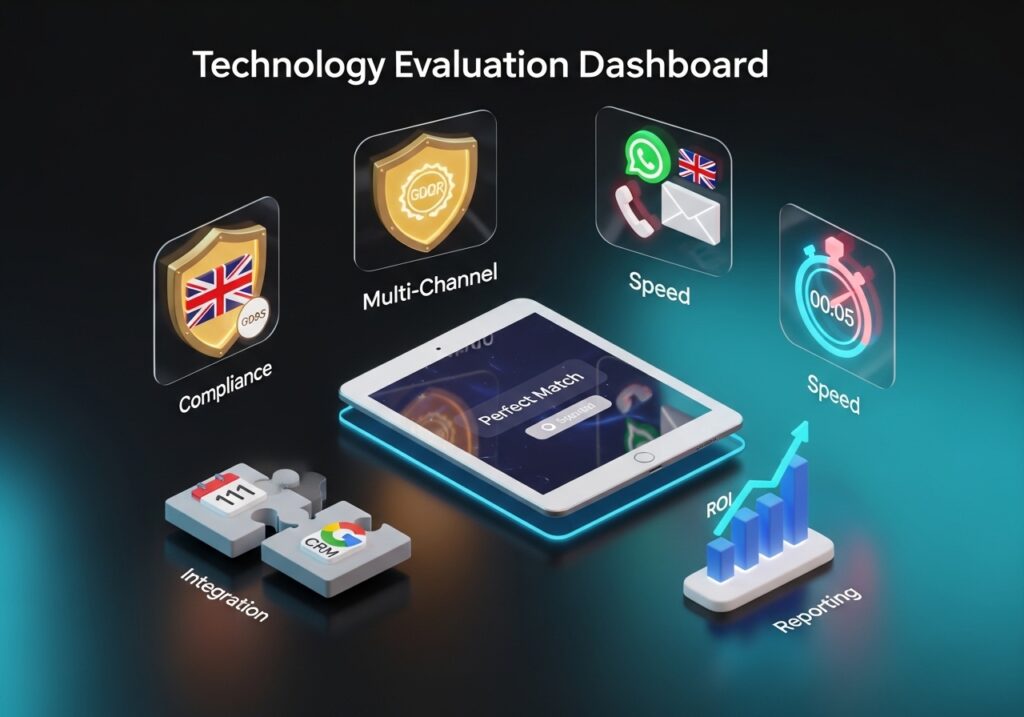
1. GDPR and PECR Compliance
Any AI tool handling customer data must comply with UK GDPR and provide a signed Data Processing Agreement (DPA). It should also support explicit consent tracking under PECR. If data is not stored in the UK or EEA, it’s a risk you shouldn’t take.
2. Multi-Channel Capability
The best AI setters work across multiple channels like SMS, email, WhatsApp, and AI voice. They should automatically follow up on different channels if one goes unanswered, ensuring no leads are missed.
3. Speed to First Response
A strong AI system responds to inbound leads within 60 seconds. Delays reduce conversion rates, so always verify this in a live demo instead of relying on marketing claims.
4. CRM and Calendar Integration
Your AI setter should integrate seamlessly with tools like Google Calendar, Outlook, and your CRM. Booked appointments should appear automatically without manual input.
5. Transparent Reporting and KPI Tracking
You need clear data on metrics like contact rate, set rate, show rate, and response time. Without transparency, you can’t optimise performance or measure ROI.
Frequently Asked Questions
Is an AI appointment setter better than a human?
It depends on your business model and sales process. AI appointment setters outperform humans in speed, consistency, and cost-efficiency, making them ideal for handling large volumes of inbound leads and routine follow-ups. However, human setters are still more effective for high-ticket sales, complex decision-making, and emotionally sensitive conversations.
For most UK businesses, the strongest results come from a hybrid approach, where AI handles first response, qualification, and scheduling, while humans focus on closing and relationship-building.
How much does a human appointment setter cost in the UK?
A full-time human appointment setter in the UK typically costs between £35,000 and £43,000 per year when you include salary, employer’s National Insurance, pension contributions, paid leave, and recruitment costs.
If your business requires evening or weekend coverage, you may need multiple hires. Providing true 24/7 availability often requires three or more staff, increasing total costs to £100,000+ annually. This is where AI becomes significantly more cost-effective.
Are AI appointment setters legal in the UK?
Yes, AI appointment setters are legal in the UK when used correctly. For inbound enquiries, automation is fully compliant as long as customer data is handled under UK GDPR. For outbound communication, including AI calling and messaging, businesses must comply with PECR (Privacy and Electronic Communications Regulations), which requires explicit prior consent before contacting individuals. It’s important to regularly review official guidance on Information Commissioner’s Office to ensure compliance.
What is a hybrid appointment setting model?
A hybrid model combines the strengths of both AI and human sales teams. AI handles instant responses, lead qualification, follow-ups, and after-hours booking, ensuring no opportunity is missed.
Human setters then step in for high-value conversations, objection handling, and closing deals. This approach improves efficiency while maintaining a personal touch, and it’s increasingly used by high-performing UK sales teams.
What metrics should I track for an AI appointment setter?
To measure performance effectively, track key metrics such as contact rate, set rate (appointments booked), show rate (attendance), and close rate (conversions).
You should compare these metrics against your pre-AI baseline and monitor trends monthly. Many businesses see a noticeable improvement in show rates within 30 days, largely due to automated reminders, faster response times, and consistent follow-ups.
Conclusion: Making the Right Choice for Your Business
There is no single correct answer to the AI vs. human appointment setter question. The right choice is the one that matches your lead volume, deal complexity, regulatory environment, and budget, not the one that is most technically impressive.
For high-volume, transactional UK businesses, AI delivers undeniable advantages in cost, speed, and consistency. For complex, relationship-driven B2B sales, humans remain the stronger option at critical stages. For most businesses, the highest-performing model combines both: AI capturing every lead instantly, humans converting the conversations that require genuine judgment.
Start with a 30-day parallel test, track the four KPIs, and let your own data make the decision. The best approach is to implement a full AI Receptionist System.
Ready to see it in action?
Book a Live Demo with The DBT AI →
See how our AI appointment setter responds to leads in seconds, qualifies them automatically, and fills your calendar — without any effort from your team. No complex setup. No CRM needed. Results within 30 days.