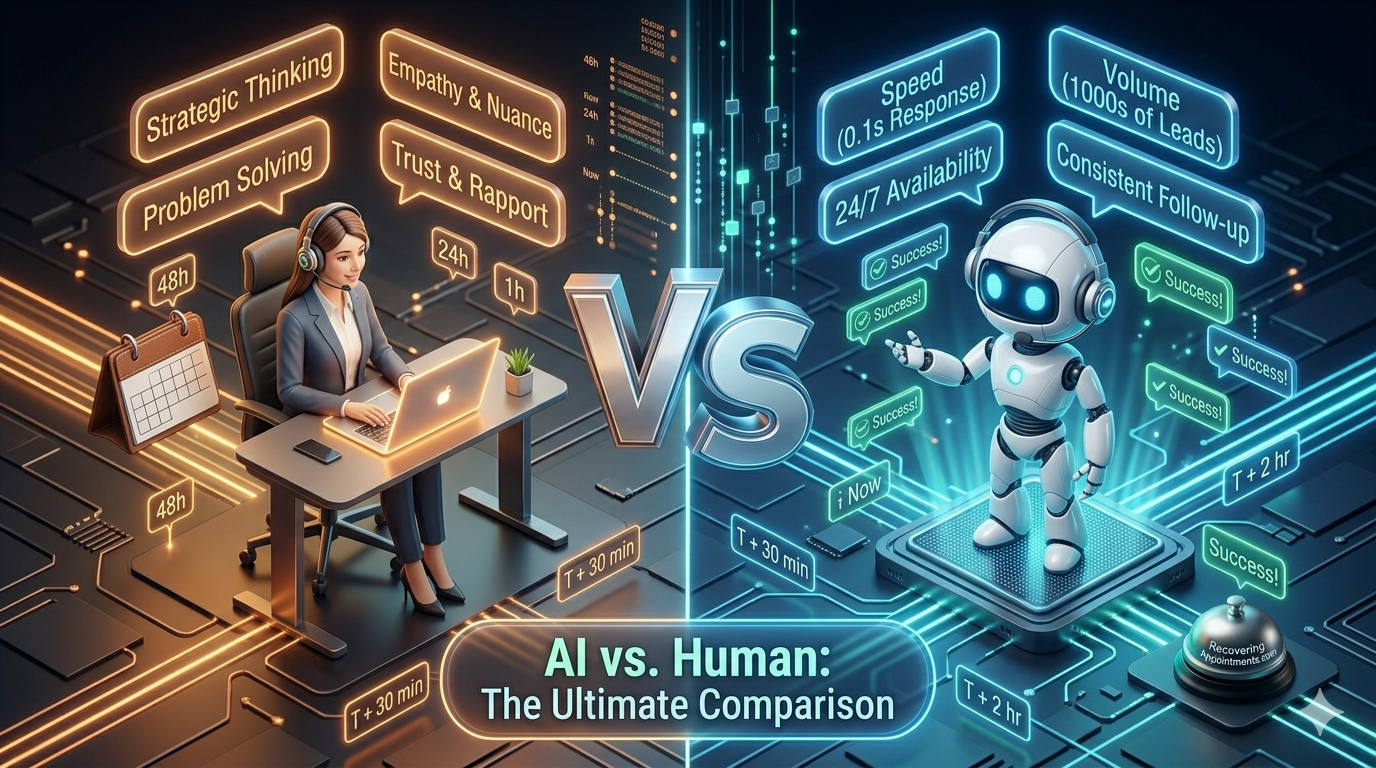
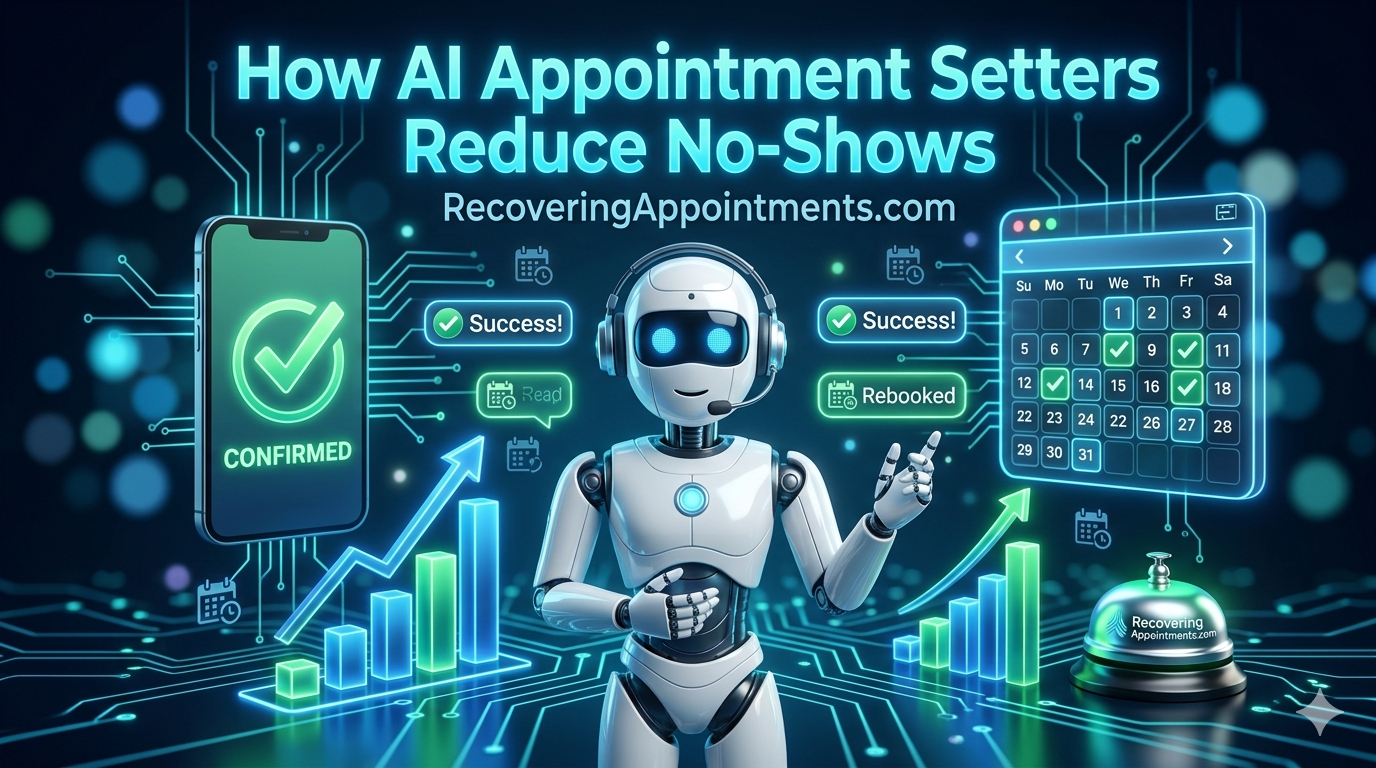
For UK small businesses, from dental practices and hair salons to law firms and physiotherapy clinics, no-show rates between 10% and 20% are common. According to a peer-reviewed study published in JMIR Formative Research (AlSerkal et al., 2026), the average no-show rate in primary healthcare sits at 21% before any intervention, translating into thousands of pounds in lost income every month. Many businesses also use AI Phone Answering to capture missed calls.
AI appointment setters solve this by automating the right message, at the right time, through the right channel, consistently and without staff involvement. This guide covers the reminder cadences, confirmation logic, buffer rules, and message templates that produce the biggest measurable reductions. This is where an AI Scheduling Assistant becomes essential.
What Is an AI Appointment Setter and How Does It Work?
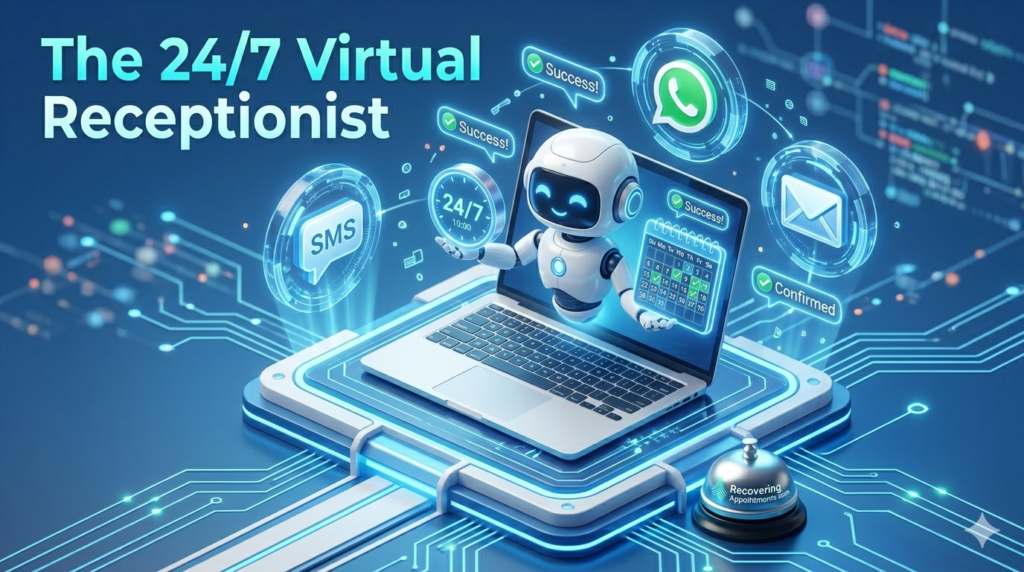
An AI appointment setter is software that manages the full booking cycle, confirmation, reminders, rescheduling, and follow-up (automatically), without a human handling each step. A modern Virtual Receptionist Service handles communication automatically.
Unlike a basic calendar alert, it uses natural language processing to communicate in a way that feels personal, adapts to each client’s behaviour, and updates your calendar in real time. Businesses combine this with 24/7 Call Answering for full coverage.
Key things an AI appointment setter does:
- Sends a timed sequence of reminder messages across SMS, email, WhatsApp, or phone
- Detects when a client has not responded and escalates to a different channel automatically
- Increases reminder frequency for clients who have previously missed appointments
- Triggers re-confirmation requests and offers rescheduling links without staff involvement
- Uses predictive modelling to identify high-risk bookings before a no-show occurs
A 2026 study from Emirates Health Services found that an AI model trained on 16 client and appointment variables achieved 86% accuracy in predicting no-show risk, cutting missed appointments by 50.7%.
The Core Components That Make AI Appointment Setters Effective
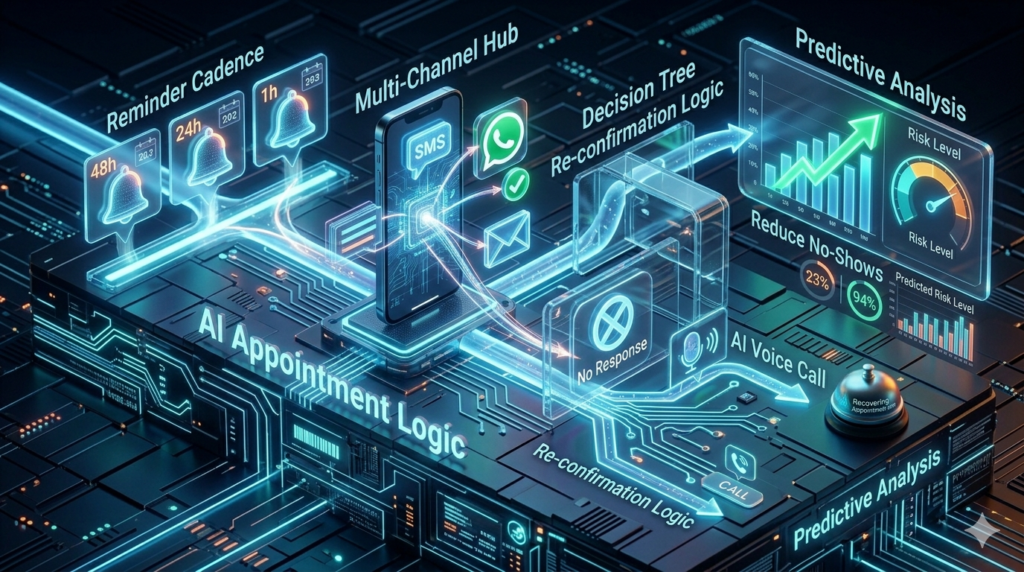
1. The Reminder Cadence: Right Message, Right Time
A reminder cadence is the planned sequence of messages sent before an appointment. The most effective structure for UK small businesses uses three messages:
- Message 1: Booking confirmation (immediate): Confirms date, time, location, and any preparation needed. Sets expectations from the start. Reminder systems often rely on Automated Call Answering to ensure consistency.
- Message 2: 48-hour reminder: The most important message in the sequence. Arrives early enough for the client to reschedule if needed, and re-anchors the appointment in their mind.
- Message 3: Morning-of nudge: Sent between 7 am and 9 am on the day. Brief, warm, and includes a one-tap confirm or reschedule option.
For high-value appointments, legal consultations, and medical procedures, an optional fourth message 30 minutes before can reduce costly late cancellations further.
Expected improvement: A structured 3-message cadence reduces no-shows by 30–50% compared to single-reminder systems (Workhub AI; Forrester Total Economic Impact).
2. Multi-Channel Confirmation: Use the Channel Clients Actually Open
Advanced setups include AI business phone integrations. A single channel assumes every client uses it. They do not. A well-configured AI setter works in sequence; if the 48-hour SMS goes unanswered, it escalates to email, then to a phone call or WhatsApp, depending on the client’s preferences.
Channel Comparison: Open Rates and Best Use
| Channel | Average Open Rate | Best Use Case | GDPR Requirement |
| SMS | 98% | Time-sensitive reminders, same-day nudges | Legitimate interest or consent |
| 90%+ | Conversational confirmations, rescheduling | Explicit opt-in required | |
| 20–28% | Detailed confirmations with documents | Legitimate interest or consent | |
| Phone call (AI) | Varies | High-value or high-risk appointments | No written consent required |
| Push notification | 40–60% | App-based businesses with mobile users | App permission required |
UK GDPR note: SMS reminders to existing customers can be sent under legitimate interest under UK GDPR and PECR, provided the client has not opted out. WhatsApp requires explicit opt-in. Check ico.org.uk for current guidance.
3. Re-Confirmation Logic: When a Client Does Not Respond
Re-confirmation logic is the rule set that triggers when a client fails to respond. Some businesses scale using White Label Answering solutions. A private physiotherapy clinic in Birmingham, for example, might configure:
- No response to 48-hour SMS → email reminder sent at 36 hours
- No response to email → AI voice call triggered at 24 hours
- Client cancels → waitlist slot offered automatically
- Client has 2+ previous no-shows → first reminder sent at 72 hours instead of 48
This runs without staff involvement and ensures every at-risk booking gets the right level of follow-up.
Expected improvement: AI re-confirmation logic delivers an additional 15–25% no-show reduction on top of standard reminders (Leaping AI; Emirates Health Services).
4. Buffer Rules: Protect Your Schedule From Disruption
Buffer rules are constraints that the AI enforces to limit schedule disruption. Common examples include:
- Minimum 24-hour booking lead time to reduce same-day no-show risk
- A 10–15 minute gap between appointments to absorb overruns
- A 24 or 48-hour cancellation window linked to a no-show fee policy
When a cancellation arrives, waitlist automation immediately offers the slot to the next waiting client, recovering 40–70% of otherwise lost revenue.
5. AI No-Show Prediction: From Reactive to Proactive
These features are often part of the Best AI Answering systems. The most advanced AI setters use predictive modelling to flag at-risk appointments before any reminder is sent. The Emirates Health Services study (AlSerkal et al., JMIR 2025) describes a Random Forest model trained on:
- Demographic factors (age, location)
- Appointment history (previous no-shows, cancellation patterns)
- Appointment-specific data (lead time, time of day, day of week, booking channel)
The model classified appointments as high, medium, or low risk with 86% accuracy. High-risk appointments received earlier, more varied contact, while low-risk bookings followed the standard 3-message sequence, avoiding communication fatigue.
SMS Reminder Templates for UK Small Businesses
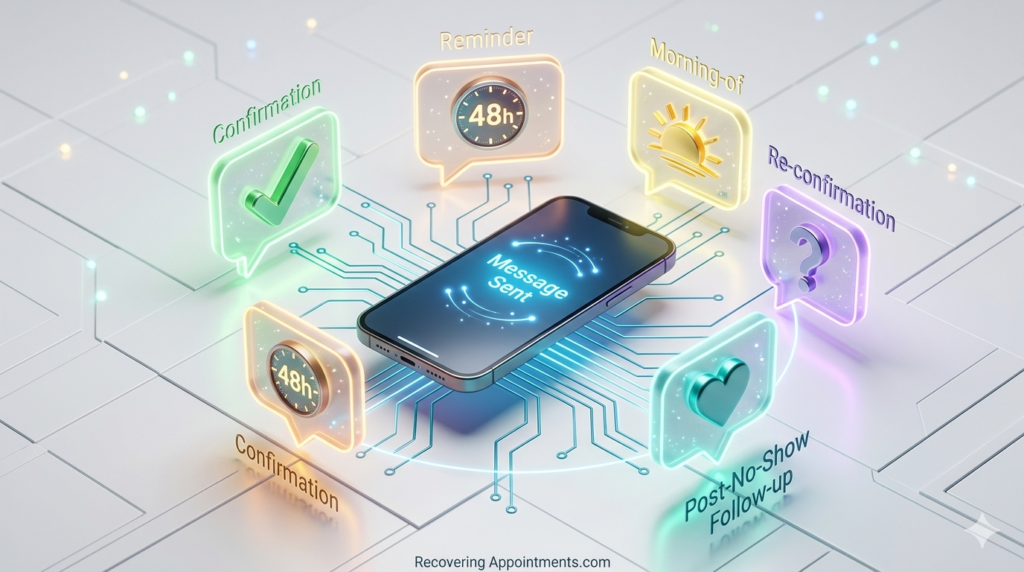
These templates are designed for SMS delivery, which offers the highest open rate of any reminder channel. Each template is under 160 characters to fit within a single SMS message.
Booking Confirmation (Immediate)
These templates are commonly used in AI Setter Operation strategies.
“Hi [Name], your [Service] appointment with [Business] is confirmed for [Date] at [Time]. Questions? Call us on [Number]. Reply CANCEL to cancel.”
48-Hour Reminder
Many businesses refine messaging using AI Lead Qualification insights.
“Hi [Name], reminder: your [Service] appointment is on [Date] at [Time] with [Business]. Reply CONFIRM to confirm or CHANGE to reschedule. See you soon.”
Morning-Of Nudge
“Good morning [Name]. Your appointment at [Business] is today at [Time]. We look forward to seeing you. Reply CANCEL if you can no longer make it.”
Re-Confirmation (No Response Received)
“Hi [Name], we haven’t heard from you about your [Date] appointment at [Time]. Please reply YES to confirm or call [Number] to reschedule. Thank you.”
Post-No-Show Follow-Up
“Hi [Name], we missed you today. We’d love to rebook a reply to this message or call [Number], and we’ll find a convenient time. No obligation.”
Expected No-Show Reductions: What the Data Shows
Insights like these are explained in AI platform features.
| Strategy | Expected No-Show Reduction | Source |
| Single automated reminder (email or SMS) | 20–30% | Industry average |
| 3-message cadence (confirmation + 48hr + morning) | 30–50% | Workhub AI, Forrester |
| Multi-channel confirmation (SMS + email escalation) | Additional 10–15% | Leaping AI case data |
| AI re-confirmation logic | Additional 15–25% | Emirates Health Services |
| AI predictive risk modelling | Up to 50.7% total reduction | AlSerkal et al., JMIR 2025 |
| Waitlist automation (slot recovery) | 40–70% of cancelled slots recovered | Industry estimate |
Common Mistakes to Avoid With Appointment Reminders
Common issues are often caused by poor AI Software Selection. Avoiding these mistakes is key to AI Adoption Success.
- Sending more than 3–4 reminders for standard appointments causes opt-outs, leaving no way to reach the client before future bookings
- Defaulting to email only ignores the fact that email open rates average just 22–28%. SMS and WhatsApp are far more reliable for time-sensitive messages
- Skipping the post-no-show follow-up misses the highest-value rebooking window, the first two hours after a missed slot
- Not separating GDPR consent settings by channel, WhatsApp requires explicit opt-in under PECR, while SMS can use legitimate interest for existing customers
- Setting no buffer time between appointments means one overrun delays the entire day, with no automatic recovery
The Post-No-Show Window: How to Rebook Within 2 Hours
A client who missed their appointment without cancelling is not a lost client; they most likely forgot or had an emergency. Businesses that follow up within two hours report rescheduling rates of 25–40%, compared to under 10% when no follow-up is sent. Recovery strategies often involve AI phone receptionist systems.
A well-configured AI setter handles this automatically:
- At the missed time: System marks the no-show and triggers the follow-up workflow
- Within 30 minutes: Sends a warm SMS “Hi [Name], we missed you today. We hope everything is okay. Reply anytime to rebook.”
- Within 2 hours: Waitlist automation offers the slot to the next waiting client
- Next working day: A second message goes out if no response is received
Keep the tone caring, not frustrated. Messages that open with concern consistently outperform those that lead with “you missed your appointment.” Many businesses automate this using AI Small Business Tools.
FAQs
How much can an AI appointment setter reduce no-shows?
Studies show reductions of between 30% and 50% with standard reminder cadences, rising to over 50% when AI predictive risk modelling is applied. The 2025 Emirates Health Services study achieved a 50.7% no-show reduction across more than 135,000 appointments using AI-driven identification of high-risk bookings.
What is the best reminder timing for reducing no-shows?
The most effective sequence is: an immediate booking confirmation, a 48-hour reminder, and a same-day morning nudge. A 72-hour first reminder should be added for clients with a history of missed appointments. This cadence balances adequate notice with practical convenience for the client.
Is it legal to send automated appointment reminders in the UK?
Yes. Appointment reminders sent to existing customers for service management purposes can be sent under the legitimate interest lawful basis under UK GDPR, provided the customer has not opted out. WhatsApp reminders require explicit opt-in under PECR. Always configure your platform’s consent settings to match these requirements and check current guidance at ico.org.uk.
Can AI appointment setters handle rescheduling automatically?
Yes. Most modern AI appointment setters include two-way messaging, which allows a client to reply to a reminder with a keyword (such as CHANGE or RESCHEDULE) and be guided through a rescheduling flow without any human involvement. The system updates the calendar in real time and sends a new confirmation automatically.
Do AI appointment setters work for small businesses with only a few staff?
Particularly well. Small businesses without dedicated reception staff benefit most from AI appointment automation because it handles the communication workload that would otherwise fall on the business owner or a single member of staff. For sole traders and micro-businesses, an AI setter essentially functions as a part-time virtual receptionist for appointment management.
Conclusion: Cut No-Shows With the Right AI Setup
No-shows are not an unavoidable cost of running a service business. They are a problem with a measurable, affordable, and well-documented solution.
The combination of a structured 3-message reminder cadence, multi-channel delivery, intelligent re-confirmation logic, and predictive risk modelling gives UK small businesses the tools to reduce missed appointments by 30% to 50%, without adding to the workload of a single staff member. The best results come from implementing a complete AI receptionist system.
Start with a properly configured AI appointment setter, apply the reminder templates and cadence structure in this guide, and review your no-show data monthly. The improvement will be visible within the first four weeks.
Ready to see it in action?
Book a Live Demo with The DBT AI →
See how our AI appointment setter responds to leads in seconds, qualifies them automatically, and fills your calendar — without any effort from your team. No complex setup. No CRM needed. Results within 30 days.