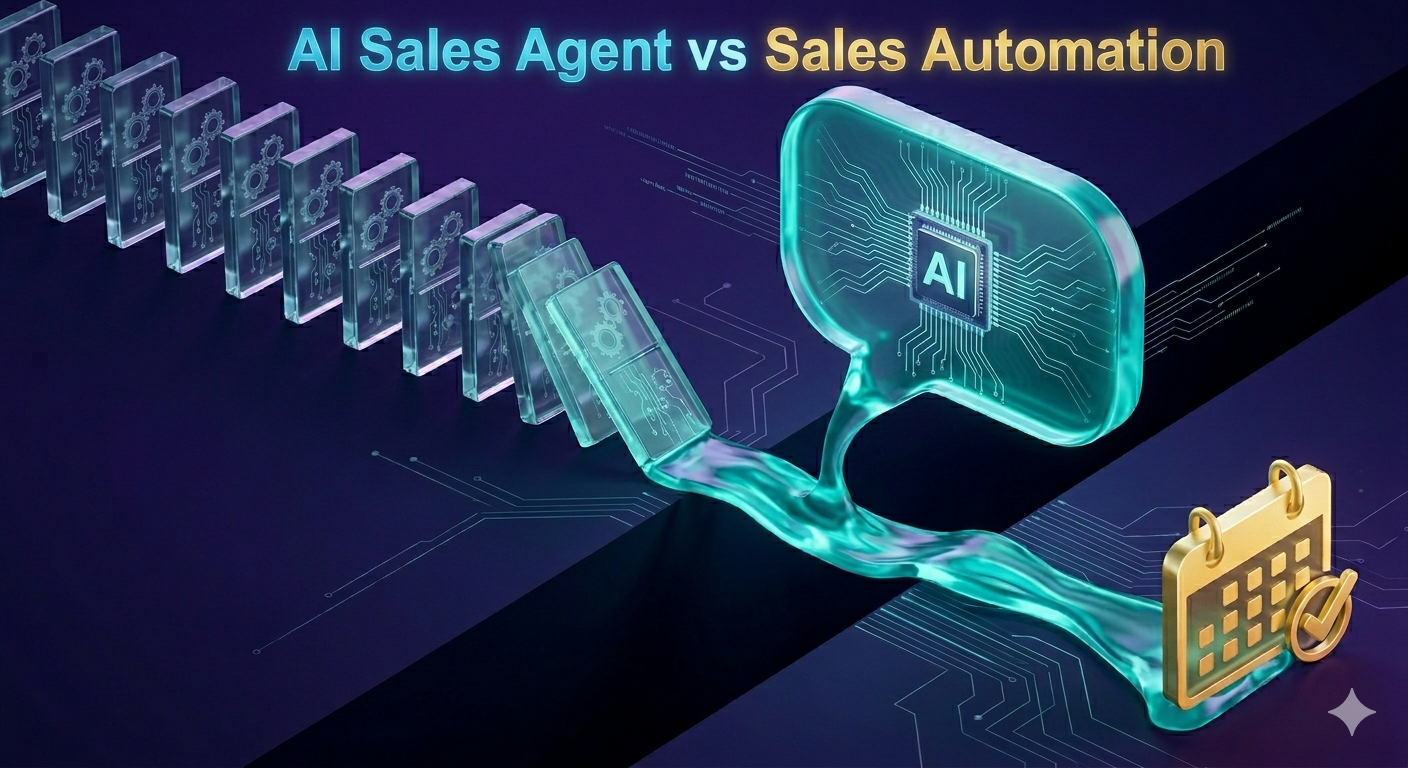
| Quick Answer Traditional sales automation is rule-based: it sends emails, creates tasks, and updates records when a trigger condition is met. An AI sales agent is conversational: it contacts leads, qualifies them through natural dialogue, handles objections, and books meetings without human involvement. Both tools serve different purposes. Traditional automation excels at background tasks, data management, and email sequences. An AI sales agent excels at first contact, live qualification, appointment booking, and lead reactivation. The most effective sales stacks use both, not one instead of the other. Many teams validate this using AI SDR benefits data. |
If you already use a CRM like Salesforce, HubSpot, or GoHighLevel, you are almost certainly using some form of sales automation. Workflows that fire emails when a lead submits a form, tasks that get created when a deal changes stage, and notifications that alert a rep when a prospect visits the pricing page. All of that is traditional sales automation, and it works well for what it is designed to do.
But there is a category of sales activity that traditional automation simply cannot handle: the live conversation. This gap is clearly shown in AI vs human SDR comparisons. The moment a new lead needs to be spoken to, qualified, and persuaded to book a call, a rule-based system runs out of capability. That is where an AI sales agent begins.
This article compares both tools across every relevant dimension, explains exactly where each one belongs in your sales process, and gives you a practical decision framework for choosing the right tool for each specific use case.
Traditional Sales Automation: What It Is and Its Limits
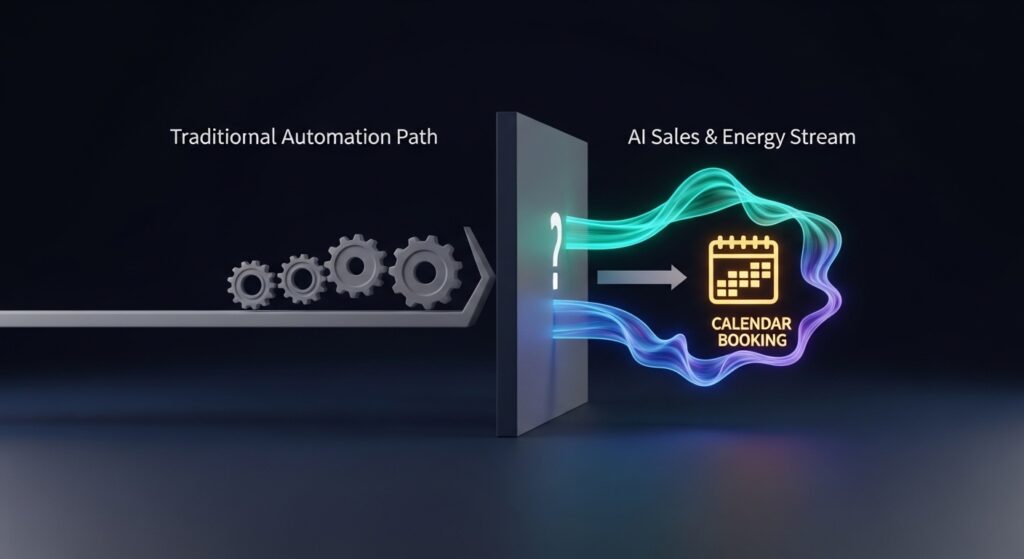
Traditional sales automation is a system built on conditional logic. This contrasts with AI-led qualification systems. A trigger occurs, a condition is checked, and an action is executed. This model powers every major CRM workflow engine on the market today, from Salesforce Process Builder and Flow to HubSpot Workflows and GoHighLevel automations.
What Traditional Sales Automation Does Well
The rule-based model is extraordinarily effective for predictable, repeatable business processes where the right action is always the same regardless of context. These workflows often integrate with an AI business phone system. The tasks that traditional automation handles best include:
- Sending a confirmation email when a lead submits a contact form
- Creating a follow-up task for a sales rep when a deal reaches a defined stage
- Updating a lead record in the CRM when a contact opens an email or visits a specific page
- Triggering a sequence of nurture emails over a defined period for contacts that have not yet taken action
- Sending an internal notification to a manager when a high-value deal is created or moves forward
- Synchronizing data between two systems, such as pushing form submissions from a website into a CRM
- Scheduling a report to be generated and emailed to stakeholders on a recurring basis
These are all scenarios where the appropriate response is always the same. The trigger occurs and the action fires without any need to understand what the lead said, what they need, or whether they are ready to buy. Traditional automation is the right tool for all of them.
Where Traditional Sales Automation Reaches Its Limits
The limitation of rule-based automation appears the moment the correct response depends on a conversation. This is where an AI phone assistant becomes essential. Traditional automation cannot:
- Make an outbound phone call to a lead and introduce your business
- Ask a lead whether their budget aligns with your pricing and adapt based on their answer
- Respond to an objection like I am not ready yet with a nuanced, context-aware reply
- Detect that a lead is interested but hesitant and offer a lower-commitment next step
- Book a specific meeting slot into a live calendar during a real-time voice or SMS conversation
- Re-engage a cold lead through a personalized call that addresses why they went quiet
All of these scenarios require something beyond rules. They require conversation. And that is what an AI sales agent is built to do.
What an AI Sales Agent Is and How It Differs From Automation
An AI sales agent uses natural language processing and machine learning to conduct real conversations with leads. These capabilities are also covered in multi-channel AI SDR strategies. Rather than checking whether a trigger condition is true and firing a pre-set action, the AI listens to what a lead actually says, interprets the meaning and intent behind it, and generates a contextually appropriate response in real time.
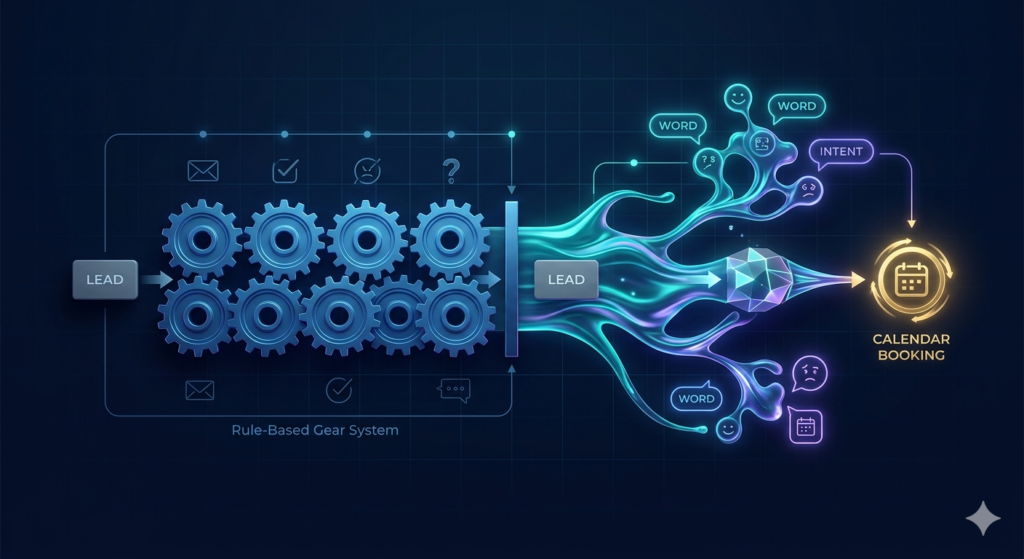
This is a fundamentally different type of system. Compared to tools in the AI vs Calendly comparison. A Salesforce workflow does not know whether a lead is interested or not. It fires the same email regardless of the lead’s sentiment, readiness, or specific situation. An AI sales agent, by contrast, adjusts every response based on what the lead communicates in each turn of the conversation.
The Core Technical Difference: Rules vs Reasoning
The clearest way to understand the difference is to follow the same lead through each system. Real-world examples are shown in AI appointment case studies. A lead named Sarah submits a form on a service business’s website at 8 pm on a Friday.
With traditional automation, A workflow fires. Sarah receives an email saying thank you for your enquiry, we will be in touch. A task is created in the CRM for a sales rep to follow up on Monday morning. Sarah has no interaction with the business until Monday. By then, she may have already spoken to a competitor.
With an AI sales agent: Within 5 seconds of form submission, Sarah receives a call. This is enabled by Automated call answering systems. The AI introduces itself on behalf of the business, asks what she is looking to achieve, qualifies her budget and timeline through natural conversation, handles her question about pricing with a trained response, and books a confirmed discovery call in the business owner’s Google Calendar while still on the call. Sarah receives an SMS confirmation and a reminder the following morning.
Both systems responded to the same trigger. But only one of them produced a booked, qualified meeting. This is not a difference in sophistication between a good and a bad automation setup. It is a fundamental difference in what the two types of systems can do.
What AI Sales Agents Can Do That Automation Cannot
- Natural language understanding: The AI reads meaning, not just keywords. Similar to AI lead qualification models. It understands that I might be interested and I am fairly keen both signal buying intent, even though neither matches an exact trigger phrase.
- Dynamic conversation flow: Every response is generated based on what the lead said in the previous turn. The conversation adapts rather than following a rigid script.
- Intent classification: The AI detects whether the lead is expressing positive interest, hesitation, an objection, or a disqualifying signal and routes the conversation accordingly.
- Live calendar access: The AI checks real-time availability and places bookings during the conversation, rather than sending a link and hoping the lead uses it.
- Objection handling: Trained response logic addresses the most common objections in a way that keeps the conversation moving toward a booking.
AI Sales Agent vs Traditional Automation: 12 Key Differences
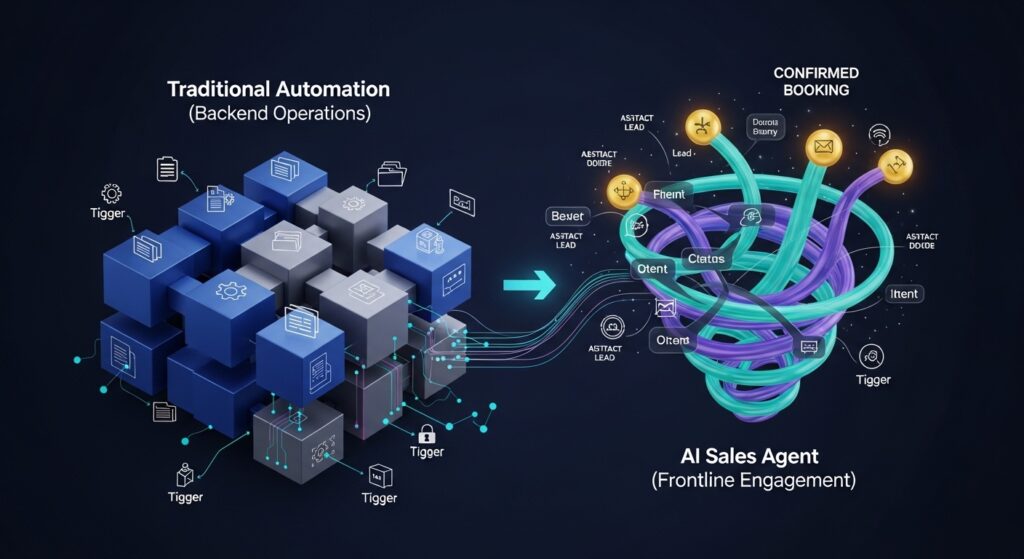
The table below compares an AI sales agent against traditional sales automation across every factor that matters for a service business sales process. These results align with AI appointment benefits. The Traditional Sales Automation column describes the typical capability of CRM workflow tools such as Salesforce, HubSpot, and GoHighLevel. The AI Sales Agent column describes the capability of a conversational AI system, such as The DBT AI.
| Sends an automated email or creates a task | Traditional Sales Automation | AI Sales Agent |
| How it works | Rule-based: IF trigger THEN action | Conversational AI: listens, reasons, and adapts in real time |
| First contact to lead | Sends automated email or creates a task | Makes an outbound voice call or sends SMS within 5 seconds |
| Lead qualification | Routes based on form fields or lead score | Qualifies through natural conversation using BANT-style criteria |
| Objection handling | Cannot handle objections | Detects objection type and responds with trained reply logic |
| Appointment booking | Sends a Calendly link and waits | Books the meeting directly from a live calendar in the same call |
| After-hours coverage | Rules run, but no live interaction with leads | Full 24/7 voice and SMS outreach with real conversations |
| No-show prevention | Sends one email reminder | Multi-step voice + SMS reminder sequence; rebooks no-shows |
| CRM data quality | Logs what the form captured, often incomplete | Logs full conversation transcript plus enriched qualification data |
| Lead reactivation | Can trigger email drip to old records | Makes outbound calls to cold leads; reactivates through conversation |
| Scalability | Scales well for email volume; not for live contact | Handles thousands of simultaneous conversations with no extra cost |
| Setup time | Days to weeks for complex workflows | Under 30 minutes for standard appointment-setting deployment |
| Ideal for | Task creation, alerts, data sync, email nurture | First contact, qualification, booking, reminders, reactivation |
The most revealing row in this table is the final one: Ideal for. This reflects how AI receptionist services are positioned. Traditional automation is best at background tasks, data operations, and email sequences. An AI sales agent is best at the live, human-facing front line of your sales process. These tools are complementary, not competing.
Where Traditional Sales Automation Wins and Why You Should Keep Using It
Traditional sales automation is genuinely excellent for specific categories of work, and replacing it with an AI sales agent for those categories would be both unnecessary and counterproductive. Especially when combined with CRM integration automation.
Administrative Tasks and Pipeline Management
When a deal in Salesforce moves from Qualified to Proposal Sent, the right response is a predictable set of actions: create a follow-up task for the rep, update the close date estimate, notify the sales manager, and log the stage change. These are deterministic operations. A rule-based workflow handles them faster, more cheaply, and more reliably than any conversational AI system could.
The same logic applies to invoice reminders, contract renewal notifications, onboarding sequences, and any workflow where the trigger always produces the same correct response. Traditional automation owns this territory and should keep it.
Email Nurture for Long-Cycle Leads
Not every lead is ready to buy within the first week of entering your pipeline. Many businesses also use online answering service tools. For contacts who are in a research phase, a 30 to 90 day email nurture sequence that shares relevant content, case studies, and product information at defined intervals is an effective and appropriate use of automation. It maintains brand presence without requiring a live conversation and costs almost nothing to operate once configured.
Traditional automation is the right tool for this. An AI sales agent used to run a months-long nurture programme would be both over-engineered and expensive relative to what a simple email sequence achieves.
Data Sync and System Integration
Keeping data consistent between your CRM, your marketing platform, your calendar, and your billing system is a technical plumbing problem. It is exactly what automation is designed to solve. When a contact moves from a prospect to a customer in Salesforce, the right response is to update that contact’s status in your email platform, create an invoice in your billing system, and trigger an onboarding workflow. All of this is rule-based, predictable, and perfectly suited to traditional automation.
Where AI Sales Agents Win Over Automation
First Contact with New Leads
This is where AI appointment booking becomes critical. The single most commercially important moment in a service business sales process is the first response to a new lead. Research from InsideSales.com, based on analysis of over 100,000 sales calls, found that the probability of qualifying a lead drops by 21 times if the first contact is made after 5 hours rather than within 5 minutes. Traditional automation sends an email. An AI sales agent makes a call. These produce fundamentally different outcomes.
A real estate agency in the US tested this directly. Before deploying an AI sales agent, their average response time to new Zillow leads was between 15 and 30 minutes, handled by human agents. After deploying the DBT AI, every lead received an outbound call in under 10 seconds. Booked property showings from web leads increased by 35% in the first month without any change to advertising spend.
Live Lead Qualification
A form can tell you that a lead entered their name, email, and company size. This is why AI scheduling assistant systems are used. A conversation tells you whether they have a real problem that needs solving, whether they can afford your service, whether they are the right person to be speaking to, and whether they are likely to show up for a meeting. This qualitative intelligence is only available through conversation, and traditional automation has no mechanism to capture it.
When an AI sales agent qualifies a lead, the sales rep receives a confirmed appointment with notes covering what the lead said about their need, their timeline, their budget, and any objections they raised. The rep walks into the meeting already informed. Traditional automation delivers a name, an email, and a form submission.
No-Show Prevention with Voice & SMS
A marketing agency in the UK was experiencing a 28% no-show rate on booked discovery calls. This aligns with 24/7 call answering workflows. Their existing CRM automation sent one email reminder the morning of each call. After activating the DBT AI’s reminder sequence, which included a voice call the evening before and an SMS confirmation two hours before the meeting, the no-show rate dropped to 11%. That represented 8 recovered meetings per month that had previously been wasted.
Traditional automation can send email reminders. It cannot make voice calls or adapt the reminder message based on whether the lead has previously responded to contact attempts.
Cold Lead Reactivation
Most businesses have a CRM filled with leads that were contacted once or twice, received automated emails they may or may not have opened, and then went quiet. Many teams use Automated call routing for re-engagement. Traditional automation can send another email sequence to these contacts. But an email from a system they have already ignored is unlikely to produce a different result.
An AI sales agent can call every contact in that list. A personalized voice outreach from a business they originally showed interest in produces a meaningfully higher response rate than a re-engagement email. One B2B company recovered over $25,000 in new contract value from 5,000 leads their human team had written off as dead, using an AI sales agent reactivation campaign run over six weeks.
The Decision Framework: Which Tool to Use for Each Sales Situation
The table below gives you a clear answer for 10 specific sales situations that businesses encounter regularly. Use it to build or review your sales technology stack and assign each function to the right tool.
| Business Situation | Best Tool | Why |
| New lead submits form from a paid ad | AI Sales Agent | Must contact within seconds. Automation cannot have a live conversation. |
| Booked meeting needs a confirmation email | Traditional Automation | A simple templated trigger is sufficient and costs nothing extra. |
| Lead goes cold after 3 emails | AI Sales Agent | A voice call reactivates cold leads. Email sequences rarely do. |
| Deal moves to a new pipeline stage | Traditional Automation | A workflow trigger to update fields or notify a rep is the right tool here. |
| Lead books but does not show up | AI Sales Agent | Voice re-confirmation and rebook logic recovers the appointment. |
| High-value deal enters negotiation stage | Human rep (neither) | Complex deals require human judgment and relationship skills. |
| Monthly report needs to run automatically | Traditional Automation | Scheduled data workflows are exactly what automation is built for. |
| 500 cold leads in CRM never followed up | AI Sales Agent | AI reactivation campaign calls all 500 automatically and books meetings. |
| New contact enrichment from web form fill | Traditional Automation | Data sync and field population are rule-based tasks, not conversational. |
| Inbound call outside business hours | AI Sales Agent | Voice re-confirmation and rebook logic recover the appointment. |
The pattern across this table is consistent. This logic is also explained in the AI sales automation tools guides. When the task requires a decision that can be pre-determined and does not depend on what a specific lead says or needs, traditional automation is sufficient and cost-effective. When the task requires a real-time conversation, a contextual judgement, or a live booking, an AI sales agent is the right tool.
How AI Sales Agents and Automation Work Together in Practice
The most effective sales technology setups do not choose between these two tools. These often include Virtual Receptionist Service solutions. They use both in their correct roles, with each one handling the part of the process it is genuinely best at.
A Practical Combined Stack for a Service Business
Here is how a marketing agency might combine traditional automation and an AI sales agent in a single coherent system without overlap or wasted cost.
- Facebook Ads lead form submission triggers a webhook to The DBT AI. The AI calls the lead within 5 seconds, qualifies them, and books a discovery call. Traditional automation does nothing at this stage.
- Once the booking is confirmed by the AI, the lead record is created in the CRM automatically with full qualification notes. A traditional automation workflow fires to notify the account manager of the new booked call.
- The AI reminder sequence handles all pre-meeting communication: a voice call the evening before, SMS two hours before the appointment.
- If the lead attends the meeting and the deal advances, a traditional workflow updates the pipeline stage, creates a proposal task, and sends an automated follow-up email to the lead with the agreed-upon next steps.
- If the lead goes cold after the initial meeting, another AI reactivation campaign can be triggered after 14 days of no response, making direct outbound contact to restart the conversation.
In this setup, the AI handles every moment that requires a live conversation and a human-like response. Traditional automation handles every moment that requires a predictable, rules-based action. There is no redundancy and no gap in coverage.
FAQs
Can I replace my Salesforce workflows with an AI sales agent?
No, and you should not try to. Salesforce workflows are excellent for the administrative and data management tasks they are designed for: pipeline stage management, task creation, field updates, and email notifications. An AI sales agent is designed for the live conversation side of the sales process. The two tools serve different functions, and the best setups use both. Replacing automation workflows with an AI sales agent would introduce unnecessary cost and complexity for tasks that rule-based logic handles perfectly well.
Does an AI sales agent integrate with existing CRM systems like Salesforce, HubSpot, and GoHighLevel?
Yes. Modern AI sales agents, including The DBT AI, integrate directly with the major CRM platforms through native connectors or API connections. Every lead interaction, qualification outcome, and confirmed booking is logged to the CRM in real time. This means the AI does not create a separate data silo. It enriches the CRM record that your existing workflows and dashboards already use, giving your team a complete, current picture of every lead without any manual data entry.
Is an AI sales agent more expensive than traditional sales automation?
The tools are not directly comparable in cost because they are not substitutes. Traditional CRM automation costs are typically bundled into your CRM subscription, which you are likely already paying. An AI sales agent is an additional platform cost, priced monthly based on conversation volume or the number of AI agents deployed. The right question is not whether an AI sales agent costs more than automation, but whether the revenue it generates through faster lead response, more booked meetings, and lower no-show rates exceeds its platform cost. Based on published deployment data, the majority of businesses see positive ROI within the first 30 days.
How long does it take to set up an AI sales agent alongside existing automation tools?
For a standard single-agent deployment connecting to one lead source and one calendar, the setup time is under 30 minutes. This includes the CRM and calendar connection, availability configuration, agent script setup using an industry template, and a test booking to confirm the flow works end-to-end. More complex deployments involving multiple lead sources, multiple team members, and custom qualification scripts may take a few hours. Either way, the setup process is significantly faster than building a complex multi-step Salesforce workflow from scratch.
The Honest Conclusion
Traditional sales automation built the infrastructure of modern CRM-driven selling. It handles the background work, the data plumbing, the email sequences, and the administrative tasks that would otherwise consume enormous amounts of time. It does all of that reliably, cheaply, and at scale. It is not going anywhere, and it should not.
But traditional automation has always had a gap. The moment a lead needs to be spoken to, the moment a conversation needs to happen, it steps aside. For years, that gap was filled by human SDR teams. The problem is that human teams cannot respond in under 5 seconds, cannot work at 2am, cannot handle 500 simultaneous lead enquiries, and cost significantly more per booked meeting than an AI system.
An AI sales agent fills the gap that traditional automation was never designed to cover. It does not replace the workflows that already work well. It handles the live, conversational, first-contact layer of the sales process that no other tool category currently addresses effectively.
For any service business that generates inbound leads and relies on booked meetings to close deals, deploying both tools in their correct roles is the single most impactful change available to their sales process today.
Ready to See the Difference in Your Pipeline?
Book a Live Demo of an AI Sales Agent →
Businesses often start with an AI appointment setter demo. An AI sales agent doesn’t just automate tasks—it speaks to your leads, qualifies them in real time, handles objections, and books meetings directly into your calendar within seconds, 24/7. No missed opportunities, no manual follow-ups.