You are at a closing, signing papers for a major transaction, and your phone buzzes in your pocket. It is a number you do not recognize—potentially a new lead on your luxury listing or a nervous first-time buyer. You send it to voicemail. Statistics suggest that lead is now likely lost to a competitor who picked up the phone. This is the perpetual struggle for property professionals: balancing current client service with future pipeline growth. An AI real estate receptionist solves this dilemma by acting as an always-on communication hub, utilizing conversational AI to capture every opportunity without human intervention.
What Is AI Real Estate Receptionist?
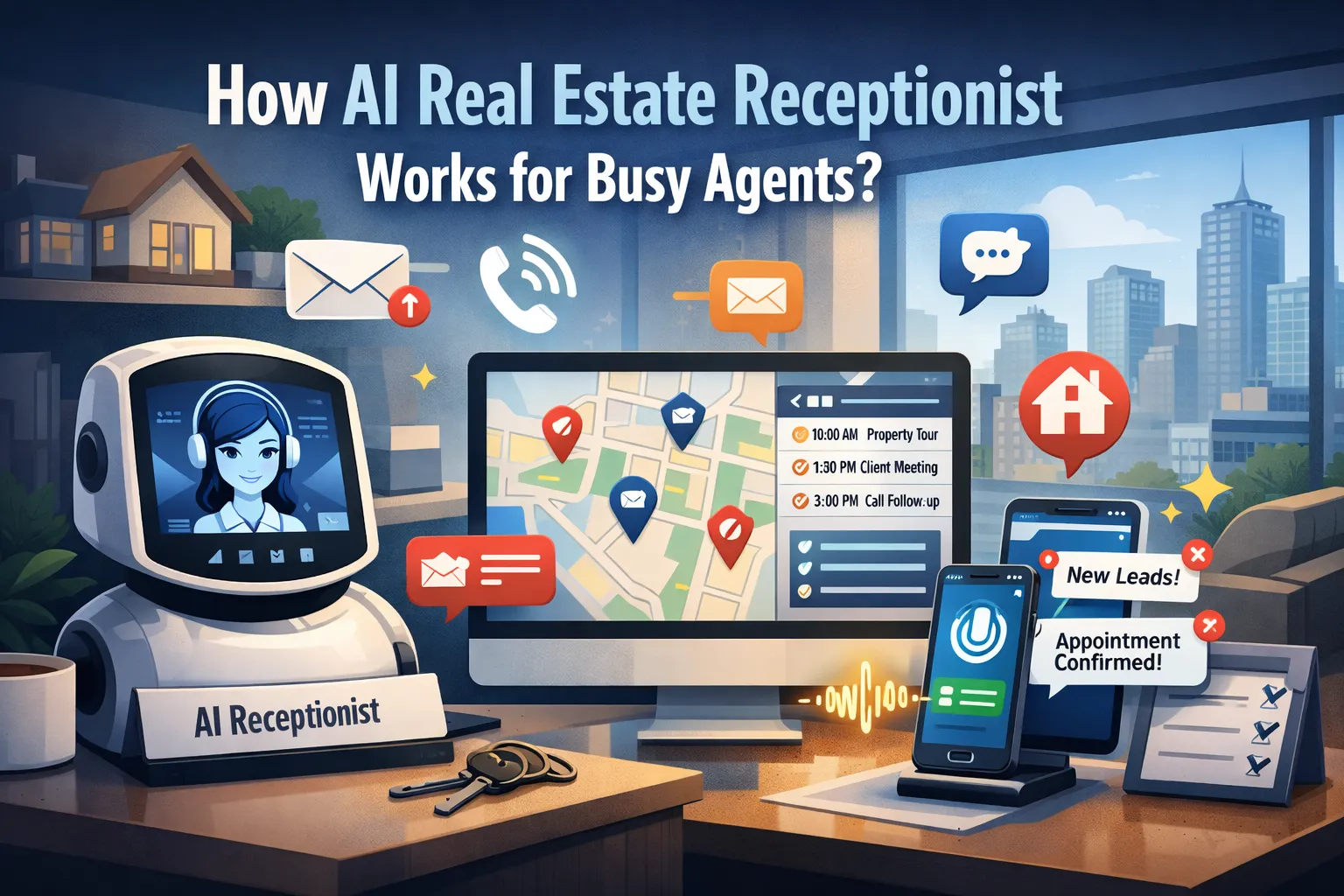
An AI real estate receptionist is an advanced software solution designed to manage inbound communications for property professionals using voice AI and natural language processing (NLP). Unlike a standard voicemail or a basic answering service, this technology understands user intent, allowing it to hold intelligent conversations with callers. It functions as a virtual assistant that can execute lead qualification, answer property-specific questions, and perform automated scheduling directly into your calendar.
These systems leverage large language models (LLMs) to generate context-aware responses, ensuring that callers feel heard and understood. By integrating with your existing real estate technology stack, such as your CRM, the AI ensures that data flows smoothly between the phone call and your client database. The primary goal is to eliminate the operational overhead associated with missed calls while maintaining a high level of customer experience (CX) through instant lead response and human-like latency.
| Feature | Traditional Answering Service | AI Real Estate Receptionist |
|---|---|---|
| Availability | Usually 24/7, but expensive for after-hours | True 24/7 coverage including holidays |
| Response Time | Hold times common during peak hours | Instant, zero hold time |
| Scalability | Limited by staff numbers | Unlimited concurrency |
| Knowledge Base | Limited to basic scripts | Access to dynamic property data |
| Booking Capability | Manual entry, prone to errors | Bi-directional calendar sync |
| Cost | High monthly retainer + per minute fees | Flat rate or low usage-based pricing |
14 Creative Ways AI Real Estate Receptionist Works for Busy Agents
Implementing an AI solution goes beyond simply answering the phone. It fundamentally changes how you manage your workflow and interact with prospects. To truly understand the value, we must look at the specific operational mechanics. Below are 14 distinct ways this technology serves as a powerhouse for your agency, ensuring you never miss a commission due to a missed connection.
1. Instant Lead Qualification and Filtering
One of the biggest time-drains for an agent is separating serious buyers from “tire kickers.” An AI real estate receptionist utilizes advanced NLP to ask pre-set qualifying questions regarding budget, timeline, and mortgage pre-approval status. By analyzing the caller’s responses, the system scores the lead immediately. If you want to dive deeper into the mechanics of how this technology filters prospects, you can read about what is an ai receptionist. This ensures that when you do pick up the phone or return a call, you are prioritizing prospects who are ready to transact, significantly improving your lead conversion rates.
2. Autonomous Appointment Scheduling
The back-and-forth friction of finding a mutual time for a showing can kill a deal’s momentum. Through bi-directional calendar sync, the AI can access your real-time availability and offer open slots to the caller instantly. It handles the entire booking process without you lifting a finger. This capability is often powered by specialized AI appointment booking protocols that prevent double-booking and automatically account for drive time between locations. This automation allows you to wake up to a calendar filled with showings rather than administrative tasks.
3. After-Hours Lead Capture
Real estate is not a 9-to-5 job, yet you cannot be awake 24 hours a day. Many potential buyers browse listings in the evenings after work and call immediately. A human receptionist service charges a premium for nights and weekends, but an AI solution operates 24/7 without fatigue. By utilizing a 24/7 call answering service, you capture leads at 10 PM on a Saturday just as effectively as 10 AM on a Monday. This ensures you are the first agent to respond, which is often the deciding factor in securing representation.
4. Intelligent Call Routing Based on Urgency
Not every call requires your immediate attention, but some demand it. AI systems employ intelligent call routing to distinguish between a vendor calling about a sign installation and a cash buyer wanting to see a house immediately. Using sentiment analysis, the AI can detect urgency in a caller’s voice and route high-priority calls directly to your mobile device while sending lower-priority administrative calls to a virtual receptionist service workflow or voicemail. This triage system protects your focus while ensuring critical business is never delayed.
5. Multilingual Support for Diverse Markets
In cosmopolitan real estate markets, language barriers can result in lost opportunities. An AI system can switch languages instantly based on the caller’s speech, providing a localized experience. This is particularly vital for agents working in diverse communities. To understand how this impacts global reach, consider how bilingual ai receptionists can engage non-English speaking investors or buyers, making them feel comfortable and valued from the very first interaction, thereby expanding your total addressable market.
6. Seamless CRM Data Entry
Manual data entry is the bane of many agents’ existence. An AI receptionist integrates directly with platforms like Salesforce, HubSpot, or GoHighLevel. As the conversation occurs, the AI transcribes the call, extracts key entities (like names, price points, and addresses), and populates your CRM automatically. For a deeper look at how this connectivity works, you can explore our app integration capabilities. This ensures your database is always up to date and clean, allowing for better marketing automation down the line.
7. Managing Open House Inquiries
Leading up to a busy weekend of open houses, agents are flooded with calls asking for times, addresses, and gate codes. An AI can handle this high concurrency volume easily, providing accurate details to dozens of callers simultaneously. By deploying an AI auto attendant, you ensure every potential attendee gets the information they need to show up, increasing foot traffic and the potential for offers, all while you are busy preparing the property.
8. Property Management Coordination
For agents who also handle property management, the volume of tenant calls can be overwhelming. An AI receptionist can act as a first line of defense, categorizing maintenance requests and dispatching them to vendors based on your predefined rules. This type of automated call answering service reduces the noise in your day, allowing you to focus on sales while ensuring tenants receive a responsive service experience, which is crucial for lease renewals and landlord retention.
9. Spam and Robocall Filtering
Real estate agents effectively publish their cell phone numbers to the world, making them prime targets for spam. An AI receptionist screens calls effectively, challenging robocalls and blocking known spam numbers before your phone even rings. This significantly reduces distraction. By implementing the best AI answering service protocols, you reclaim your time and mental energy, ensuring that when your phone does ring, it is a legitimate business opportunity.
10. Automated Follow-Up Sequences
Capturing the lead is only step one; nurturing them is where conversion happens. Once a call is completed, the AI can trigger instant SMS or email follow-ups based on the conversation context. For example, if a caller asks about a specific listing, the system can instantly text them the brochure. You can learn more about how this aids retention in our article on ai receptionist customer service. This speed creates a “wow” factor that establishes your professionalism immediately.
11. Scalable Team Coordination
For team leads running a brokerage or a large group, distributing leads fairly and quickly is a challenge. An AI system can route calls to different agents based on round-robin rules or territory assignments. This functions similarly to a automated call routing system, ensuring that the right agent gets the right lead instantly. This reduces internal friction and maximizes the team’s overall speed to lead.
12. Providing Vendor Information
Agents often act as concierges, fielding calls asking for plumber or inspector recommendations. An AI can be programmed with your preferred vendor list. When a client calls asking for a roofer, the AI phone assistant can provide the contact details of your trusted partners via text. This reinforces your value as a resource center without requiring you to stop what you are doing to look up a phone number.
13. Event and Webinar Registration
If you host first-time homebuyer seminars or investment webinars, managing RSVPs via phone is tedious. An AI receptionist can register callers for events, add them to the guest list, and trigger calendar invites. Utilizing an AI scheduling assistant for event management streamlines the administrative burden and ensures higher attendance rates through automated reminders.
14. Cost-Effective Scaling
Hiring a full-time assistant involves salaries, payroll taxes, and benefits. An AI solution provides enterprise-level capability for a fraction of the cost. This operational efficiency allows you to reinvest savings into marketing or lead generation. Agencies looking to offer this to their own clients can even explore a white label answering service model to add a new revenue stream while solving a critical pain point for their team.
What Industries Benefited By AI Receptionist?
While real estate agents see massive benefits, the underlying technology of voice AI and intelligent automation is industry-agnostic. Any sector that relies on appointment setting and high-touch client communication can experience significant ROI.
- Real Estate Agents: High-volume agents and real estate agents use AI to manage listing inquiries and coordinate showings without missing a beat during busy weekends.
- Legal Services: Law firms utilize a virtual receptionist for law firms to handle sensitive client intake, ensuring confidentiality and 24/7 availability for urgent legal services & law firms.
- Healthcare: Clinics and private practices deploy AI to manage patient scheduling and FAQ handling, reducing administrative strain on front-desk staff in private healthcare clinics.
- Home Services: Plumbers, electricians, and HVAC technicians use AI to capture emergency service calls and dispatch crews efficiently, a staple for home services businesses.
Which AI Receptionist Provider Should You Choose?
When selecting an AI receptionist, you must look for a provider that balances advanced technical capability with ease of use. The market is flooded with basic chatbots, but true voice AI requires neural text-to-speech engines that sound indistinguishable from humans. You need a solution that offers robust data privacy compliance (GDPR/HIPAA) and deep integration with your existing tools.
The DBT AI establishes itself as the premier choice for property professionals. Our platform is built specifically to handle the nuance of appointment setting and lead management. We offer features like intelligent call routing and instant CRM updates that reduce your operational overhead immediately. Unlike generic tools, The DBT AI understands the context of a sale. We invite you to explore our full features list to see how our proprietary logic outperforms standard solutions.
Conclusion
The real estate industry is moving toward a future where speed and data dictate success. By 2026, it is predicted that the majority of initial client interactions will be managed by intelligent systems. Adopting an AI real estate receptionist is no longer just a competitive advantage; it is becoming a necessity for maintaining a viable business model. The DBT AI offers you the ability to clone your best administrative traits—efficiency, politeness, and accuracy—and scale them infinitely.
Future trends indicate a shift toward even more predictive assistance, where AI will not just answer calls but anticipate client needs based on market data. Don’t let another commission slip through the cracks because you were busy serving another client.
Let us demonstrate The DBT Ai and show you how to automate your growth today.
Frequently Asked Questions (FAQS)
How does an AI receptionist handle complex property questions?
Advanced AI receptionists access a knowledge base you provide. While they handle most inquiries regarding price, location, and features, complex negotiation questions are routed to you via intelligent call routing. For more on this, check out our insights on ai receptionists operation.
Will my clients know they are talking to a robot?
Modern voice AI utilizes neural text-to-speech technology that includes natural pauses and intonation. The human-like latency makes the conversation feel organic. You can listen to examples in our ai receptionist demo article.
Is the AI compliant with data privacy laws?
Yes, reputable providers like The DBT AI adhere to strict data privacy standards, including GDPR and HIPAA compliance, ensuring your client data is secure during lead qualification and storage.
Can the AI integrate with my specific calendar?
Yes, most top-tier systems utilize bi-directional calendar sync to read your availability in real-time and write new appointments directly to Google Calendar, Outlook, or iCloud. Read more about ai scheduling assistant capabilities.
What happens if the AI cannot understand the caller?
If the user intent is unclear or the query falls outside the AI’s training, the system is designed to gracefully transfer the call to a human agent or take a detailed message for immediate review.