You can be doing “right” and still lose revenue for one simple reason: calls go unanswered, follow-ups arrive too late, and high-intent prospects get stuck in voicemail or long hold times. The result is predictable—missed bookings, wasted ad spend, and a calendar that looks busy but not profitable.
Reliable AI appointment setter software fixes that gap by responding instantly, understanding what the caller wants, and booking meetings in seconds—without adding headcount or increasing operational.
What is an AI Appointment Setter Software?
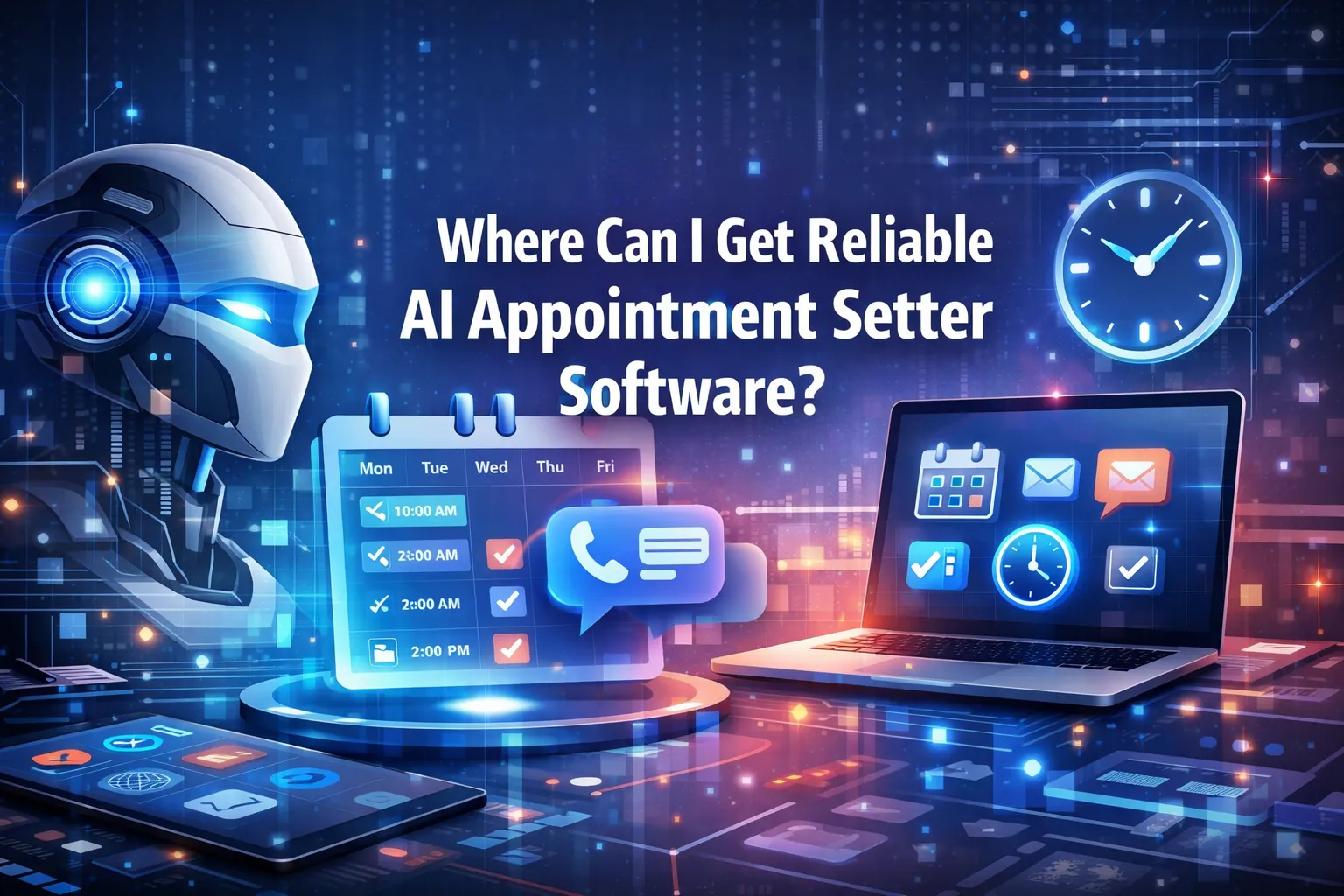
Reliable AI appointment setter software is a voice-first system that uses conversational AI, voice AI, natural language processing (NLP), and large language models (LLMs) to detect user intent during live conversations, qualify leads, and schedule appointments automatically.
What makes it “reliable” isn’t only that it can talk—it’s that it can consistently real-world business conditions:
- High concurrency (multiple at the same time).
- Human-like latency (no awkward delays) bi-directional sync (to prevent double-booking).
- Intelligent call routing (to move the right caller to the right outcome).
- Instant lead response (so leads don’t go cold).
- Sentiment analysis (to identify urgency and buying signals).
- CRM integration (Salesforce, HubSpot, GoHighLevel).
- Data privacy (GDPR/HIPAA compliance).
The core function of this software goes beyond simple answering. It integrates directly with your business infrastructure to perform lead Qualification and execute bi-directional calendar sync. This means the AI can read your calendar availability in real-time, offer slots to the lead, and write the appointment back to your schedule without double-booking.
When we discuss reliability in this context, we refer to systems capable of high concurrency—handling unlimited simultaneous calls without a busy signal—and maintaining human-like latency. A reliable AI appointment booking system ensures that whether a customer calls at 2:00 PM or 2:00 AM, the quality of customer experience (CX) remains consistent, accurate, and professional.
If you want a deeper foundational overview before selecting a tool, this guide on what is ai receptionist clarifies how modern AI reception differs from older IVR systems.
AI appointment setter vs. traditional (comparison table)
Here’s the practical difference most operators feel in week one—speed, accuracy, and scalability.
| Capability | Reliable AI appointment setter software | Traditional receptionist / answering service |
|---|---|---|
| Availability | 24/7 coverage with consistent performance | Limited to staffed hours and breaks |
| Response time | instant lead response within seconds | delays during and-hours |
| Handling volume | concurrency without busy signals | queues, missed calls, overflow |
| Scheduling | bi-directional calendar sync reduces conflicts | manual booking, human error |
| Routing | intelligent call routing by user intent | depends on scripts and training |
| Lead Qualification | automated lead Qualification + sentiment analysis | subjective, inconsistent screening |
| CRM updates | CRM integration (Salesforce, HubSpot, GoHighLevel) in real time | manual entry or delayed updates |
| Compliance | supports data privacy (GDPR/HIP compliance) policies | varies widely by vendor and process |
| Cost structure | predictable subscription operations | payroll + training + turnover costs |
Key Reliability Factors to Evaluate Before You Choose a Provider
Not all tools that “book appointments” are dependable under pressure. The difference between a demo that sounds good and a system that performs for months comes down measurable reliability traits.
1) Uptime and failure handling (what happens when something breaks)
A reliable platform isn’t just “online”—it must fail safely. If calendar connection drops or a CRM token expires, the system should:
- Detect the issue
- log it
- route calls to a fallback path (like taking a message, offering alternatives, or escalating)
This matters because reliability is not only performance—it’s continuity of customer experience (CX).
2) True instant lead response (not “fast,” but immediate)
Lead conversion drops sharply when response time stretches beyond minutes. Reliable voice AI should answer quickly and move straight into intent capture:
- “Are you calling to book,chedule, or ask a question?”
- “Which service are you looking for?”
- “What’s the best day and time?”
That speed is often the highest ROI driver in AI appointment setting.
3) Human-like latency that keeps callers engaged
If your system pauses too long, callers assume it’s broken or “robotic” and hang up. Reliability includes pacing.
Look for human-like latency created by strong voice AI pipelines and neural text-to-speech that sounds natural while responding.
4) NLP accuracy for real-world requests
Callers rarely speak in clean, form-like inputs. They say things like:
- “I need next Thursday, too early”
- “Can you move it to after my kid’s appointment?”
- “I talked to someone last time, I think her name was Jen?”
Reliable natural language processing (NLP) and LLMs should interpret these requests and confirm details without forcing callers into rigid flows.
5) User intent detection (the engine behind conversions)
Reliability means correctly identifying user even when callers are unclear.
Strong systems can separate:
- sales inquiries vs. support vs. billing
- new patient/customer calls vs. existing client reschedules
- urgent requests vs. general questions
If intent detection is weak, everything downstream fails—routing, booking, lead qualification, and CX.
6) Lead Qualification that reflects your actual business rules
A serious AI appointment setter should qualify leads like a top-performing rep, using structured questions and sentiment analysis signalsExamples:
- Service fit (do they match your?)
- Budget or insurance type (if relevant)
- Timeline/urgency
- Location or service area
- sentiment analysis cues (frustrated, urgent, ready-to-buy)
If you’re mapping buying to automated outcomes, it’s worth reviewing how an ai receptionist that books appointments typically handles booking workflows end-to-end.
7) Bi-directional calendar sync (the non-negotiable reliability)
“Calendar integration” is not enough. You want bi-directional calendar sync so the:
- checks availability in real time
- books instantly
- updates changes both ways (reschedules/cancellations)
- prevents double-booking when staff manually add events
This is one of the biggest differences between a tool that looks good in a demo and a system that works during real operations.
8) Concurrency that survives peak hours and ad spikes
If you run ads, you already know what happens when calls cluster. Reliability means:
- no busy tone
- no dropped calls
- consistent during surges
Concurrency is also where many cheaper systems quietly fail.
9) Intelligent call routing that protects revenue
Routing is not just “press 1 for sales.” Modern intelligent call routing uses user intent plus rules such as:
- VIP callers
- existing customers vs. net-new
- language preferences
- location-based routing
When routing is tight, your team spends more time closing and less time filtering.
10. CRM integration that sales teams actually trust
If your AI doesn’t write clean, consistent data into the CRM, your pipeline becomes unreliable.
Reliable CRM integration (Salesforce, HubSpot, GoHighLevel) should:
- create or update leads/contacts automatically
- log call outcomes and appointment details
- tag lead sources
- trigger workflows (texts/emails/tasks)
When you’re evaluating tools, check how deeply the platform supports real integrations rather than “generic webhook only.” For context, The DBT outlines supported connections on its app integration page.
11) Security posture and data privacy (GDPR/HIPAA compliance)
If you operate in regulated environments, reliability includes compliance readiness.
At a minimum, validate:
- encrypted storage and transfer
- access controls and audit logs
- retention policies
- data privacy (GDPR/HIPAA compliance) alignment, where applicable.
12) Reporting that proves ROI (not vanity metrics)
You be able to measure:
- lead conversion by source and intent
- booking rate
- missed-call reduction
- time-to-response
- call reasons and drop-off points
- cost per booked appointment
If you can’t measure it, you can’t improve it—and reliability becomes a guess.
For additional evaluation criteria, this resource on ai receptionist benefits can help connect feature performance to tangible cost and CX outcomes.
Which AI Appointment Setter Provider Should You Choose?
The market is flooded with generic chatbots, but for a solution that truly acts as a reliable appointment setter, you need a provider that specializes in voice automation and deep integration.
The DBT AI stands out as a premier solution for businesses that refuse to compromise on quality. We combine proprietary automation logic with top-tier voice AI to deliver an experience that is indistinguishable from a human operator. Our platform is built on the pillars of intelligent call routing and neural text-to-speech, ensuring that your brand voice is preserved in every interaction.
For businesses looking to integrate these tools, The DBT AI features include native connections to your existing tech stack. Whether you need a 24/7 call answering service or a complex outbound sales agent, our infrastructure is designed to handle the load. You can learn more about how our system functions by reading about our ai receptionist system.
Unlike generic platforms, we allow for extensive customization. If you are an agency, you might be interested in our white label answering service, which allows you to resell this powerful technology under your own brand.
TheDBT.ai Spotlight
At The DBT AI, we do not just provide software; we provide a strategy. Our specific automation logic is designed to minimize lead decay. When a lead enters your funnel, our AI analyzes the user intent and sentiment instantly. It then checks your CRM for context—is this a new lead or a returning client?—and tailors the conversation accordingly.
We solve the “booking friction” problem by integrating directly with your calendar. The AI does not just say “we will call you back”; it says, “I see you have an opening at 3 PM, shall I lock that in for you?” This proactive approach is why our clients see a significant boost in confirmed appointments. You can see this logic in action with our AI auto attendant capabilities.
Conclusion
The era of manual appointment setting is drawing to a close. Future trends indicate that businesses adopting voice AI and conversational AI will dominate their markets by simply being faster and more available than their competitors. The technology has matured from experimental to essential.
To stop losing revenue to missed calls and inefficient scheduling, you must act now. Schedule a trial today and witness how The DBT AI can transform your communication strategy.
Frequently Asked Questions (FAQS)
How accurate is AI appointment setter software in understanding accents?
Modern NLP engines are trained on vast datasets encompassing diverse global accents and dialects. Reliable software like The DBT AI boasts high recognition rates, ensuring that customer experience (CX) remains positive regardless of the caller’s background.
Can the AI handle rescheduling and cancellations?
Yes. Through bi-directional calendar sync, the AI can identify an existing appointment, remove it from the calendar, and offer new available slots in real-time. It can also trigger automated confirmation emails or texts regarding the change.
Is it difficult to integrate AI with my current CRM?
Most modern AI platforms are designed for plug-and-play app integration. Whether you use Salesforce, HubSpot, or a custom solution via API, the setup is typically quick and does not require extensive coding knowledge.
How do I know if an AI appointment setter is actually reliable?
Check real performance factors, concurrency during peak hours, human-like latency, bi-directional calendar sync accuracy, and whether CRM integration stays consistent without manual cleanup.
Can AI appointment setter software qualify leads, or does it only book?
Yes— tools handle lead Qualification using structured questions plus sentiment analysis, then route or book based on user intent and fit.
What integrations should reliable AI setter software support?
At minimum, calendar and CRM integration should be stable; many teams prioritize CRM integration with Salesforce, HubSpot, and GoHighLevel, plus dependable bi-directional calendar sync.
Is AI appointment setting safe for and legal calls?
It can be, if the provider supports data privacy (GDPRIPAA compliance) requirements, access controls, and secure policies appropriate to your workflow.
How long does it take to launch phone booking for a business?
Many businesses can launch quickly for core booking flows, but timelines depend on call routing rules, CRM integration complexity, and how detailed your lead qualification logic is.