Imagine a potential client calling your business at 7:45 PM. They are ready to buy, but your office is closed. They hear a generic voicemail greeting, hang up, and immediately dial your competitor who uses an automated system to answer. That single missed interaction isn’t just a lost call; it is lost revenue, wasted marketing spend, and a dent in your brand reputation.
In an era where consumer patience is measured in milliseconds, businesses cannot afford to let operational hours dictate lead capture. This is where the AI voice receptionist shifts the paradigm. It is no longer just about answering phones; it is about deploying intelligent automation to manage high-volume communication without increasing headcount.
By leveraging conversational AI and natural language processing (NLP), modern voice agents understand user intent, manage complex scheduling, and integrate seamlessly with your tech stack. This article analyzes the specific roles an AI voice receptionist plays in business automation and how it transforms operational efficiency.
What Is an AI Voice Receptionist?
An AI voice receptionist is a software-driven telephony solution that uses large language models (LLMs) and voice AI to simulate human conversation. Unlike traditional IVR (Interactive Voice Response) systems that force callers to “press 1 for sales,” an AI receptionist listens, understands context, and responds with human-like latency.
At its core, the technology relies on a sophisticated stack:
- Speech-to-Text (STT): Transcribes the caller’s voice instantly.
- NLP & LLM Processing: Analyzes the text to determine sentiment and intent.
- Text-to-Speech (TTS): Generates a natural-sounding vocal response using neural text-to-speech engines.
The goal is not to trick the caller, but to provide an experience so seamless that the distinction between human and machine becomes irrelevant to the outcome. Whether it is handling a simple query or executing a complex AI appointment booking workflow, the system operates with a level of consistency that human staff simply cannot maintain over 24-hour shifts.
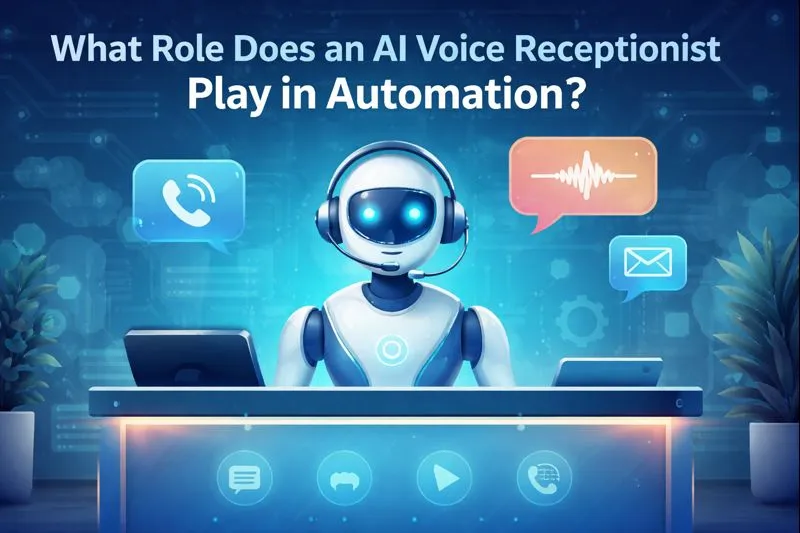
13 Roles an AI Voice Receptionist Plays For Your Business Automation
Implementing voice automation is not just about replacing a front-desk employee; it is about augmenting your entire operational workflow. Here are the thirteen critical roles this technology fulfills.
1. The 24/7 Lead Capture Agent
The modern consumer expects immediate gratification, regardless of the time zone. An AI voice receptionist ensures that your business is effectively open every second of the year. By utilizing a 24/7 call answering service, you capture leads that would otherwise vanish into voicemail, drastically increasing your speed-to-lead ratio.
2. The Intelligent Gatekeeper
Not every call requires the attention of your senior staff. Through intelligent call routing, the AI assesses the nature of the inquiry and directs it to the appropriate department only when necessary. If you utilize an automated call routing system, you ensure that high-value technical queries reach specialists while the AI handles routine FAQs autonomously.
3. The Appointment Setter
The back-and-forth friction of finding a meeting time is a major productivity killer. An AI receptionist utilizes bi-directional calendar sync to check your real-time availability and book slots instantly. You can see how this works by exploring our features which allow the AI to read and write to your schedule simultaneously, preventing double-bookings.
4. The Lead Qualifier
Before a prospect speaks to a sales representative, they should be vetted for budget, authority, and timeline. An AI phone assistant can be programmed to ask specific qualifying questions, ensuring your sales team focuses their energy solely on high-intent prospects.
5. The CRM Data Entry Clerk
Manual data entry is prone to human error and eats up valuable time. Advanced voice AI integrates directly with platforms like Salesforce, HubSpot, and GoHighLevel. For a deeper understanding of how this connectivity works, you can review our app integration capabilities that automatically log call summaries and caller details into your database.
6. The Scalability Manager
Human receptionists can only handle one call at a time, leading to busy signals during peak hours. An AI system handles unlimited concurrency, meaning it can speak to 5, 50, or 500 callers simultaneously. An automated call answering service ensures that a sudden spike in marketing traffic never results in a bottleneck.
7. The Sentiment Analyst
Understanding how your customers feel is as important as understanding what they say. Through sentiment analysis, the AI detects frustration or urgency in a caller’s voice. This data is critical for businesses looking to implement a best AI answering service that prioritizes escalating upset customers to human managers immediately.
8. The Cost Controller
Operational overhead kills profit margins. By automating the front-line communication, businesses significantly reduce the salary, benefits, and training costs associated with human staff. Transitioning to an online phone answering service converts a variable, expensive labor cost into a fixed, predictable software expense.
9. The Outbound Nurturer
Voice automation isn’t strictly inbound; it can also manage outbound follow-ups for appointment reminders or reactivation campaigns. An AI scheduling assistant can proactively call existing clients to reschedule missed appointments, recovering revenue that would otherwise be lost to attrition.
10. The Brand Consistency Guardian
Humans have bad days; AI does not. Every caller receives the exact same brand name.
11. The Multi-Language Support Agent
In a globalized market, language barriers restrict growth. AI models can switch between languages instantly based on the caller’s preference. An AI receptionist equipped with multilingual capabilities allows local businesses to serve diverse communities without hiring specialized bilingual staff.
12. The Compliance Officer
Industries like healthcare and law require strict adherence to data privacy. Secure AI voice solutions ensure that all data handling meets GDPR and HIPAA compliance standards. For example, a virtual receptionist for law firms ensures client confidentiality while efficiently processing intake information.
13. The Analytics Engine
Every interaction generates data points that can be analyzed for business intelligence. By using an AI business phone system, managers can access dashboards showing peak call times, common customer objections, and conversion rates, enabling data-driven decision-making.
What Industries Benefited By AI Voice Receptionists?
Any business that relies on inbound calls for can benefit, but these tend to see fast results:
Home Services
Plumbers, HVAC technicians, and roofers are often in the field and cannot answer phones. A missed emergency call is a job lost to a competitor. Utilizing AI ensures that home services companies capture every emergency request and dispatch crews efficiently.
Healthcare and Medical
Patient engagement is critical, but front-desk burnout is real. Private practices use AI to manage appointment reminders and routine questions. Private healthcare clinics benefit immensely by freeing up medical staff to focus on patient care rather than administrative phone tag.
Legal Services
Law firms deal with high-stress clients who need immediate reassurance. An AI agent can handle the initial intake script for legal services & law firms, ensuring that valid cases are prioritized while the system filters out solicitors or wrong numbers.
Marketing Agencies
Agencies must practice what they preach regarding automation and efficiency. By integrating AI voice handling, marketing agencies use voice AI to answer pricing questions and book consultations instantly, capitalizing on the impulse motivation of potential clients.
Coaching and Consulting
For solopreneurs, every minute spent on the phone is a minute not billed. Coaches & consultants utilize AI to qualify leads before they ever get on a strategy call, protecting their time.
AI Automation Agencies
Naturally, those selling automation services need robust infrastructure. AI automation agencies use these tools as a proof-of-concept to showcase reliability and technical sophistication to potential buyers.
Which AI Voice Receptionist Provider Should You Choose?
Selecting a provider requires looking beyond the basic ability to answer a call. You must evaluate the “brain” behind the voice.
Key selection criteria include:
- Latency: Does the voice respond instantly, or is there an awkward 3-second pause?
- Context Retention: Can the AI remember what was said at the start of the call?
- Integration Ecosystem: Does it talk to your CRM and Calendar?
Why The DBT AI Stands Out?
At The DBT AI, we focus on the intersection of empathetic conversation and rigid business logic. We don’t just provide a talking bot; we provide a fully integrated virtual receptionist service designed to drive revenue.
Our system excels in bi-directional calendar sync, meaning it doesn’t just read your calendar—it understands the nuances of your schedule. It utilizes intelligent call routing to ensure that while automation handles the volume, your human touch is applied exactly where it matters most. With native CRM integration, The DBT AI turns your phone system into a data-gathering asset, enriching your customer profiles with every interaction.
Whether you need a simple AI auto attendant or a complex, multi-step qualification agent, our platform is built to adapt to your specific business logic.
Conclusion
The role of the AI voice receptionist has evolved from a simple answering machine to a central pillar of business automation strategies. It solves the “iron triangle” of customer service: it is fast, it is cheap, and it is high-quality—simultaneously.
By adopting this technology, businesses eliminate the operational overhead of managing phone lines and shift their focus toward growth and service delivery. As we move forward, the integration of voice AI with predictive analytics will only deepen, making these systems not just reactive but proactive participants in your business success.
If you are ready to stop missing calls and start automating your appointment setting, let us demonstrate The DBT Ai.
Frequently Asked Questions (FAQS)
How does the AI handle complex questions it hasn’t been trained on?
When an AI voice receptionist encounters a query that falls outside its knowledge base or confidence threshold, it utilizes intelligent fallback logic. It can politely inform the caller that it will connect them with a human specialist or take a detailed message for priority review. This ensures the customer experience (CX) remains positive even during edge cases.
Can the AI voice receptionist integrate with my existing calendar?
Yes, this is a core function of a robust system. The DBT AI utilizes bi-directional calendar sync to read your availability in real-time and write new appointments directly to your schedule. Whether you use Google Calendar, Outlook, or specialized booking software, the AI phone answering service acts as an extension of your current tools.
Is the setup process difficult for non-technical business owners?
Modern AI platforms are designed for ease of use. While the underlying technology involves complex NLP and LLMs, the user interface is typically drag-and-drop or prompt-based. You can define your business hours, upload your knowledge base, and configure your call flows without writing code. You can schedule a trial to see how user-friendly the onboarding process is.
How does the AI ensure data privacy and security?
Data privacy is paramount, especially for legal and medical sectors. Enterprise-grade AI voice receptionists rely on encrypted data transmission and storage protocols. They are designed to be compliant with major regulations like GDPR and HIPAA, ensuring that sensitive client information collected during the AI appointment booking process is protected.
Will my customers know they are talking to a robot?
The goal of high-end voice AI is “human-like latency” and natural intonation. While transparency is often recommended for ethical reasons, the quality of neural text-to-speech has advanced to the point where many callers cannot distinguish the AI from a human. The conversation flows naturally, with the AI utilizing filler words and understanding interruptions, providing a virtual receptionist service experience that feels personal and authentic.