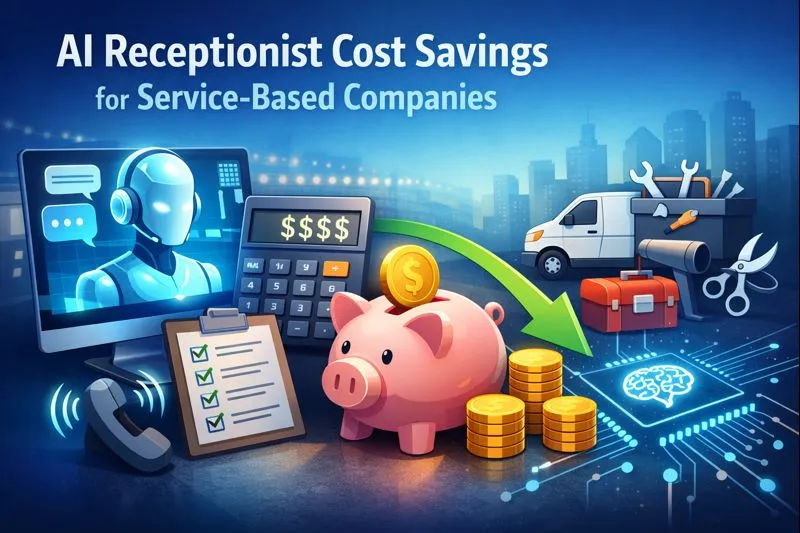
Service-based companies lose thousands of dollars in potential revenue every month simply because the phone goes unanswered. Whether it is due to peak hour congestion, after-hours inquiries, or staff being tied up with administrative tasks, every missed call represents a lead that likely went to a competitor. Implementing an AI receptionist cost savings strategy is no longer just about cutting a salary line item; it is about fundamentally restructuring operational overhead to capture maximum revenue with minimal input.
For law firms, medical clinics, and home service providers, the front desk is the heartbeat of revenue generation. However, relying solely on human labor creates a bottleneck. Human receptionists take breaks, go home at 5 PM, and can only handle one conversation at a time. The financial impact of these limitations is often underestimated until it is compared against the capabilities of voice AI.
By integrating large language models (LLMs) and natural language processing (NLP), businesses can now deploy a digital workforce that never sleeps. This shift moves customer service from a variable, high-friction cost center to a fixed, high-efficiency asset. This article provides a comprehensive analysis of the financial benefits of automation, detailing how AI receptionist cost savings are achieved through salary elimination, increased lead conversion, and operational efficiency.
What Is An AI Receptionist?
An AI receptionist is an advanced software solution powered by conversational AI that handles inbound and outbound calls with human-like latency. Unlike old-fashioned IVR systems that require callers to press buttons, these agents understand user intent through complex neural text-to-speech and NLP algorithms. They can hold natural conversations, answer frequently asked questions, and execute tasks like qualifying leads or booking meetings.
The core utility lies in its ability to integrate with business tools. Through intelligent call routing and bi-directional calendar sync, the system manages schedules in real-time without human intervention. To understand the foundational technology behind this, you can read more about what is an ai receptionist and how it differentiates from standard answering machines.
AI vs. Traditional Methods Comparison
The following table outlines the structural cost and performance differences between hiring a human receptionist, using a call center, and deploying an AI solution.
| Feature | Human Receptionist | Outsourced Call Center | AI Receptionist (The DBT AI) |
|---|---|---|---|
| Annual Cost | $35,000 – $50,000+ | Variable ($1 – $2.50/min) | Fixed Monthly (Fraction of salary) |
| Availability | 40 hours/week | 24/7 (often with surcharges) | 24/7/365 |
| Concurrency | 1 call at a time | Dependent on agent pool | Unlimited simultaneous calls |
| Response Time | 10 – 60 seconds | 15 – 45 seconds | Instant (< 1 second) |
| Training Required | Weeks to Months | Constant calibration | Pre-trained LLMs |
| Data Entry | Prone to human error | Manual logging | 100% accurate CRM integration |
AI Receptionist Cost Savings for Service-Based Businesses
The financial argument for AI adoption goes beyond the sticker price of software versus salary. It encompasses the total cost of ownership, opportunity costs, and efficiency gains. AI receptionist cost savings for service-based businesses are realized through a combination of eliminating fixed overhead and increasing the velocity of revenue capture.
Below are the primary areas where automation directly impacts the bottom line.
1. Elimination of Salaries, Benefits, and Taxes
The most immediate impact on the ledger is the removal of a full-time salary. In major metro areas, a qualified receptionist commands between $40,000 and $55,000 annually. When you factor in payroll taxes, health insurance, paid time off, and 401(k) contributions, the true cost to the business is often 1.25x to 1.4x the base salary. An AI solution operates on a predictable, low monthly subscription model. This allows small businesses to reallocate tens of thousands of dollars toward marketing or product development rather than administrative payroll.
2. Zero Recruitment and Training Costs
Turnover in administrative roles is notoriously high, leading to a perpetual cycle of recruiting, hiring, and training. The hidden costs of this cycle—advertising the role, interviewing, and the productivity dip during onboarding—average $4,000 to $7,000 per new hire. An AI receptionist requires no onboarding period. Once the system is configured with your business logic and tone, it performs consistently forever. You can see how this stability supports operations by looking at how a ai receptionist system maintains continuity.
3. Capturing After-Hours Revenue
Service businesses often operate 9-to-5, but their customers do not. A leak in the sales funnel occurs when potential clients call during evenings or weekends and hit voicemail. Statistics show that nearly 80% of callers will not leave a voicemail; they simply hang up and call the next competitor. the system pays for itself immediately.
4. Unlimited Scalability and Concurrency
Human receptionists have a physical limit: they can only speak to one person at a time. If two potential clients call simultaneously, one goes to hold or voicemail, creating a poor customer experience (CX). AI utilizes infinite concurrency, meaning it can handle 5, 50, or 500 calls simultaneously without a drop in quality. This is vital for businesses that run ad campaigns causing sudden spikes in call volume, ensuring no marketing dollars are wasted on missed inbound traffic.
5. Automated Lead Qualification
Not every caller is a paying customer; many are solicitors or unqualified leads that waste valuable staff time. AI acts as a sophisticated gatekeeper, asking pre-set qualifying questions to determine user intent before passing the data to your team. This reduces operational overhead by ensuring your highly paid sales staff or practitioners only spend time on revenue-generating activities. An automated call answering service can filter noise from value effectively.
6. Reduction in No-Show Rates
For clinics and consultants, a no-show is a direct loss of revenue that cannot be recovered. While humans can make reminder calls, it is a tedious task often skipped when the office gets busy. AI can automate the confirmation process via voice or text, updating the schedule instantly. Reducing no-show rates by even 15% can add tens of thousands of dollars to the annual top line, a key factor when considering ai receptionist benefits.
7. Seamless CRM Data Entry
Manual data entry is a significant source of operational friction and error. A human receptionist might forget to log a lead source or misspell a client’s name in the CRM. AI integrates directly with platforms like Salesforce, HubSpot, and GoHighLevel, logging call transcripts, sentiment analysis, and contact details with 99.9% accuracy. This automation saves hours of administrative work weekly. You can learn more about how this works on our app integration page.
8. Elimination of Outsourcing Variable Costs
Many companies try to solve the coverage problem with outsourced answering services. While this covers the phones, these services often charge by the minute. As your business grows, your costs skyrocket, punishing out a form or calls, the vendor who responds first usually wins the business. AI responds instantly. There is no “let me check the calendar” delay; the bi-directional calendar sync allows the AI to propose times and book slots in seconds. This instant gratification increases conversion rates significantly.
Deploying an ai appointment drives up salary demands. AI receptionists can switch between languages fluently, allowing you to service a broader demographic without hiring specialized personnel. This expands your total addressable market without increasing overhead. Businesses with global or diverse local clientele benefit immensely from a bilingual ai receptionist.
11. Consistency in Brand Messaging
Humans have bad days, get tired, or deviate from the script. This inconsistency can damage brand reputation. An AI follows the prompt and brand guidelines strictly, ensuring every customer receives the same high-level professional experience. This consistency builds trust and long-term brand equity, which indirectly supports pricing power and retention.
12. Office Space and Equipment Savings
Remote work is common, but receptionists often need a physical presence or at least a hardware setup (phones, computers, headsets). By moving the front desk to the cloud, businesses can downsize their physical footprint or eliminate hardware costs entirely. This is a substantial component of AI receptionist cost savings for lean startups and virtual companies utilizing an online phone answering service.
Industries Benefiting from AI Receptionist
While all service businesses can save money, specific verticals see a higher ROI due to their high transaction values and scheduling complexities.
Legal Services & Law Firms
Lawyers bill by the hour, meaning every minute spent on administrative tasks is a loss of billable time. A missed call from a potential client facing a legal emergency is a lost retainer. Using a virtual receptionist for law firms ensures 24/7 intake and qualification, allowing attorneys to focus solely on billable work while the AI filters out non-case-related inquiries.
Private Healthcare & Dental Clinics
Medical practices face high volumes of appointment rescheduling and basic FAQs regarding insurance or location. An AI receptionist significantly reduces the administrative burden on nursing staff. By automating patient engagement and appointment reminders via private healthcare clinics solutions, clinics reduce empty slots and administrative payroll simultaneously.
Med Spas & Aesthetic Clinics
This industry relies heavily on booking consultations and managing repeat treatments. The clientele expects a high-end, responsive experience. An AI agent handles high-volume booking requests during promotional periods without the need for temporary staff. Med spas & aesthetic clinics use AI to maintain a premium feel while keeping operational costs lean.
Home Services (Plumbing, HVAC, Electrical)
For contractors, an emergency call at 2 AM is often the most lucrative job of the week. If that call goes to voicemail, the homeowner calls the next provider on Google. AI ensures immediate response and dispatch coordination. Home services companies leverage this technology to secure emergency rates and recurring maintenance contracts without paying for a night-shift dispatcher.
Which AI Receptionist Provider Should You Choose?
When evaluating providers, look beyond basic “answering” capabilities. True AI receptionist cost savings require a system that integrates deeply with your tech stack. You need a solution that offers low latency, high reliability, and robust data protection (GDPR/HIPAA compliance).
The DBT AI stands apart as a comprehensive solution designed for ROI. We don’t just answer calls; we act as a full-service AI Appointment Setter. Our platform features:
- Human-Like Latency: Conversations feel natural, not robotic.
- Bi-Directional Sync: We read and write to your calendar in real-time.
- Deep Integrations: Seamless connection with Salesforce, HubSpot, and GoHighLevel.
- Intelligent Routing: Calls are directed based on sentiment analysis and user intent.
For businesses looking to implement a white label answering service or a direct enterprise solution, The DBT AI provides the infrastructure to scale.
Conclusion
The shift toward AI-driven front desk operations is inevitable for service-based companies aiming to remain competitive. The mathematics of AI receptionist cost savings are undeniable: for a fraction of the cost of a human employee, businesses gain 24/7 coverage, infinite scalability, and perfect data accuracy.
As large language models continue to evolve, these systems will only become more predictive and personalized. The businesses that adopt this technological innovation now will secure a significant advantage in efficiency and customer acquisition costs.
If you are ready to reduce overhead and stop losing revenue to missed calls, let us demonstrate The DBT Ai and show you the future of appointment setting.
Frequently Asked Questions (FAQs)
What is the average ROI of an AI receptionist?
Most service businesses see a return on investment within the first month. By eliminating a $3,500+ monthly salary and replacing it with a lower fixed cost, plus capturing just 1-2 additional clients per month via 24/7 call answering service, the ROI is typically over 500%.
Can AI receptionists handle complex scheduling?
Yes. Through bi-directional calendar sync and integration with tools like Calendly or proprietary EMRs, AI can manage complex time zones, buffer times, and multi-staff calendars more accurately than humans.
Is the AI voice indistinguishable from a human?
Modern neural text-to-speech technology has advanced to the point where latency and intonation are incredibly human-like. While sophisticated listeners may notice, the vast majority of interactions feel natural and conversational.
How does the AI handle angry or frustrated callers?
Advanced systems utilize sentiment analysis to detect frustration or aggression. The AI can be programmed to de-escalate the situation or intelligently route the call to a human supervisor if the sentiment score drops below a certain threshold.
Is my client data secure with an AI receptionist?
Leading providers like The DBT AI prioritize data privacy with strict adherence to GDPR and HIPAA compliance standards. All call logs and CRM integrations are encrypted to ensure client confidentiality.