It is 6:30 PM on a Friday. Your office is closed, your staff has gone home human staffing or accept the losses associated with voicemail. Today, that trade-off is obsolete. The adoption of conversational AI has democratized round-the-clock availability, but confusion remains regarding the investment required.
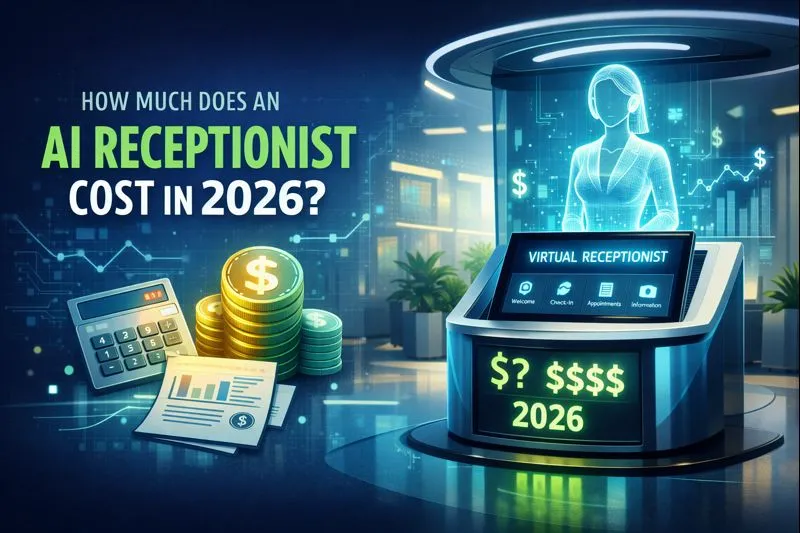
Business owners often ask: How much does an AI receptionist cost in 2026? The answer is not a single number but a spectrum of value. While a basic automated system might cost the price of a daily coffee, a fully integrated enterprise solution represents a larger, albeit highly profitable, investment.
This guide analyzes the financial landscape of voice AI, breaking down pricing tiers, operational overhead comparisons, and the Return on Investment (ROI) that makes the AI receptionist cost a strategic growth lever rather than a mere expense.
What Is An AI Receptionist?
Before assessing value, we must define the asset. An AI receptionist is not a glorified voicemail or a rigid IVR system that forces customers to “press 1 for sales.” It is a dynamic solution powered by natural language processing (NLP) and large language models (LLMs) designed to understand user intent.
Unlike static bots, these systems possess human-like latency and emotional intelligence. They can manage bi-directional calendar sync to book meetings in real-time, execute intelligent call routing based on the caller’s needs, and perform lead qualification before a human ever touches the phone.
When you invest in AI receptionist software, you are deploying a digital employee capable of handling infinite concurrency—meaning it can speak to 100 people simultaneously without frustration or fatigue.
AI Receptionist Cost Breakdown by Business Size
The market for AI voice automation has matured, resulting in distinct pricing tiers tailored is stopping the “leaky bucket” of missed calls. At this tier, the focus is on instant lead response and basic data capture.
An entry-level AI phone answering service in this range typically offers:
- After-hours and overflow call handling.
- Basic appointment scheduling directly into calendars like Google or Outlook.
- Simple message taking and forwarding via SMS or email.
While affordable, these plans may have limits on usage minutes or lack deep CRM integration. However, for a small business, capturing just two extra clients a month usually covers the annual cost.
Mid-Sized Growth Companies (20–100 Employees)
Estimated Cost: $800 – $2,000 per month
As organizations grow, operational overhead and complexity increase. Mid-sized companies require systems that can distinguish between a frustrated client and a hot lead, routing them differently using sentiment analysis.
At this investment level, you are looking at a robust AI scheduling assistant that includes:
- CRM integration (Salesforce, HubSpot, GoHighLevel) for automated data entry.
- Custom workflows for different departments (Sales vs. Support).
- Higher volume allowances (1,000+ minutes).
- Neural text-to-speech customization to match brand voice.
This tier is where efficiency gains skyrocket. By automating the mundane, your human staff focuses on high-level strategy rather than data entry.
Enterprise & High-Volume Operations (100+ Employees)
Estimated Cost: $2,500 – $10,000+ per month
For national service providers or large franchises, the AI receptionist cost shifts from a subscription model to a volume/customization model. These organizations need data privacy (GDPR/HIPAA compliance) and bespoke training on proprietary datasets.
An enterprise-grade automated call answering service delivers:
- Unlimited concurrent calls to handle massive spikes.
- API access for deep backend integration.
- Dedicated account management and custom prompt engineering.
- Detailed analytics on customer experience (CX) metrics.
Cost Comparison: AI vs. Traditional Solutions
To understand the true value, we must compare the AI investment against traditional alternatives. The following table contrasts a modern AI solution against hiring in-house staff or using a legacy call center.
| Feature | AI Receptionist | Human Receptionist | Outsourced Call Center |
|---|---|---|---|
| Monthly Cost | $200 – $2,000 | $3,500+ (Salary + Benefits) | $1,500 – $3,000 |
| Availability | 24/7/365 | 40 Hours/Week | Varies / Shift-based |
| Concurrency | Unlimited (No busy signals) | 1 Call at a time | Limited by agent availability |
| Training Time | Instant (Data upload) | 2-4 Weeks | 1-2 Weeks |
| Accuracy | 100% Data Entry Accuracy | Prone to human error | Variable quality |
| Response Time | Instant | Variable | Hold times common |
The math is straightforward. An AI virtual receptionist operates at a fraction of the cost while delivering superior availability.
Top 10 Factors Influencing AI Receptionist Pricing
While the tiered estimates above provide a baseline, the specific cost for your business will depend on several technical and operational variables. Understanding these drivers ensures you pay for value, not features you will never use.
1. Minute Usage vs. Per-Contact Pricing
Most providers structure their billing based on usage. Some charge per minute of conversation, while others charge per “successful interaction” or booked appointment. A per-minute model is often better for general answering, whereas a performance-based model aligns incentives for sales-heavy teams. If you run a high-volume inbound line, look for an unlimited AI auto attendant model to cap costs.
2. The Complexity of Conversational Flows
A system that simply says “Hello, please leave a message” is cheap. However, a system capable of complex lead qualification, handling objections, and answering specific product questions requires sophisticated prompt engineering. The more “human” and capable you need the logic to be, the more the setup and maintenance might cost.
3. CRM and Tech Stack Integration
Standalone AI is helpful; integrated AI is powerful. Connecting your voice AI to update fields in Salesforce, trigger workflows in HubSpot, or tag contacts in GoHighLevel requires API maintenance. Deep integrations often push you into a “Pro” or “Business” pricing tier but save thousands in manual data entry labor.
4. Custom Voice Cloning and Brand Identity
Generic robotic voices kill conversion rates. Premium providers offer neural text-to-speech that sounds indistinguishable from a human. Some even allow you to clone the voice of your founder or a top sales rep. This level of sonic branding usually commands a premium but significantly boosts trust and customer experience (CX).
5. Setup and Onboarding Fees
Some platforms are self-serve, while others act as a white label answering service requiring managed setup. Managed onboarding fees can range from $500 to $5,000 depending on the complexity of your knowledge base. This fee covers the “training” of the AI so it knows your business policies inside and out.
6. Security and Compliance Requirements
If you are in healthcare or finance, you cannot use a generic tool. You need a system that ensures data privacy and meets HIPAA or SOC2 standards. The infrastructure required to secure voice data and transcripts is significant, which is reflected in the pricing of compliant solutions.
7. Multilingual Capabilities
Serving a global base? A bilingual AI receptionist eliminates the need to hire specific language speakers for different shifts. While standard English models are the baseline, adding Spanish, French, or Mandarin capabilities may involve add-on costs for localized LLM processing.
8. Number Procurement and Telephony Costs
Does the pricing include the phone number? Do you need to port your existing landline? Some providers bundle telephony costs (Twilio/carrier fees) into the subscription, while others pass them on as a variable cost. Always clarify if there is a surcharge for toll-free (800) numbers or international routing.
9. Ongoing Optimization and Maintenance
AI isn’t “set it and forget it” if you want peak performance. You need to analyze call transcripts, tweak scripts, and adjust to new customer questions. Higher-tier plans often include a dedicated success manager to help refine your [AI receptionist capabilities for booking management](https://www.thed99.99% uptime. For a business where a phone line down means zero revenue, paying for this infrastructure reliability is non-negotiable.
Industry Context: Who Benefits Most?
The ROI of an AI receptionist is not uniform; it varies by industry necessity and customer urgency. Here is how specific sectors that clog phone lines. By offloading scheduling to AI, private healthcare clinics improve patient satisfaction. The AI can check calendar availability in real-time, reducing the administrative burden on front-desk staff and allowing them to focus on in-person patient care.
Home Service Professionals
Plumbers, HVAC technicians, and electricians are often working with their hands and cannot answer the phone. Yet, homeowners with emergencies need immediate reassurance. An AI solution for home services acts as a dispatcher, booking the job and capturing details even if the business owner is under a sink or on a roof.
Marketing Agencies
Agencies spend heavily to generate leads for clients. If those leads call and nobody answers, the ad spend is wasted. [Marketing agencies](https://www. and consultant](https://www.thedbt.ai/industries/coaches-and-consultants/) qualifying high-ticket prospects, our logic adapts to your business rules.
We understand that the goal isn’t just to answer the phone—it’s to grow the business. That is why our [features) in a live environment tailored to your workflow.
Conclusion
The question “How much does an AI receptionist cost?” is ultimately less important than “How much is your current phone system costing you?”
In 2026, the technology has stabilized to a point where affordability meets high performance. The **0 AM, book the meeting instantly, and provide a professional experience every single time.
Don’t let another qualified lead hang up. Future-proof your communication strategy today.
Schedule a trial with The DBT AI and transform your inbound calls into a consistent revenue stream.
Frequently Asked Questions (FAQs)
Will an AI receptionist sound robotic to my customers?
No. Modern solutions utilize advanced neural text-to-speech technology that replicates human intonation, pausing, and pacing. Most callers are unable to distinguish a high-quality AI voice receptionist from a human agent.
How quickly can I set up an AI receptionist?
Depending on complexity, setup can take anywhere from a few minutes to a few days. Simple answering services can be active immediately, while a complex AI business phone system with deep CRM integrations may require a guided onboarding process to ensure accuracy.
Can the AI handle multipledata privacy?
If you operate in regulated industries like healthcare or finance, ensure your provider offers HIPAA or GDPR compliant solutions to protect sensitive caller information.
Can I keep my existing business phone number?
Yes. You can typically forward your existing lines to the AI service or port your number entirely. This ensures a smooth