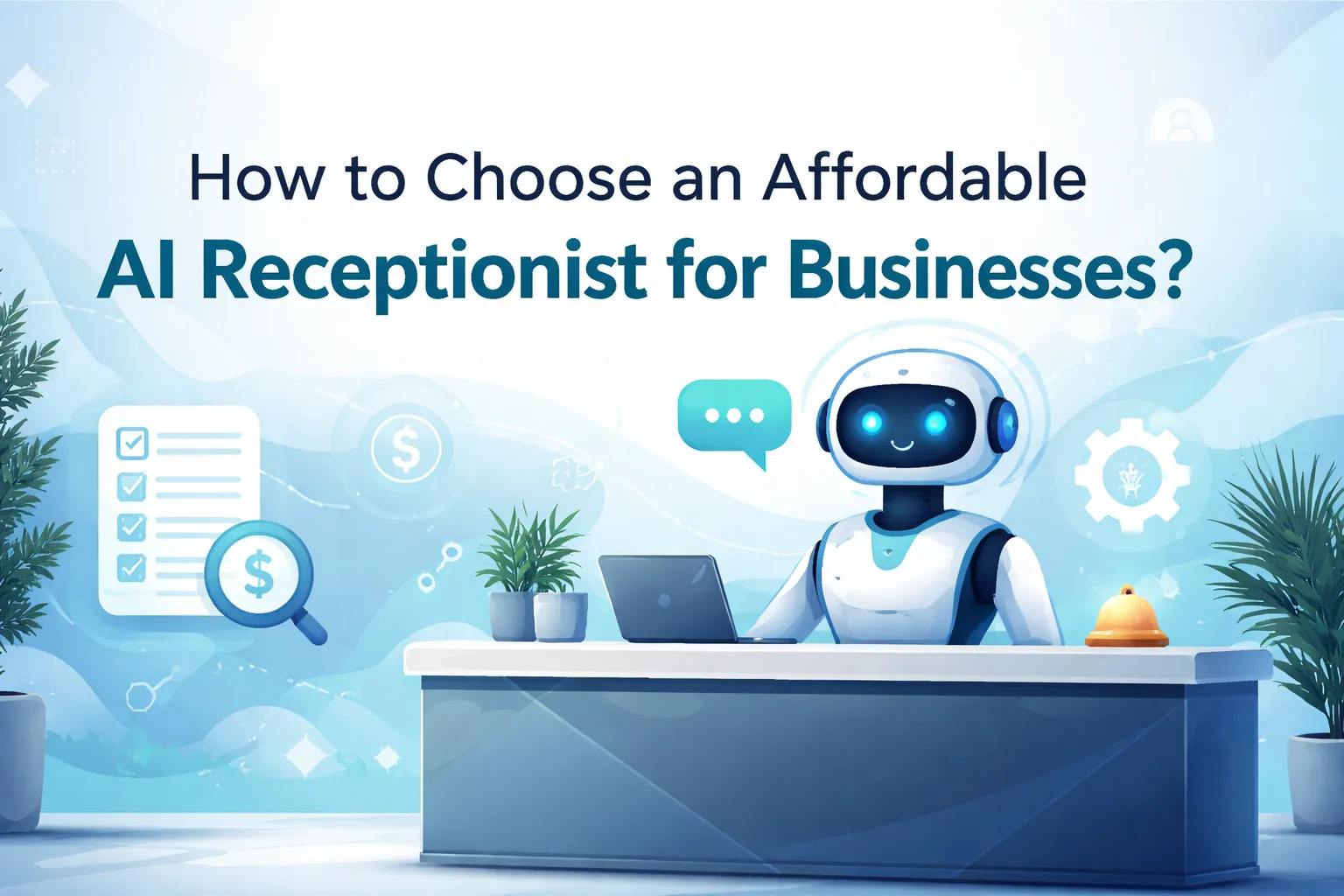
Missed calls are a silent revenue killer for growing businesses. Statistics indicate that approximately 60% of callers abandon a line if they are sent to voicemail, representing a massive leak in potential revenue. For small to mid-sized enterprises, the cost of hiring a full-time front desk staff member often outweighs the immediate return, creating a “catch-22” where you are too busy to answer the phone but cannot afford the overhead to hire help. This is where an affordable AI receptionist bridges the gap, offering enterprise-level lead capture at a fraction of the cost.
Unlike basic auto-attendants that frustrate callers with rigid menus, modern solutions utilize voice AI to manage conversations fluidly. Choosing the right tool requires looking beyond the monthly subscription fee; you must analyze the total return on investment (ROI), the capability to handle concurrency, and the quality of the customer experience (CX) provided to your callers.
What Is An AI Receptionist?
An AI receptionist is voice AI software that handles inbound calls using natural language processing (NLP) and large language models (LLMs) to understand user intent, route calls intelligently, and perform tasks like booking via bi-directional calendar sync it delivers human-like latency and concurrency for multiple calls, integrating with CRMs like Salesforce or HubSpot for instant lead response and lead qualification.
This creates cost-effective automation, slashing receptionist software savings by up to 90% while maintaining superior customer experience (CX). The technology combines conversational AI with neural text-to-speech to create digital front desk solutions that operate as budget-friendly virtual assistant systems.
| Aspect | Traditional Receptionist | AI Receptionist |
|---|---|---|
| Cost | $2,000-5,000/month + benefits | $50-200/month fixed pricing |
| Availability | 9-5, weekdays only | 24/7, no breaks needed |
| Scalability | Limited by hiring capacity | Unlimited concurrency |
| Error Rate | 10-15% manual mistakes | <1% automated accuracy |
| Lead Capture | 40% during business hours | 95%+ around the clock |
| Integration | Manual data entry required | Real-time CRM/calendar sync |
7 Ways to Choose an Affordable AI Receptionist for Businesses
Selecting an affordable AI receptionist requires balancing upfront costs with long-term ROI, focusing on features that drive lead conversion while reducing operational overhead. Look beyond price tags to evaluate scalability, integration depth, and proven results in virtual receptionist solutions. These seven critical evaluation methods will guide your decision with real-world benchmarks.
1. Evaluate Pricing Models for True Affordability
Fixed monthly subscriptions under $200 deliver the best value, avoiding per-minute fees that spike with call volume—unlike traditional services charging $1-3 per minute. Demand complete transparency with no hidden setup fees or overage charges that inflate costs. Providers offering tiered plans based on call minutes ensure budget-friendly virtual assistant access while maintaining predictable expenses.
This pricing model yields 40-60% savings per booked appointment compare centers. Annual subscription discounts of 20-30% can further maximize your ROI. Calculate total cost of ownership including integration fees, training time, and ongoing support to identify the most affordable artificial intelligence tools for your business needs.
2. Prioritize 24/7 Availability and Concurrency
Unlimited simultaneous call handling prevents busy signals during peak periods, capturing leads that humans miss outside business hours—boosting qualified leads by demo calls for first-ring answers under 2 seconds with human-like latency via neural text-to-speech technology. This capability is essential for small business AI services handling after-hours inquiries without the 60% abandonment rate associated with voicemail.
The system should maintain consistent performance whether handling 1 call or 100 simultaneously. Look for providers offering 24/7 call answering service capabilities that ensure no potential customer ever encounters a busy signal or delayed response.
3. Assess Integration Capabilities
Seamless CRM integration with platforms like Salesforce, HubSpot, and GoHighLevel plus bi-directional calendar sync automate data flow, reducing manual entry by 90%. Verify Zapier or native API support for your existing tools—avoid platforms requiring custom development costing $5,000 or more. Real-time updates should log calls to CRMs instantly, improving lead qualification and follow-up efficiency.
The most effective systems offer app integration capabilities that connect with your entire tech stack, creating a unified workflow. Confirm compatibility during trial periods and test data synchronization accuracy across all connected platforms.
4. Test Voice Quality and NLP Accuracy
Conversational AI must parse accents, slang, and complex queries via advanced NLP and LLMs, achieving 95%+ intent recognition accuracy. Listen carefully for natural neural text-to-speech that avoids robotic tones—poor voice quality leads to 20% hang-up rates during initial interactions. Sentiment analysis should detect urgency for intelligent call routing to appropriate departments or staff members.
Pilot the system with your actual scripts and common customer scenarios. The AI should handle interruptions, understand context switches, and maintain conversation flow naturally. This technology forms the foundation of reliable ai receptionist software that delivers consistent performance.
5. Confirm Scalability and Performance Metrics
The system must handle 100+ calls daily without performance degradation, providing analytics on conversion rates and average handle times of 90-120 seconds for routine calls. Scalable systems support growth from 10 to 1,000 calls monthly at flat rates, ideal for low-cost customer engagement strategies. Review uptime service level agreements exceeding 99.9% and concurrency limits that match your peak monitoring real-time dashboards showing call volume, success rates, and booking conversions. The platform should automatically scale resources during periods without manual intervention or additional fees.
6. Check Data Privacy and Compliance
GDPR and HIPAA compliance is non-negotiable for sensitive industries, requiring no-data-resale policies. Audit SOC2 certifications and data retention policies—avoid providers storing raw audio files indefinitely. These protections maintain customer trust while enabling economic AI chatbot deployments across regulated industries.
Verify geographic data storage locations and third-party data sharing agreements. The provider should offer detailed compliance documentation and regular security audits to protect your business and customer information.
7. Demand Proven ROI and Free Trials
Seek comprehensive case studies showing measurable improvements like 21% conversion lifts from instant appointment confirmations and 27% reductions in no-shows. Insist on a DBT AI free trial or 14-day pilot program using your actual business data and call scenarios.
Calculate potential ROI using this formula: (additional leads captured × average deal value) – monthly subscription fee. Document baseline metrics before implementation to measure improvement accurately. The trial period should include full feature access and support to evaluate real-world performance.
What Industries Benefited By AI Receptionist?
AI receptionists excel in high-call-volume sectors requiring instant scheduling and rapid lead response capabilities:
Legal Services – Legal services & law firms utilize AI for client intake and case consultation scheduling through virtual receptionist for law firms services, reducing missed consultations by 50%. The technology handles sensitive client information while maintaining professional communication standards.
Healthcare – Private healthcare clinics benefit from automated appointment reminders and booking confirmations, cutting patient no-shows by 27%. The system manages complex scheduling requirements while maintaining HIPAA compliance for patient data protection.
Home Services – Home services companies book emergency repairs and routine maintenance appointments 24/7, boosting revenue by 35% through improved lead capture. The AI qualifies urgent requests and schedules appropriate service windows automatically.
Professional Services – Marketing agencies and coaches & consultants use AI receptionists to qualify leads instantly for real estate agents and other clients, streamlining their sales processes significantly.
Which AI Receptionist Provider Should You Choose?
Leading providers share essential qualities including fixed pricing models, guaranteed 24/7 uptime, deep integration capabilities, accurate NLP for understanding user intent, advanced sentiment analysis, and comprehensive compliance frameworks. They deliver measurable ROI through 90% cost reductions, real-time performance analytics, and hybrid human escalation options.
The DBT AI exemplifies these standards as an affordable AI receptionist platform, combining advanced voice AI technology with bi-directional calendar sync, comprehensive CRM integration, and instant lead response capabilities for booking within seconds. Its comprehensive features include intelligent call routing, GDPR and HIPAA compliance, and unlimited concurrency without latency issues.
Businesses consistently report higher lead conversion rates through precise qualification processes, making it an ideal solution for digital front desk operations. The platform maintains human- quality while automating routine tasks that traditionally consume staff time. For foundational understanding, review what is an ai receptionist to grasp operational capabilities.
The system’s affordability stems from fixed monthly pricing that scales with business growth rather than penalizing success through per-minute charges. This approach ensures predictable costs while maximizing return on investment through improve and conversion rates.
Conclusion
The affordable AI receptionist market will continue expanding as large language models improve NLP capabilities for handling increasingly complex customer queries. Hybrid models combining AI efficiency with human expertise offering the perfect balance of cost savings and service quality.
Smart businesses are already implementing these solutions to capture missed opportunities and reduce operational costs while standards
Schedule a trial with The DBT AI to experience how an affordable AI receptionist can transform your customer engagementd booking processes starting today.
Frequently Asked Questions (FAQS)
How much does an affordable AI receptionist cost for small businesses?
Basic AI receptionist plans start at $49-79 monthly for essential features, scaling to $150-199 for unlimited calls with advanced CRM integrations—representing 90% savings compared to hiring full-time human receptionists. Fixed pricing models eliminate surprise overage charges while providing predictable monthly expenses.
Can an AI receptionist completely replace human staff?
AI receptionists handle 80% of routine tasks including appointment booking, basic inqu routing. Hybrid setups route complex issues to human staff while reducing their workload by 75%, allowing focus on high-value customer interactions and relationship building rather than repetitive administrative tasks.
What integrations are AI receptionist operation?
Critical integrations include CRM platforms like HubSpot and Salesforce, calendar systems such as Google Calendar and Outlook, and automation tools like Zapier for workflow connections. These integrations eliminate manual data entry while ensuring consistent information across all business systems.
Is customer data secure with AI receptionist systems?
Reputable providers implement GDPR and HIPAA encryption standards with strict no-data-resale policies. Security features include encrypted call transmission, secure data storage, and compliance auditing. Verify SOC2 certifications and geographic data storage policies before selecting a provider.
How quickly can I implement an affordable AI receptionist?
Most systems deploy within 1-2 business days using pre-built conversation flows and templates. Custom configuration may require additional setup time, but basic functionality typically activates immediately. Take advantage of free trials and demo periods to test performance with your specific business requirements.