It is 5:03 PM on a Tuesday. A high-value prospect calls your office with an urgent inquiry. Your front desk staff has just clocked out, and the line rings until it hits voicemail. Statistics suggest that 85% of people who reach voicemail do not leave a message; they simply hang up and call the next competitor. Large language models and natural language processing, these systems engage callers, understand context, and secure bookings without human intervention.
A conversational AI appointment setter acts as an always-on frontline defense for your calendar. It ensures that user intent is understood immediately, regardless of the time of day, and transforms passive inbound calls into confirmed meetings on your schedule.
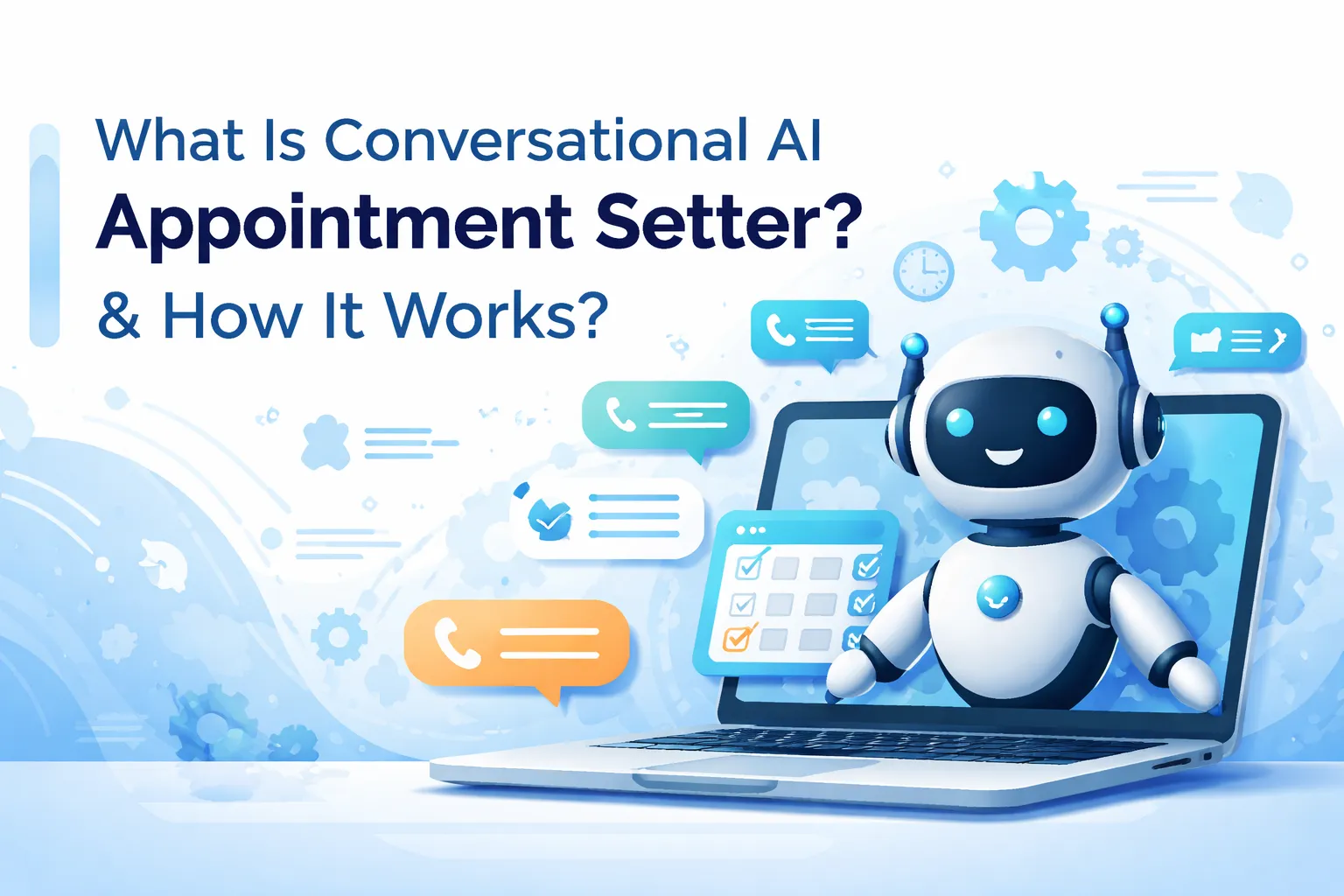
What Is a Conversational AI Appointment Setter?
A conversational AI appointment setter is an advanced software solution that uses voice AI and generative language models to hold natural, two-way conversations with humans for the specific purpose of scheduling meetings. Unlike a standard chatbot that relies on text, or a rigid IVR (Interactive Voice Response) system that requires keypad inputs, this technology listens to spoken language, interprets the meaning, and responds with human-like latency.
At its core, it serves as a virtual receptionist service that never sleeps. It combines speech-to-text transcription, a decision-making engine based on your business rules, and text-to-speech synthesis to simulate a real receptionist. The primary goal is to qualify leads and execute bi-directional calendar sync to book appointments directly into your CRM or scheduling software.
The Evolution from IVR to AI
To understand the value proposition, one must compare the old standard (IVR) with modern AI capabilities.
| Feature | Traditional IVR System | Conversational AI Appointment Setter |
|---|---|---|
| Interaction Mode | “Press 1 for Sales” (Rigid) | “How can I help you today?” (Fluid) |
| Availability | 24/7 (Menu only) | 24/7 (Full Resolution) |
| Lead Qualification | None (Routing only) | Dynamic questioning based on criteria |
| Data Entry | Non-existent | Automated into CRM |
| Booking Speed | Slow (Requires human pickup) | Instant (Real-time sync) |
| Customer Experience | High friction (Frustrating) | Low friction (Empathetic) |
How Conversational AI Appointment Setter Works
The mechanism behind a conversational AI appointment setter is a complex orchestration of several technological layers. It is not merely a recording; it is a cognitive engine designed to replicate the workflow of your best human employee.
1. Instantaneous Voice Capture and Transcoding
The process begins the millisecond a call is received. The system utilizes neural audio processing to capture the caller’s voice. This audio is instantly transcoded into text using Automatic Speech Recognition (ASR). This step is critical because high-fidelity transcription ensures that the AI hears exactly what the customer says, differentiating between similar-sounding words based on acoustic patterns. This allows for an automated call answering service that feels responsive rather than sluggish.
2. Natural Language Understanding (NLU) and Intent Analysis
Once the audio is transcribed, the natural language processing (NLP) engine analyzes the semantic structure of the sentence. It does not just look for keywords; it deciphers user intent. If a caller says, “I’m looking to squeeze in a consultation before my vacation next week,” the AI understands the urgency (“squeeze in”), the service type (“consultation”), and the timeframe (“next week”). This semantic analysis allows the system to act as a competent AI phone assistant rather than a simple call router.
3. Dynamic Lead Qualification Protocols
Before offering a calendar slot, the AI must ensure the caller is a viable prospect. This is where the “setter” aspect functions as a filter. Based on pre-programmed logic, the AI asks qualifying questions regarding budget, timeline, or specific needs. For example, if a lead does not meet the minimum budget requirement you have set, the AI can politely redirect them to resources rather than booking a meeting. This intelligent filtering ensures your sales team only speaks with qualified leads. You can configure these protocols extensively within The DBT AI features settings to match your specific intake requirements.
4. Real-Time Bi-Directional Calendar Synchronization
This is the technical anchor of the system. The AI maintains a live connection to your Google, Outlook, or iCloud calendars. It does not just read availability; it writes to it. When a time is agreed upon, the system locks that slot instantly to prevent double-booking. This capability is essential for businesses offering AI appointment booking to high-volume client bases where slots fill up rapidly.
5. Empathetic Sentiment Analysis
Modern AI models are trained to detect emotional cues. Through sentiment analysis, the system gauges if a caller is frustrated, anxious, or happy. If a caller sounds distressed—perhaps calling a law firm regarding an accident—the AI adjusts its tone to be more empathetic and concise. If the sentiment score drops below a certain threshold, the system can trigger an automated call routing system protocol to escalate the call to a human manager immediately, ensuring customer experience (CX) is preserved.
6. Seamless CRM Integration and Data Hygiene
A major failure point in manual appointment setting is data entry error. An AI setter integrates directly with platforms like Salesforce, HubSpot, or GoHighLevel. As the conversation progresses, the AI populates fields in the CRM: name, phone number, summary of the issue, and appointment time. This reduces operational overhead significantly. For businesses using specific software stacks, robust app integration ensures that the data flows without manual transcription.
7. Managing Concurrency and Infinite Scalability
Human receptionists can only handle one call at a time. If three people call simultaneously, two are placed on hold. A conversational AI appointment setter handles infinite concurrency. Whether you receive five calls or five hundred calls at once, every caller interacts with an agent immediately. This is particularly vital for implementing a 24/7 call answering service during marketing campaigns when call volume spikes unpredictably.
8. Handling Complex Re-scheduling and Cancellations
The lifecycle of an appointment often involves changes. The AI is equipped to handle re-scheduling requests via voice or text. If a client calls back to move their meeting, the AI authenticates the user, finds their existing booking, and negotiates a new time, automatically updating the calendar and notifying the staff. This functions as a full-service AI scheduling assistant that manages the calendar logistics so your team does not have to.
9. Latency Optimization and Human-Like Pausing
To maintain the illusion of a natural conversation, latency (the delay between the user speaking and the AI responding) must be minimized. Top-tier systems utilize edge computing and optimized LLMs to respond in under 800 milliseconds. Furthermore, the AI utilizes “filler words” (like “Let me check that for you…”) during processing moments to prevent “dead air” silence, which often causes callers to hang up. This creates a superior AI business phone system experience.
10. Privacy and Compliance Security Layers
Handling personal data requires strict adherence to regulations like GDPR and HIPAA. The AI architecture includes encryption protocols for data at rest and in transit. For healthcare and legal sectors, the system ensures that sensitive information collected during the appointment setting process is stored securely. This allows professional entities to use a white label answering service with confidence regarding liability and data protection.
What Industries Benefit From AI Appointment Setters?
While any business with a phone line can benefit, high-ticket service industries see the most immediate ROI from this technology.
Legal Services and Law Firms
Attorneys often bill by the hour, meaning every minute spent scheduling is a minute not billing. Furthermore, legal inquiries are often urgent and happen after hours. A virtual receptionist for law firms ensures that potential clients seeking representation for DUIs, accidents, or family disputes are captured immediately, qualified, and scheduled for a consultation, stopping them from calling another firm.
Med Spas and Aesthetic Clinics
The aesthetic industry is highly competitive and relies on consultation bookings. Clients often have specific questions about treatments which a standard answering machine cannot address. By deploying an AI reception specifically tailored for med spas & aesthetic clinics, owners can ensure that inquiries about pricing and availability are converted into booked treatments instantly, increasing clinic utilization rates.
Home Services (Plumbing, HVAC, Electrical)
When a pipe bursts or the AC fails, the customer has zero patience. They call providers until someone answers. An AI appointment setter ensures that home services companies catch every emergency lead. The AI can be trained to distinguish between routine maintenance calls and emergency dispatch needs, prioritizing the schedule accordingly.
Real Estate Agents and Agencies
Real estate is a volume game requiring speed to lead. Agents are often in showings and cannot answer their phones. An AI assistant can screen callers, distinguishing between solicitations and serious buyers. For real estate agents, this means the AI can book property viewings directly into the agent’s calendar while they are busy closing other deals.
Healthcare and Dental Practices
Missed appointments and administrative bottlenecks plague private practices. An AI system handles the volume of routine check-up bookings and reminders. For dental & private healthcare clinics, this automation reduces the workload on front-desk staff, allowing them to focus on in-person patient care rather than ringing phones.
Which AI Appointment Setter Provider Should You Choose?
Selecting the right provider depends on the balance between sophistication, ease of use, and integration capabilities.
Key Qualities to Look For
- Latency Speed: Can the AI respond fast enough to feel real?
- Customizability: Can you script the qualification questions?
- Voice Quality: Does the neural text-to-speech sound robotic or human?
- Integration: Does it actually sync with your specific CRM?
The DBT AI Advantage
The DBT AI has engineered a system specifically designed to bridge the gap between complex automation and user-friendly setup. Our platform provides a best AI answering service that prioritizes “Human-Like” interaction above all else. We focus on the nuances of conversation—interruptibility, tone, and context retention—to ensure your callers never feel like they are talking to a machine.
Our solution offers a pre-configured AI auto attendant that can be deployed in minutes, not months. We understand that for an AI appointment setter to be effective, it must integrate deeply with your operations, which is why we offer robust connections to major calendar and CRM platforms out of the box.
Conclusion
The era of the unanswered business call is ending. The conversational AI appointment setter is not just a tool for efficiency; it is a fundamental shift in how businesses manage customer engagement. By automating the initial intake and scheduling process, companies can reduce operational overhead, improve lead conversion rates, and ensure that their brand is accessible 24/7.
As large language models continue to advance, the distinction between human and AI interactions will continue to blur. Early adopters who integrate these systems now will secure a significant competitive advantage in responsiveness and customer satisfaction.
If you are ready to stop losing leads to missed calls and start automating your calendar, you can schedule a trial with our team to see the technology in action. Experience the power of a DBT AI free trial and transform your phone line into your best-performing sales asset.
Frequently Asked Questions (FAQS)
How much does a conversational AI appointment setter cost compared to a human?
Typically, an AI solution costs a fraction of a full-time salary. While a human receptionist may cost upwards of $3,000 per month plus benefits, an online phone answering service powered by AI usually operates on a subscription basis or usage-minute model, often resulting in 60-80% savings on operational costs.
Can the AI handle multiple languages?
Yes, most advanced systems are multilingual. They can detect the language the caller is speaking and switch instantly. This makes them ideal for businesses serving diverse demographics. For example, a bilingual ai receptionist can manage English and Spanish calls simultaneously without needing two different staff members.
Will my customers know they are talking to an AI?
While the goal is to make the interaction as natural as possible, transparency is often recommended. However, the quality of modern neural text-to-speech is so high that many callers do not realize they are speaking to an AI voice receptionist until the end of the call, or at all. The focus is on resolving their need quickly, which usually overrides the concern of who is speaking.
How long does it take to set up?
Setup time varies by complexity, but platforms like The DBT AI are designed for rapid deployment. A basic AI receptionist setup can often be live within 24 to 48 hours. More complex integrations involving deep CRM workflows and custom API connections may take slightlyceptionist/) for legal or medical intake, the architecture is built to comply with data privacy regulations like GDPR and HIPAA to protect your client information.