Your office lights are off, the doors are locked, and your team has gone home for the day. Yet, at 8:43 PM, a high-value prospect calls your business line with an urgent inquiry. In a traditional setup, this call goes to voicemail, where it sits stagnant until the next morning. By the time you return the call, that prospect has likely moved on to a competitor who answered immediately.
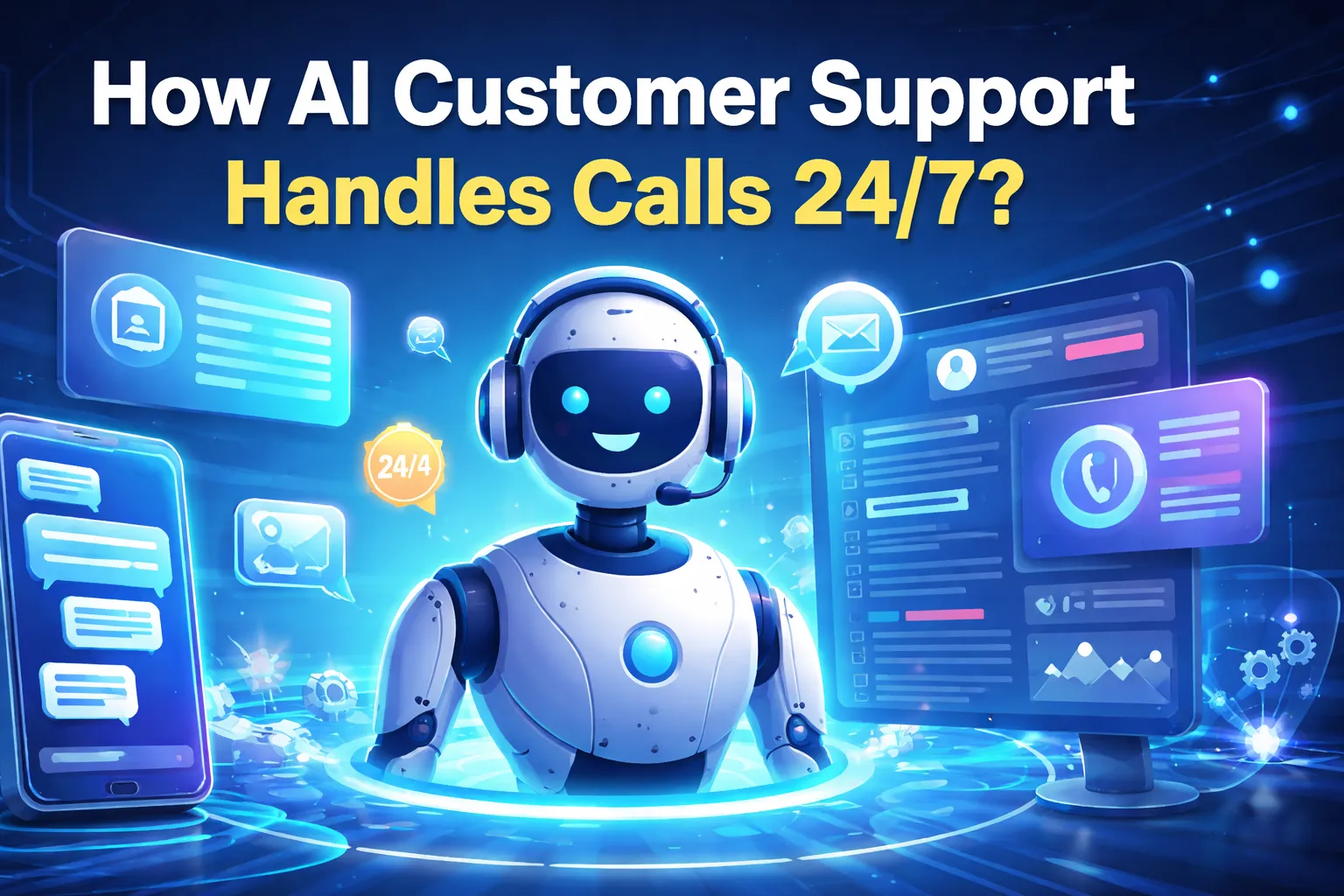
This operational gap costs businesses roughly 35% of potential leads annually. Relying solely on human staff for phone coverage creates an inevitable bottleneck between operational costs and revenue capture. AI customer support bridges this gap by functioning as an always-on intelligence layer for your communications. Unlike static voicemail or rigid phone trees, these systems utilize conversational AI to answer, qualify, and convert leads at any hour.
In this guide, we will analyze the mechanisms behind how AI customer support manages calls around the clock, compares against traditional staffing models, and drives tangible ROI for modern enterprises.
What is AI Customer Support?
AI customer support is the application of natural language processing (NLP), machine learning (ML), and voice AI technologies to automate interactions between a business and its customers. It moves beyond simple “call deflection” and enters the realm of “call resolution.”
Historically, automation meant IVR (Interactive Voice Response) systems that forced users to “Press 1 for Sales.” These systems were rigid and often caused customer frustration. Today, a robust AI phone assistant utilizes large language models (LLMs) to understand user intent spoken in natural phrasing. The AI listens, interprets the semantic meaning of the request—whether it is an appointment booking, a pricing query, or a support ticket—and executes the necessary task within your business software.
This technology allows companies to provide customer service automation that feels human but operates with the speed and data processing capabilities of a computer. It handles ticket management, multichannel support, and response algorithms instantly, regardless of call volume.
If you want a foundational overview before going deeper, this guide on what is an ai receptionist connects the dots between traditional reception and AI-driven call handling.
AI Customer Support vs. Traditional Methods
To understand the value proposition, we must look at the data. Below is a comparison of operational metrics between human receptionists, outsourced call centers, and The DBT AI customer support solutions.
| Feature | Human Receptionist | Outsourced Call Center | AI Customer Support |
|---|---|---|---|
| Response Time | 15-45 seconds (if not busy) | 30-90 seconds | < 1 second |
| Availability | 40 hours/week | 24/7 (High Cost) | 24/7 (Standard) |
| Concurrency | 1 call at a time | Variable based on staffing | Unlimited concurrent calls |
| Cost Per Interaction | High ($15-$25/hr + benefits) | Medium ($1.50-$3.00/min) | Low (Flat subscription usage) |
| Data Accuracy | Subject to human error | Variable quality | 100% Digital Logging |
| Scalability | Requires hiring/training | Contract negotiation | Instant |
16 Ways How AI Customer Support Handles Calls 24/7
The ability of AI to manage calls autonomously relies on a complex stack of technologies working in unison. Here are the 16 specific mechanisms that enable an AI receptionist to function effectively.
1. Instant Wake-Word Activation and Response
Latency is the enemy of natural conversation. When a call comes in, the AI engine activates immediately. It does not need to “wake up” or finish a coffee break. The system uses voice activity detection (VAD) to determine exactly when the caller starts speaking. This allows the automated call answering service to pick up the line in under one second, creating an immediate sense of presence and professionalism that retains the caller’s attention.
2. Natural Language Understanding (NLU) for Intent
The core of modern AI is NLU. The system does not just transcribe words; it deciphers meaning. If a caller says, “I need to see someone about my back pain,” the AI identifies the intent as “Appointment Booking” and the category as “Medical/Chiropractic.”
This capability is one of the most complex tasks for a human is finding a free time slot while a client waits on hold. AI customer support connects directly to your Google, Outlook, or CRM calendar via API. It reads availability in real-time and offers slots that are actually open. Once the caller agrees, the AI scheduling assistant writes the appointment back to the calendar instantly, preventing double-booking and removing the administrative burden from your staff.
4. Intelligent Call Routing
Not every call can be solved by AI, and the system knows this. Using intelligent call routing protocols, the AI assesses the complexity and nature of the inquiry. Simple queries are handled automatically, while high-stakes or complex issues are transferred to specific human departments. An automated call routing system ensures that your sales team only talks to qualified leads, while support staff only deal with technical issues, optimizing your human capital.
5. Neural Text-to-Speech (TTS) Humanization
Trust is established through voice quality. Early chatbots sounded robotic, which increased hang-up rates. Modern systems use neural TTS to generate audio that includes breath pauses, intonation changes, and natural pacing. This makes the AI voice receptionist sound indistinguishable from a human operator in many contexts, making callers feel comfortable engaging in a detailed conversation rather than rushing to get off the line.
6. Dynamic Script Adaptation
Static scripts fail when customers go off-topic. AI customer support utilizes generative models to adapt its responses dynamically. If a caller interrupts the flow with an unrelated question, the AI answers it and then gently guides the conversation back to the primary objective. This flexibility is characteristic of a high-quality AI business phone system, ensuring that the conversation remains productive even when the user, or GoHighLevel. This app integration means that when your sales team arrives in the morning, their CRM is already populated with structured data from calls that happened overnight.
8. Lead Qualification and Scoring
Marketing teams spend massive budgets generating leads, but many are unqualified. AI customer support acts as a gatekeeper. It asks pre-set qualifying questions—such as budget availability, timeline, or decision-making authority—before passing the lead to a human. By using a virtual receptionist service and speech patterns to detect frustration, anger, or urgency. If the system detects a negative sentiment spike, it can trigger a priority escalation or adjust its tone to be more apologetic and soothing. This capability is vital for maintaining brand reputation when using an online phone answering service.
10. Multi-Language Support
Global business requires global communication. AI models are trained on vast datasets encompassing dozens of languages and dialects. A single AI instance can switch from English to Spanish, French, or Mandarin instantly based on the caller’s input. This allows a standard 24/7 call answering service to serve a diverse client base without the expense of hiring multilingual staff for every shift.
11. Handling Infinite Concurrency
A human receptionist can only handle one call at a time. If three people call simultaneously, two go to voicemail. AI customer support scales elastically. Whether you receive five calls or five hundred calls at 9:00 AM, the system spins up parallel instances to answer every single one immediately. This is particularly useful for marketing agencies running aggressive ad campaigns that generate sudden spikes in inbound traffic.
12. Contextual Memory and Recall
Customers hate repeating themselves. Advancedceptionist/best-ai-answering-service) apart from generic auto-attendants.
13. Automated Follow-Up Workflows
The conversation does not end when the call disconnects. AI customer support triggers post-call workflows automatically. This might include sending an SMS confirmation, emailing a brochure, or dispatching a calendar invite. By using The DBT AI features for automation, businesses close the loop immediately, increasing the probability of conversion while the interaction is still fresh in the customer’s mind.
14. Self-Correction and Learning
Machine learning models improve over time. If the AI struggles with a specific accent or phrase, that data is flagged. Over subsequent updates, the model refines its understanding, effectively “learning” from its mistakes. This continuous improvement cycle means your AI receptionist platform becomes smarter and more efficient the longer you use it, unlike human staff who may suffer from burnout or turnover.
15. Compliance and Security protocols
For industries like healthcare and law, data privacy is non-negotiable. AI customer support systems are built with enterprise-grade security, often including HIPAA and SOC2 compliance measures. They can automatically redact sensitive payment information (PCI compliance) from recordings. A white label answering service can provide these security guarantees while appearing fully branded to your agency’s clients.
16. Outbound Calling and Reactivation
While inbound handling is critical, AI can also manage outbound tasks. It can call leads who filled out a web form within seconds of submission (speed-to-lead). Additionally, it can run database reactivation campaigns, calling old leads to see if they are ready to buy. Using an AI receptionist that books appointments for outbound efforts turns a cold database into an active revenue source.
What Industries Benefit from AI Receptionists?
The utility of AI customer support transcends specific niches, but certain industries see an immediate and dramatic impact on their bottom line due to the nature of their client interactions.
Private Healthcare and Medical Clinics
Doctors and dentists are often in procedure rooms and cannot answer phones. Yet, missed calls often mean patients go elsewhere for relief. An AI receptionist benefits these clinics by integrating with EMR systems to book patient visits, handle cancellations, and answer pre-op questions 24/7. This improves patient satisfaction and fills-receptionist/virtual-receptionist-for-law-firms) ensures that every lead is screened, intake questions are answered, and consultations are scheduled immediately, regardless of whether the attorneys are in court or at lunch.
Home Services (HVAC, Plumbing, Electrical)
Home service emergencies happen at inconvenient times. A burst pipe at 2 AM requires immediate attention. An AI phone answering service can differentiate between a routine maintenance request and an emergency, dispatching an on-call technician only when necessary. This protects the business owner’s sleep while capturing high-value emergency jobs.
Real Estate
Real estate is a speed game. Agents spend much of their day showing properties and cannot always answer their phones. AI support for real estate agents acts as a personal assistant, fielding inquiries about listings, scheduling viewings, and collecting buyer criteria, ensuring that no potential commission slips through the cracks.
Which AI Receptionist Provider Should You Choose?
When selecting a provider, you must look beyond basic call answering. You need a platform that offers low latency, high customization, and deep integration capabilities. Many generic options on the market rely on standard APIs that introduce lag or sound robotic.
The DBT AI is engineered specifically for revenue-focused businesses. Our proprietary orchestration layer ensures that voice latency is minimized, creating a truly conversational experience. We prioritize. Consumers demand instant gratification, immediate answers, and 24/7 accessibility. AI customer support is no longer a futuristic concept; it is a fundamental operational requirement for businesses that intend to scale efficiently.
From instant lead qualification to handling massive concurrent call volumes, the mechanisms we discussed demonstrate that AI is not just a replacement for human effort—it is an enhancement of it. By automating the routine and logistical, you free your human team to focus on high-level strategy and complex problem-solving.
As we look toward the future, these systems will only become more predictive and personalized. The businesses that adopt this infrastructure today will own the market share of tomorrow. To begin transforming your voice operations and stop losing revenue to missed calls, claim your DBT AI free trial today.
Frequently Asked Questions (FAQS)
What can AI customer support handle without human agents?
AI customer support can answer FAQs capture caller details, perform lead qualification, book or reschedule appointments, calls using intelligent call routing, and create for follow-up via ticket management. Escations still make sense for complex billing disputes, complaints, edge-case.
AI support the same as chatbots?
Not exactly text-first, while is natural turn-taking and speech handling Many businesses use together as part of support but phone-based AI can large parts of front-desk call.
Can AI customer support with my CRM and calendar?
—most serious systems CRM integration (Salesforce, Hub, GoHighLevel). The key is bi-directional calendar sync so appointments created, prevented from doubleing in real time.
Will customers know they are talking to AI?
Sometimes they will sometimes they won’t—because neural text-to-speech and better NLP reduce robotic. experience (CX): fast, clear options, and resolution more about and accuracy than whether the voice is.
Can the AI understand heavy accents or bad connections?
Yes. Modern AI customer support utilizes advanced speech-to-text engines trained on diverse global datasets. These models are designed to filter out background noise and decipher various accents and dialects with high accuracy, often outperforming humans in noisy environments.
Is the setup process complicated for non-technical business owners?
No. Leading platforms like The DBT AI are designed with user-friendly interfaces. You typically upload your business information, connect your calendar, and configure your phone number forwarding. The process can often be completed in under an hour without writing a single line of code.
Will my customers know they are talking to a robot?
While transparency is often recommended, the quality of neural text-to-speech has advanced to the point where many callers cannot distinguish the AI from a human. The conversation flows naturally with pauses, “