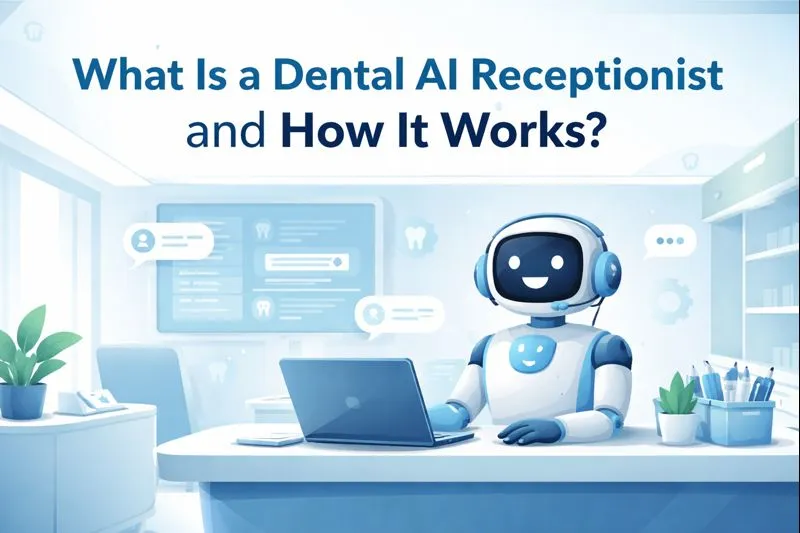
A busy dental practice often faces a chaotic front desk: phones ringing while staff assist patients with check-ins or insurance paperwork. Industry data suggests that clinics lose between 20% to 30% of potential appointments simply because calls go unanswered or to voicemail after hours. A dental AI receptionist solves this revenue leak by serving as an always-on intelligent agent capable of managing patient interactions without human fatigue.
What Is A Dental AI Receptionist?
A dental AI receptionist is a specialized voice AI system built on large language models (LLMs) and natural language processing (NLP) specifically tuned for the dental and healthcare sector. Unlike a standard answering machine or basic IVR menu, this technology understands complex user intent, allowing it to converse naturally with patients, qualify their needs, and execute tasks like booking appointments directly into the clinic’s schedule.
It functions as a comprehensive dental practice automation tool. By integrating with patient scheduling software and clinic management AI, it ensures that every inquiry—whether it is a new patient seeking a consultation or an existing patient with a post-op concern—is handled instantly. The primary goal is to reduce operational overhead while significantly improving the customer experience (CX) through immediate engagement and precise data handling.
Below is a comparison of how this technology stacks up against traditional staffing methods:
| Feature | Traditional Receptionist | Dental AI Receptionist |
|---|---|---|
| Response Time | 15–60 seconds (or hold time) | < 2 seconds (Instant lead response) |
| Availability | 40 hours/week (Business hours) | 168 hours/week (24/7 coverage) |
| Concurrency | 1 call at a time per person | Unlimited simultaneous calls |
| Data Accuracy | ~85–90% (Human error) | 99.9% (via API integration) |
| Cost Efficiency | High (Salary + Benefits) | ( \approx 40-60% ) lower operational cost |
| Booking Speed | 3–5 minutes | 30–60 seconds |
How Dental AI Receptionist Works?
To understand the efficacy of a dental AI receptionist, one must look beyond simple “call answering.” It is a sophisticated orchestration of neural text-to-speech, sentiment analysis, and bi-directional data syncing. The system operates through a multi-stage process designed to replicate—and often outperform—human efficiency in administrative tasks.
Here are the 12 key operational stages of a dental AI receptionist:
1. Instant Call Engagement and Intent Recognition
When a patient calls a clinic, the system answers within the first ring using ultra-low latency voice AI. It conversational rather than robotic. You can learn more about the technical nuances of an online phone answering service to see how latency impacts caller retention.
2. Intelligent Lead Qualification
Once the intent is established, the AI moves to qualify the patient. For a dental practice, not all calls are equal. A patient in pain requires different handling than a sales call or a routine inquiry. The system asks dynamic follow-up questions to determine the nature of the visit, insurance type, or patient status (new vs. returning). This process of lead qualification ensures that valuable chair time is reserved for qualified patients. Effective qualification logic is a core component of our AI appointment booking protocols, ensuring high-value slots are filled efficiently.
3. Bi-Directional Calendar Synchronization
Perhaps the most critical technical feature is the real-time link between the AI and the clinic’s Practice Management Software (PMS). The AI does not just “request” a slot; it reads the live calendar to offer only available times. When a patient selects a time, the AI writes it back to the calendar instantly, preventing double-booking. This bi-directional calendar sync is what allows a virtual receptionist service to operate autonomously without risking schedule conflicts.
4. Sentiment Analysis and Empathy Adaptation
Dental anxiety is real, and how a receptionist speaks to a patient matters. Large language models allow the system to perform real-time sentiment analysis. If a caller sounds distressed or angry, the AI adjusts its tone to be more empathetic and urgentcustomer-service-boosts-profits/).
5. Automated Patient Intake and Data Capture
During the conversation, the AI listens for and extracts critical entities such as the patient’s full name, date of birth, insurance provider, and contact details. It populates these fields directly into the CRM or intake forms. This automated patient intake capability removes the need for manual data entry by staff, reducing administrative workload. This level of precision is why many clinics are transitioning to an automated call answering service to handle data-heavy intake procedures.
6. Intelligent Call Routing and Triage
Not every call results in an appointment. Some are billing questions, vendor calls, or clinical emergencies that require a doctor’s immediate attention. The system utilizes intelligent call routing to triage these calls effectively. Based on the identified intent, it can transfer the call to a specific department extension or take a detailed message if the staff is unavailable. Implementing a robust automated call routing system ensures that the front desk is only interrupted for calls that truly require human intervention.
7. CRM and Marketing Automation Integration
Beyond the calendar, the AI integrates with CRMs like Salesforce, HubSpot, or GoHighLevel. When a new lead calls but does not book, the AI logs the interaction as a “missed opportunity” and can trigger an automated SMS follow-up or email sequence. This ensures no lead is left behind. This seamless data flow is a hallmark of high-functioning features found in modern automation platforms.
8. Handling Rescheduling and Cancellations
Managing schedule gaps caused by last-minute cancellations is a major headache for dental practices. The AI allows patients to reschedule effortlessly over the phone without staff involvement. It immediately opens the cancelled slot back up to the public and can even notify a waitlist. This dynamic management acts as an AI scheduling assistant, keeping chair utilization rates high.
9. Multilingual Accessibility
Many dental practices serve diverse communities where English may not be the primary language. A dental AI receptionist can fluently switch between languages (such as Spanish, French, or Mandarin) based on the caller’s input. This neural text-to-speech capability ensures that language barriers do not prevent patients from receiving care. Businesses looking to expand their reach often rely on a bilingual ai receptionist to serve a wider demographic.
10. Insurance Verification Pre-Screening
While deep insurance verification often requires a human billing specialist, the AI can handle the pre-screening phase. It can ask for the carrier name, group number, and subscriber ID, then validate the format of this data before the patient arrives. This proactive step reduces waiting room bottlenecks. This utility is a key reason why practices choose a white label answering service that can be customized to ask specific insurance questions.
11. After-Hours Emergency Handling
Dental emergencies do not adhere to business hours. If a patient calls at 2 AM with a broken tooth, the AI can differentiate this from a routine query. It can provide specific instructions (e.g., “apply cold compress”) and flag the message as “URGENT” for the dentist to see immediately upon waking, or route the call to an on-call mobile phone. This reliability is characteristic of a 24/7 call answering service.
12. Operational Analytics and Reporting
Finally, the system provides granular data on practice performance. It tracks peak call times, common reasons for calling, and appointment conversion rates. This data helps practice owners make informed decisions about marketing and staffing. Understanding these metrics helps reduce operational overhead and is a primary benefit discussed in our analysis of ai receptionist benefits.
What Industries Benefited By AI Receptionist?
While dental practices see immense value, the underlying technology drives efficiency across various sectors.
- Healthcare: Beyond dentistry, private healthcare clinics utilize these systems for patient engagement tools, handling volume for general practitioners and specialists alike to manage intake and reminders.
- Aesthetics: High-volume appointment businesses like med spas & aesthetic clinics rely on instant booking capabilities to capture clients who are browsing for treatments on social media after hours.
- Legal: For legal services & law firms, missing a call from a potential client often means losing a case to a competitor; AI ensures every lead is screened and captured instantly.
- Home Services: Contractors and home services businesses use AI to quote and schedule jobs while they are out in the field, ensuring they never miss a revenue opportunity due to being on a job site.
Which Dental AI Receptionist Provider Should You Choose?
Selecting the right provider is critical for maintaining patient trust and data security. You should look for a solution that prioritizes GDPR and HIPAA compliance, ensuring that all patient data is encrypted and secure. Furthermore, the ability to integrate with your existing tech stack—specifically your CRM and PMS—is non-negotiable.
The DBT AI excels in these areas by offering a robust AI receptionist platform designed for high-conversion environments. Our system provides seamless app integration with major platforms like HubSpot, Salesforce, and GoHighLevel. Unlike generic solutions, The DBT AI focuses on human-like latency and advanced sentiment analysis to ensure your patients feel heard and cared for. If you are evaluating options, we recommend reading our guide on the best AI answering service to understand the benchmarks for quality.
Conclusion
The integration of dental AI receptionists marks a shift in how clinics manage patient relationships. By automating the repetitive tasks of scheduling and intake, practices can focus on clinical excellence and patient care. As large language models continue to evolve, we can expect even deeper integrations, such as predictive analytics for no-show prevention and personalized treatment plan follow-ups.
To see how this technology can transform your practice’s efficiency, schedule a trial with us today.
Frequently Asked Questions (FAQS)
How much does a dental AI receptionist cost?
Costs typically range from $50 to $200 per month per line, or are based on usage minutes. This is generally 40-60% cheaper than hiring a full-time human receptionist, offering significant savings on operational overhead.
Can the AI handle dental emergencies?
Yes, the system uses NLP to detect words associated with pain or emergencies (e.g., “broken tooth,” “bleeding”). It can be programmed to prioritize these calls, offer immediate advice, or route the call to an emergency line.
Is the system HIPAA compliant?
Reputable providers ensure full HIPAA compliance. The DBT AI, for example, uses encryption for all voice data and transcripts to ensure patient privacy and data security are never compromised.
Will it work with my existing dental software?
Most advanced AI receptionists integrate with popular dental practice management software like Dentrix, Eaglesoft, and Open Dental via API or bridging software to ensure real-time calendar accuracy.
What happens if the AI cannot understand the caller?
If the system encounters a query it cannot resolve or a dialect it struggles to parse, it utilizes intelligent fallback logic to transfer the call to a human staff member or take a detailed message for later follow-up.