The phone at the front desk rings incessantly. It is Monday morning, the waiting room is full, and your administrative staff is juggling patient check-ins, insurance verifications, and urgent triage questions. Amidst this chaos, the phone continues to ring. Eventually, it goes to voicemail. That missed call could have been a new patient seeking a primary care provider or an existing patient with a post-operative concern. In the healthcare sector, missed calls are not just lost revenue; they represent a break in the continuum of care.
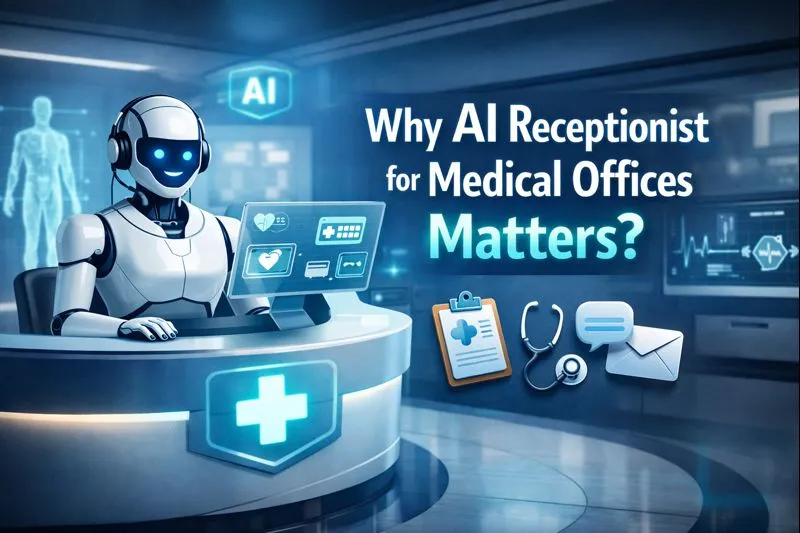
For modern practices, the solution is not necessarily hiring more staff, which adds significant operational overhead. The solution lies in adopting an AI receptionist for medical offices. This technology has evolved beyond simple automated menus into sophisticated systems capable of handling complex interactions. By integrating conversational AI, medical practices can ensure every patient feels heard immediately, regardless of call volume or time of day.
What Is An AI Receptionist for Medical Offices?
An AI receptionist for medical offices is an advanced software solution powered by large language models (LLMs) and natural language processing (NLP). Unlike traditional IVR systems that frustrate callers with rigid “press 1 for appointments” menus, an AI receptionist understands spoken language, context, and user intent. It functions as a virtual front desk agent capable of engaging in two-way conversations.
These systems utilize neural text-to-speech to provide a human-like voice experience. They are designed to handle specific healthcare workflows, such as checking provider availability via bi-directional calendar sync, answering FAQs about clinic hours, and routing urgent calls to on-call nurses. Crucially, for the medical sector, these tools are built with data privacy frameworks ensuring GDPR and HIPAA compliance, protecting sensitive patient health information while streamlining clinic workflow optimization.
If you’re new to the concept, this guide on what is an ai receptionist helps set the baseline before you evaluate vendors.
AI Receptionist vs. Traditional Methods
To understand the value proposition, it is helpful to compare the capabilities of an AI solution against traditional staffing and outsourced call centers.
| Feature | Human Receptionist | Outsourced Call Center | AI Receptionist |
|---|---|---|---|
| Availability | Business Hours (approx. 40h/week) | 24/7 (often with high hold times) | 24/7 (Instant response) |
| Concurrency | 1 call at a time | Limited by agent availability | Unlimited simultaneous calls |
| Cost | High (Salary, Benefits, Training) | Moderate (Per minute/Per call) | Low (Fixed subscription) |
| Data Accuracy | Prone to human error | Varies by agent quality | High (Direct CRM integration) |
| Scalability | Slow (Requires hiring/training) | Moderate | Instant |
| Patient Experience | Varies by stress levels | Often impersonal | Consistent, professional tone |
10 Reasons Why An AI Receptionist for Medical Offices Matters
The adoption of AI in healthcare administration is not just about keeping up with technology; it is about survival in a competitive, patient-centric market. Below are ten detailed reasons why implementing an AI receptionist for medical offices is essential for modern practices.
1. Eliminating Missed Calls and Abandonment Rates
The primary driver for adopting voice AI is the sheer volume of missed opportunities. Statistics suggest that a significant percentage of calls to medical practices go to voicemail, and the majority of those callers will not leave a message; they will simply call the next doctor on Google.
An AI receptionist ensures zero human-like latency in picking up the phone. It answers instantly on the first ring, capturing 100% of inbound traffic. By utilizing a reliable 24/7 call answering service, practices ensure that a patient calling at 2 AM with a toothache or a parent calling at 7 AM before work receives immediate attention, securing the appointment before the competition opens their doors.
2. Significant Reduction in Operational Overhead
Staffing costs are the largest expense for most medical offices. Hiring, training, and retaining quality front desk staff is expensive and time-consuming. When you factor in salaries, healthcare benefits, and paid time off, the cost per interaction is high.
An AI receptionist operates at a fraction of the cost of a full-time employee and never requires overtime pay or sick leave. This financial efficiency allows small private practices to operate with the professionalism of a large hospital system. For larger clinics, deploying ai virtual receptionist software means existing funds can be reallocated toward clinical equipment or marketing efforts rather than expanding administrative payroll.
3. Seamless Appointment Management and Integration
One of the most complex tasks for a front desk is managing the schedule. Double bookings, gaps in the schedule, and manual entry errors plague efficiency. An AI receptionist integrates directly with your Electronic Health Records (EHR) or CRM platforms.
Through app integration, the AI can read real-time availability and write new appointments directly into the calendar. It understands the nuances of scheduling—knowing that a “new patient physical” requires 45 minutes while a “flu shot” only requires 15. This automates the most time-consuming aspect of the reception role, allowing the software to function as a highly competent AI appointment booking agent that never makes a double-booking error.
4. Improving Patient Satisfaction Through Instant Gratification
We live in an on-demand economy. Patients expect the same speed from their healthcare providers that they get from Amazon or Uber. Being put on hold for ten minutes to ask a simple question regarding parking or operating hours is a major dissatisfied for patients.
An AI receptionist provides instant answers. It can handle routine inquiries immediately, which improves the overall Customer Experience (CX). When a patient interacts with a sophisticated AI phone assistant that respects their time, their perception of the practice’s quality of care increases. This immediate responsiveness builds trust and reduces the anxiety often associated with medical interactions.
5. Enhancing Staff Retention and Morale
Burnout is rampant in healthcare, and it is not limited to doctors and nurses. Administrative staff often face abuse from frustrated patients and the stress of a never-ending ringing phone. By offloading repetitive calls—confirmations, directions, basic FAQs—to an AI, you protect your human staff. They can then focus on high-value interactions, such as comforting a distressed patient in the waiting room or managing complex insurance prior authorizations. The ai receptionist benefits extend to the human team by creating a quieter, more focused work environment, which directly correlates to lower turnover rates and higher job satisfaction.
6. Supporting Multilingual Patient Populations
Accessibility is a cornerstone of ethical medical care. For clinics in diverse areas, language barriers can delay care and complicate scheduling. Human staff may not always be bilingual, or a translator service may take time to patch in. Advanced AI receptionists can be programmed to detect and speak multiple languages fluently. When you ask can ai receptionists handle multiple languages effectively, the answer is a resounding yes. This capability ensures that non-native speakers can book appointments and convey their symptoms accurately, expanding the practice’s reach and ensuring equitable access to healthcare services for the community.
7. Precise Lead Qualification and Triage
Not every call is an appointment ready to be booked; some are sales calls, some are pharmacy requests, and some are medical emergencies. An AI receptionist uses sentiment analysis and intelligent call routing to distinguish between these call types. It can qualify a potential new patient by asking about insurance and symptoms before checking availability. Conversely, if the AI detects urgent keywords indicating a medical emergency, it can be programmed to immediately transfer the call to a triage nurse or direct the patient to emergency services. This intelligent filtering is a core part of effective features in modern AI systems, ensuring that human attention is preserved for calls that truly require clinical judgment.
8. Robust Data Collection and CRM Hygiene
Human receptionists, while well-intentioned, can make mistakes when transcribing names, phone numbers, or insurance details during a busy shift. An AI receptionist captures data with machine precision. It transcribes the conversation and logs structured data directly into the system. This ensures that when the patient arrives, their file is accurate. Furthermore, a comprehensive ai receptionist system can categorize call reasons, providing practice owners with analytics on why patients are calling (e.g., 40% for refills, 20% for new appointments), which helps in making data-driven operational decisions.
9. Reducing No-Show Rates via Automation
No-shows are a revenue leak that can cripple a practice’s profitability. If a standard visit is worth $150 and a practice has two no-shows a day, the annual loss is substantial. $$ \text{Annual Loss} = $150 \times 2 \times 5 \text{ days} \times 50 \text{ weeks} = $75,000 $$ An AI receptionist combats this by managing proactive outbound reminders. Unlike simple SMS blasts, voice AI can call patients to confirm appointments and, if the patient needs to cancel, immediately offer to reschedule them or fill the slot with a patient from the waitlist. This dynamic management proves how ai receptionist customer service directly impacts the bottom line by keeping the provider’s schedule full.
10. Scalability for Seasonal Fluctuations
Medical offices often experience surges in volume, such as during flu season, back-to-school physicals, or Monday mornings after a weekend. A human front desk has a fixed bandwidth; they can only answer one phone at a time. An AI receptionist offers infinite concurrency. It can answer 5, 50, or 500 calls simultaneously without a drop in performance quality. This elasticity means the practice never gets overwhelmed. Implementing a virtual receptionist service allows the practice to handle these peaks effortlessly without the need to bring in temporary agency staff or pay overtime.
What Industries Benefited By AI Receptionist?
While the focus here is on medical offices, the underlying technology of automated call routing and booking is transforming various sectors within the broader healthcare and wellness ecosystem.
Dental & Private Healthcare Clinics
Dentists and private specialists rely heavily on keeping their chairs full. A missed call is often a patient who calls the next dentist on the list who accepts their insurance. By using AI for private healthcare clinics, these practices ensure that high-value procedures like implants or cosmetic work are captured immediately. The AI handles the repetitive scheduling of hygiene checks, freeing staff to discuss financing and treatment plans with patients in the office.
Med Spas & Aesthetic Clinics
The aesthetic industry is highly competitive and consumer-driven. Clients expect high-touch, immediate service. An AI receptionist for med spas & aesthetic clinics can answer questions about treatment pricing, pre-care instructions, and availability. It adds a layer of professionalism and privacy, as clients can book discrete consultations without waiting on hold or speaking to a busy receptionist in a crowded lobby.
Mental Health Professionals
For psychiatrists, psychologists, and counselors, the front desk environment must be calm and private. However, solo practitioners often cannot afford full-time staff. An AI receptionist acts as the perfect buffer, ensuring that clients in crisis reach the right resources while managing routine scheduling for coaches & consultants or therapists. It ensures the practitioner can focus entirely on the session without interruption.
Marketing Agencies for Healthcare
Agencies that drive leads to medical practices need to prove ROI. If an agency sends 100 leads to a doctor, but the front desk misses 40 of them, the agency looks bad. Marketing agencies are increasingly reselling or integrating AI receptionist solutions for their medical clients to ensure that every lead generated by their campaigns is answered, qualified, and booked, thereby proving their marketing efficacy.
Which AI Healthcare Receptionist Provider Should You Choose?
When selecting a provider, medical offices must look for specific qualities: HIPAA compliance, latency speed, voice quality, and integration capabilities. Many generic AI tools lack the security protocols required for patient data or sound too robotic to build trust.
The DBT AI stands apart by focusing specifically on ROI and operational efficiency. Our platform is not just a voicemail replacement; it is a comprehensive engagement engine. We utilize advanced conversational AI that reduces pauses to human levels, creating a natural rapport with patients.
Our system features:
- Bi-directional Sync: We don’t just read your calendar; we write to it in real-time.
- Custom Knowledge Base: You train The DBT AI on your specific clinic protocols, insurance lists, and provider preferences.
- Rapid Deployment: We can have your AI agent live and answering calls quickly, minimizing downtime.
If you are ready to stop losing patients to voicemail, let us demonstrate The DBT Ai in a live environment to show you exactly how it handles complex medical scheduling.
Conclusion
The era of the unanswered patient call is ending. An AI receptionist for medical offices matters because it bridges the gap between patient demand and administrative capacity. It provides a solution that is financially sustainable, scalable, and remarkably efficient. By leveraging voice recognition technology, medical office automation, and intelligent call routing, practices can reclaim their time, revenue, and focus.
Future trends indicate that AI will only become more integrated, likely handling insurance verification and post-visit check-ins autonomously. For now, the competitive advantage belongs to those who adopt early. To see how this technology can transform your patient scheduling and lead conversion, schedule a trial with The DBT AI today.
Frequently Asked Questions (FAQS)
Is an AI receptionist HIPAA compliant?
Yes, reputable AI receptionists designed for the medical sector utilize encryption and secure data handling protocols to ensure full HIPAA compliance. They are built to protect sensitive patient health information (PHI) during voice processing and data storage.
Will an AI receptionist replace my front desk staff?
No, the goal is augmentation, not replacement. The AI handles high-volume, repetitive tasks like scheduling and FAQs. This frees your human staff to handle complex patient issues, in-office hospitality, and clinical support tasks that require a human touch.
Can the AI handle emergency calls?
Yes, sophisticated AI systems use sentiment analysis and keyword detection. If a caller says “emergency,” “chest pain,” or “shortness of breath,” the system can be programmed to immediately transfer the call to an emergency line or instruct the caller to dial 911.
How does the AI integrate with my existing EHR/EMR?
Most advanced AI receptionists connect via API to major practice management systems. This allows for bi-directional synchronization, meaning the AI can see real-time availability and book appointments directly into your existing schedule without manual data entry.
Does the AI sound robotic?
Modern solutions utilizing neural text-to-speech and large language models sound incredibly natural. They mimic human intonation, pauses, and pacing, often making it difficult for callers to distinguish between the AI and a human receptionist.