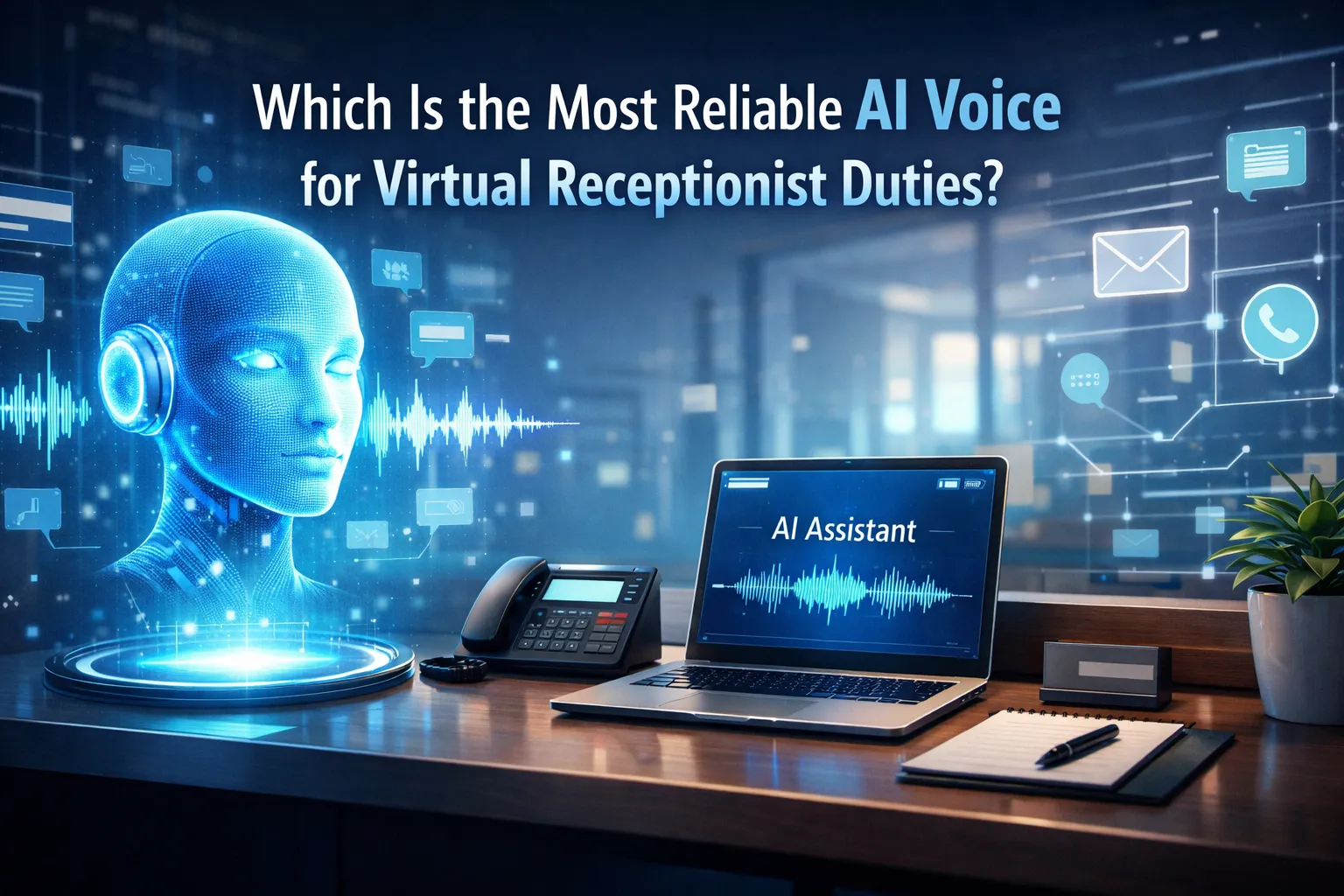
A missed call is often a missed opportunity, and in today’s immediate-gratification economy, it is likely a lost customer. Statistics indicate that roughly 60% of customers hang up if placed on hold for more than one minute, and 85% of those callers will not call back. This reality has driven businesses toward automation, but not all automation is created equal. Finding the most reliable AI voice for virtual receptionist duties is no longer just about having a machine answer the phone; it is about replicating a high-quality human interaction that captures leads, solves problems, and integrates with your business logic instantly.
The most reliable ai voice for virtual receptionist duties utilizes advanced large language models (LLMs) and neural text-to-speech technology to understand nuance, manage interruptions, and execute complex workflows without fatigue. While traditional IVR systems frustrate users with rigid menus, modern conversational AI offers a fluid, empathetic, and efficient alternative.
Below is a comparison of how a reliable AI solution stacks up against traditional staffing models.
| Feature | Human Receptionist | Standard IVR System | Reliable AI Voice (The DBT AI) |
|---|---|---|---|
| Availability | 8-10 hours/day (Weekdays) | 24/7 | 24/7 |
| Concurrency | 1 call at a time | Unlimited (Queue based) | Unlimited (Simultaneous) |
| Response Time | Variable (Hold times common) | Instant (Menu based) | Instant ( < 500ms latency) |
| Cost Efficiency | High (Salaries + Benefits) | Low | Low (Fixed operational overhead) |
| Lead Qualification | High (Requires training) | None | High (Script & Sentiment based) |
| Scalability | Slow (Hiring process) | High | Instant |
Which Are the Most Reliable AI Voice for Virtual Receptionist Duties?
To understand reliability, we must first define the scope of the role. An AI virtual receptionist is not merely a voicemail replacement; it is an intelligent operational asset. Its primary duties revolve around managing inbound communications with the sophistication of a trained human staffer but without the biological limitations.
These systems utilize natural language processing (NLP) to decipher user intent. Whether a caller wants to check business hours, reschedule a consultation, or speak to a specific department, the AI parses the request and acts immediately. A critical function is intelligent call routing, where the system determines if a call requires human intervention or if it can be handled autonomously. Furthermore, they handle instant lead response, ensuring that potential revenue is captured the moment interest is shown, rather than hours later.
For service-based businesses, the ability to execute bi-directional calendar sync is paramount. This ensures that when the AI books a meeting, it checks real-time availability and updates the CRM immediately, preventing double-bookings and administrative chaos. For a deeper understanding of the foundational technology, you can read about what is an ai receptionist a system that maintains high performance under pressure while delivering a customer experience (CX) that feels natural and helpful. Below are the critical components that constitute a truly reliable system.
1. Human-Like Latency and Response Speed
The most immediate indicator of reliability is latency. In a natural conversation, humans typically respond within 200 to 500 milliseconds. If an AI takes two or three seconds to process a response, the illusion breaks, and the caller becomes frustrated, often assuming the call has dropped.
Reliable voice AI utilizes optimized edge computing and efficient LLMs to achieve human-like latency. This speed ensures the conversation flows back and forth without awkward pauses, maintaining the caller’s engagement. When you deploy an AI phone assistant, this speed is the difference between a satisfied lead and a hung-up call.
2. Neural Text-to-Speech (TTS) Quality
Reliability is also auditory. Early robotic voices caused caller fatigue and mistrust. Modern reliable systems use neural text-to-speech engines that synthesize speech waves from text in real-time. These engines are trained on vast datasets of human speech to replicate intonation, breath pauses, and cadence.
A reliable AI voice does not sound like a computer reading a script; it sounds like a professional representative. This sonic quality establishes trust immediately, which is vital for industries like healthcare or law where empathy is required. For businesses looking for a specific brand image, a customizable AI voice receptionist can be tuned to sound authoritative, friendly, or formal.
3. Concurrency and Scalability
A human receptionist can only handle one phone call at a time. If three customers call simultaneously, two go to voicemail. Reliability in an AI context means unlimited concurrency. A robust system can scale from handling five calls to five thousand calls simultaneously without a degradation in voice quality or processing speed. This is crucial for marketing campaigns that generate sudden spikes in traffic. By using a [24/7 call answering) Reliability is synonymous with understanding.
Callers do not always use specific keywords; they use slang, idioms, and indirect phrasing. A reliable AI utilizes advanced NLP to understand context. If a caller says, “I need to see someone about a toothache,” the system must understand this as an “emergency appointment” request for a dentist, not just a general query. This level of comprehension reduces the friction of the interaction. The ability of the system to parse complex sentences ensures that the AI appointment booking process is accurate and frustration-free.
5. Interruptibility and Barge-In Capability
In natural conversation, people interrupt each other to correct details or ask quick questions. A rigid AI that forces a caller to listen to a full paragraph of text before speaking is unreliable because it ignores social dynamics.
“Barge-in” capability allows the AI to stop speaking the moment the user makes a sound, listen to the new input, and adjust its response accordingly. This feature makes the interaction feel respectful and responsive. It is a key feature of a sophisticated virtual receptionist service that prioritizes user experience.
6. Robust Integration Ecosystem
A voice AI is only as reliable as the data it can access. It must integrate deeply with existing business tools. This includes CRM integration (Salesforce, HubSpot, GoHighLevel) to pull caller history and bi-directional calendar sync to manage schedules.
If the AI promises a slot that is actually taken because the sync is slow, it fails its primary duty. Reliability here means real-time API calls that fetch and push data instantly. You can review how these connections work on our app integration page, ensuring your tech stack operates as a unified entity.
7. Sentiment Analysis and Emotional Intelligence
Calls regarding billing disputes or emergency services carry emotional weight. A reliable AI uses sentiment analysis to detect the tone of the caller. If the system detects anger or high stress, it can be programmed to change its tone to be more soothing or, more importantly, to escalate the call to a human supervisor immediately. This capability acts as a safety valve, preserving brand reputation. This is particularly effective when using an AI receptionist customer service model, where customer satisfaction is the primary metric.
8. Noise Cancellation and Signal Processing
Callers contact businesses from cars, busy streets, or crowded offices. A reliable voice AI must possess strong background noise cancellation capabilities to isolate the caller’s voice from the environment. If the AI constantly asks “Could you repeat that?”, it fails the reliability test. Advanced signal processing ensures that transcription accuracy remains high even in suboptimal audio conditions. This technical robustness is what makes a best AI answering service stand out from basic automated attendants.
9. Data Privacy and Compliance
Reliability extends to how data is handled. For industries like finance and healthcare, data privacy (GDPR/HIPAA compliance) is non-negotiable. A reliable AI provider ensures that all voice data is encrypted at rest and in transit. It must also have protocols for scrubbing personally identifiable information (PII) from transcripts. Trusting an AI with your client data requires certification that the architecture is secure.
This is essential when implementing an online phone answering service account number in the first minute, a reliable AI will not ask for it again in the third minute. This “context retention” mimics human short-term memory and is vital for complex workflows like insurance claims or technical support. Advanced large language models excel at holding this context window open, allowing for a coherent and professional that answers niche questions correctly every time.
12. Fallback Logic and Error Handling
Finally, no system is perfect 100% of the time. The hallmark of reliability is how the system fails. If the AI cannot understand a caller after two attempts, or if the request is outside its scope, it must have graceful fallback logic. This usually involves routing the call to a human, taking a detailed message, or offering a callback. It should never hang up or enter a loop. This logic ensures that the customer experience (CX) remains positive even when the automation reaches its limit.
What Industries Benefited By AI Virtual Receptionist?
While almost any business with a phone line can benefit, certain industries see a compounding ROI due to high call volumes and the high value of individual leads.
Legal Services
Law firms often deal with high-stress clients who need immediate reassurance. A missed call can mean a lost case worth thousands of dollars. An AI receptionist can perform client intake, screen for conflicts of interest, and schedule consultations directly into the partners’ calendars. By utilizing a virtual receptionist for law firms, attorneys can focus on billable hours rather than administrative phone tag, ensuring that every potential claimant is heard immediately.
Healthcare and Private Clinics
Patient engagement is critical in healthcare. Missed appointments and administrative bottlenecks create massive operational overhead. AI receptionists can manage appointment reminders, handle rescheduling, and answer FAQs about pre-procedure preparations. Specifically, for private healthcare clinics, the ability to handle sensitive calls with empathy and HIPAA-compliant security transforms the patient experience, reducing no-show rates significantly.
Home Services
Plumbers, electricians, and HVAC technicians are often in the field and unable to answer phones. However, homeowners with emergencies will not leave a voicemail; they will call the next competitor. An AI solution ensures 24/7 coverage, booking jobs directly into the field team’s schedule. Implementing AI for home services guarantees that emergency calls at 2 AM are captured and routed to the on-call technician, maximizing revenue from emergency rates.
Marketing Agencies
Agencies drive traffic for clients, but if the client cannot answer the phone, the ad spend is wasted. AI acts as a safety net for lead capture. It qualifies inbound leads from campaigns instantly, distinguishing between tire-kickers and serious buyers before passing them to the sales team. For marketing agencies, this proves the ROI of their campaigns by providing transparent call logs and conversion data.
Which AI Virtual Receptionist Provider Should You Choose?
When selecting the most reliable ai voice for virtual receptionist duties, you must look beyond flashy marketing and examine the core infrastructure. You need a provider that balances neural text-to-speech realism with rigid data security and flexible integration.
The DBT AI is engineered specifically for high-performance business environments. Unlike generic chatbots wrapped in voice skins, The DBT AI is built on a proprietary stack that prioritizes lead conversion and operational stability.
We offer:
- Human-level Latency: Our infrastructure is optimized to respond instantly, ensuring calls feel like natural conversations.
- Deep Integrations: We connect natively with your CRM and calendars to automate the backend work.
- 24/7 Reliability: Our systems are built for redundancy, ensuring your phone lines are never down.
By choosing The DBT AI, you aren’t just getting an answering machine; you are installing a AI receptionist that acts as your best sales representative, working tirelessly day and night. You can explore our specific capabilities on our features page to see how we handle complex workflows that other providers cannot touch.
Conclusion
The landscape of business communication is changing. Customers demand instant responses, and the window to capture a lead is shrinking. The most reliable ai voice for virtual receptionist duties is the one that allows you to scale your operations without sacrificing the human touch. As we look toward the future, we will see trends moving toward multimodal AI that can handle voice, text, and even video interactions simultaneously, further reducing operational overhead.
However, the technology to solve your missed call problem exists today. Don’t let another lead go to voicemail.
If you are ready to modernize your intake process and capture every opportunity, we invite you to let us demonstrate The DBT Ai and show you exactly how reliable voice automation can be.
Frequently Asked Questions (FAQS)
How reliable is an AI receptionist compared to a human?
AI receptionists are statistically more reliable regarding availability and data accuracy. They operate 24/7 without breaks, sick days, or fatigue. While humans excel at complex emotional negotiation, a well-tuned AI handles 80-90% of routine interactions with higher consistency and zero wait times.
Can the AI voice handle different accents and languages?
Yes. Modern systems utilize large language models trained on diverse global datasets. This allows them to understand various accents and dialects with high accuracy. Furthermore, many systems are multilingual; you can learn more about how they perform in our article on can ai receptionists handle multiple languages effectively.
Is the setup process for an AI receptionist complicated?
No, it is designed to be user-friendly. Most businesses can be up and running quickly. The process involves selecting a phone number, integrating your calendar/CRM, and uploading your business knowledge base. The DBT AI team assists with the configuration to ensure your automated call routing system is optimized from day one.
Will my customers know they are talking to a robot?
With older systems, yes. However, with the most reliable ai voice for virtual receptionist duties, the line is blurred. The use of neural text-to-speech, natural pauses, and low latency makes the voice sound incredibly human. While transparency is recommended, many callers conduct entire bookings without realizing they spoke to an AI.
Is my client data safe with an AI receptionist?
Data privacy is a top priority for reputable providers. The DBT AI adheres to strict security protocols, including encryption and compliance standards like GDPR and HIPAA where applicable. This ensures that sensitive information collected during calls is protected better than it would be on a paper notepad at a front desk.