Every missed call represents a lost opportunity. Every delayed response chips away at customer trust. In today’s business environment, customers expect instant, personalized support that understands their needs before they finish explaining them. Traditional customer service models struggle to meet these demands, often leaving customers frustrated and businesses overwhelmed.
The answer lies in AI customer service solutions that don’t just respond to queries but anticipate needs, personalize interactions, and deliver support with human-like understanding. These intelligent systems are transforming how businesses engage with customers, turning every interaction into an opportunity to build loyalty and drive revenue.
What are AI Customer Service Solutions?
AI customer service solutions are intelligent systems that combine conversational AI, natural language processing, and machine learning to automate and personalize customer support interactions. Unlike traditional support methods that rely solely on human agents working fixed hours, these solutions provide 24/7 support through chatbots, virtual assistants, and automated systems that understand customer intent and deliver contextually relevant responses.
At their core, these solutions process customer queries using natural language processing to comprehend the meaning behind each message, regardless of how it’s phrased. Large language models enable the system to generate human-like responses, while sentiment analysis detects emotional cues to adjust the tone and urgency of support. Through machine learning, these systems continuously improve their accuracy by learning from thousands of customer interactions.
Modern AI customer service solutions integrate seamlessly with existing business systems, pulling customer data from CRM platforms like Salesforce, HubSpot, and GoHighLevel to deliver personalized support. They handle everything from simple FAQs to complex troubleshooting, routing sophisticated issues to human agents when necessary while maintaining complete conversation context.
The technology stack includes voice recognition for handling phone inquiries, automated support workflows for ticket routing, and analytics and reporting capabilities that provide insights into customer behavior patterns. Self-service portals empower customers to find solutions independently, while knowledge bases ensure every response draws from verified, up-to-date information.
| Traditional Customer Service | AI Customer Service Solutions |
|---|---|
| Limited to business hours | Available 24/7 across all time zones |
| Response time: minutes to hours | Response time: seconds |
| Inconsistent quality based on agent | Consistent, data-driven responses |
| High operational overhead | Reduced costs, scalable infrastructure |
| Manual ticket routing | Intelligent call routing and automation |
| Limited personalization | Deep personalization using customer data |
| Struggles with high volume | Handles unlimited concurrent interactions |
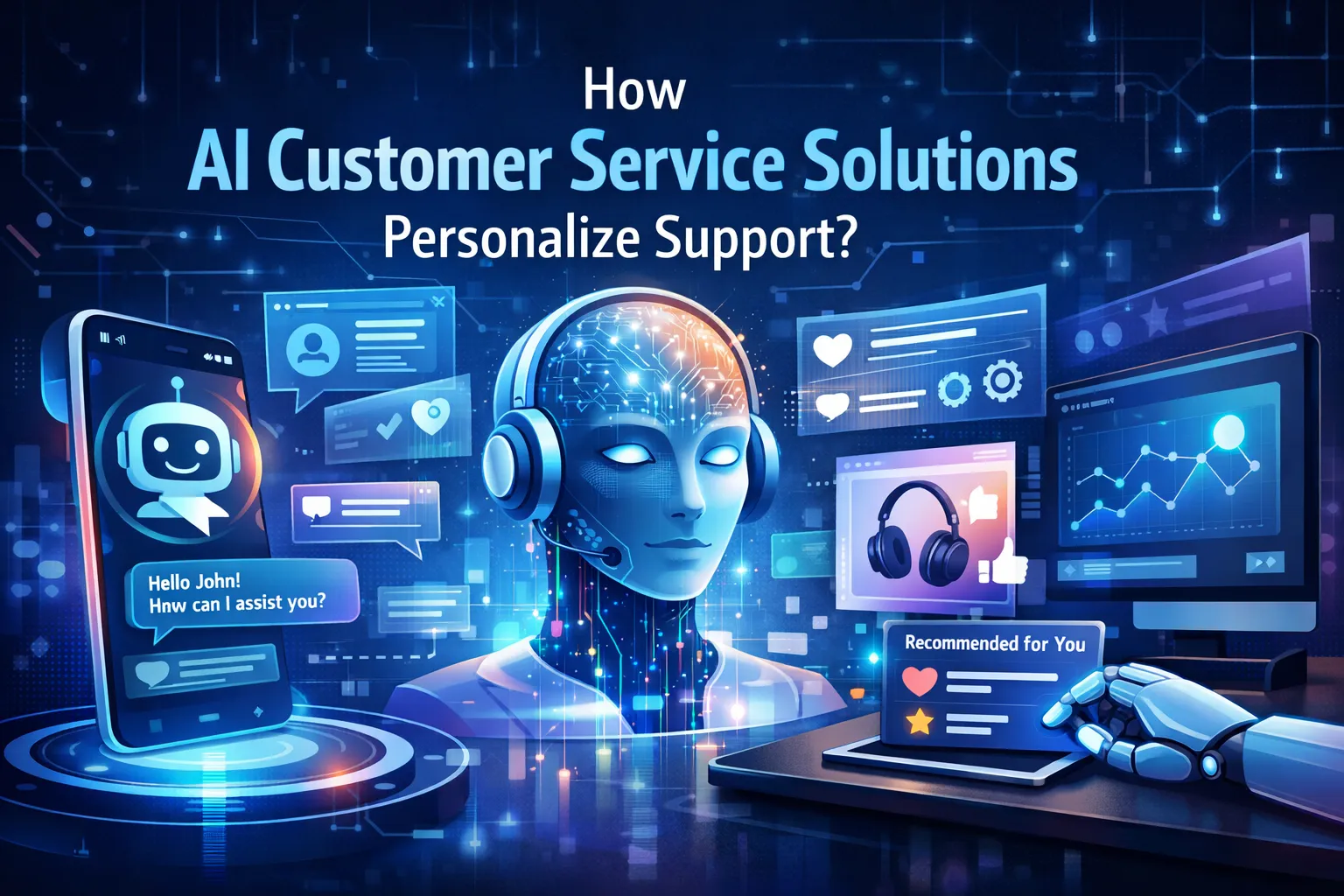
How AI Customer Service Solutions Personalize Support?
The true power of AI customer service solutions lies in their ability to transform generic interactions into tailored experiences that resonate with each individual customer.
Here’s how these systems create personalized support at scale.
Analyzing Historical Customer Data for Context
AI systems examine every previous interaction a customer has had with your business to build a comprehensive understanding of their journey. When a customer reaches out, the system instantly retrieves their purchase history, past support tickets, product preferences, and communication patterns. This contextual awareness means customers never have to repeat information or explain their situation from scratch.
For instance, when implementing an AI receptionist for your business, the system remembers that a customer called three days ago about a delayed shipment and proactively provides an update without being asked. This level of personalization reduces frustration and shows customers that your business values their time.
Detecting User Intent Through Natural Language Processing
Natural language processing enables AI systems to understand what customers actually want, not just what they say. The technology analyzes sentence structure, keywords, context, and conversational nuances to identify the underlying intent behind each message. A customer typing “I can’t log in” might actually need password reset assistance, account recovery, or technical support for a system issue.
By accurately detecting user intent, AI customer service solutions route customers to the right resource immediately. The system doesn’t waste time asking clarifying questions that frustrate users; instead, it interprets the request and provides the most relevant solution. This intent recognition capability is especially valuable for businesses using automated call answering service systems that need to understand spoken queries in real-time.
Delivering Real-Time Response Personalization
Every customer interaction receives a uniquely tailored response based on multiple data points processed in milliseconds. AI systems consider the customer’s communication history, current emotional state detected through sentiment analysis, time of day, device being used, and urgency level to craft the perfect response. A frustrated customer who has contacted support multiple times receives a different response tone than a first-time user with a simple question.
This real-time personalization extends to product recommendations, troubleshooting steps, and even the complexity of language used. The system adjusts its vocabulary and explanation depth based on the customer’s technical proficiency demonstrated in past interactions, ensuring every response hits the mark.
Implementing Predictive Analytics for Proactive Support
Rather than waiting for problems to arise, AI customer service solutions use predictive analytics to anticipate customer needs and intervene before issues escalate. By analyzing patterns across thousands of customer journeys, the system identifies when a customer might encounter difficulties and offers assistance proactively. If data shows that customers who purchase a specific product frequently need setup help within 48 hours, the AI automatically sends personalized guidance before the customer even reaches out.
This predictive capability transforms customer engagement from reactive to proactive, significantly reducing support tickets while improving customer experience. Businesses utilizing AI appointment booking systems can predict when customers are likely to reschedule and offer convenient alternatives ahead of time.
Personalizing Communication Channels Based on Customer Preferences
Different customers prefer different communication channels, and AI systems learn these preferences over time. Some customers consistently choose chat support, while others prefer phone calls or email. AI customer service solutions automatically route communications through each customer’s preferred channel and adjust the interaction style accordingly.
For multichannel support scenarios, the system maintains conversation continuity across platforms. A customer who starts a conversation via chat and later calls can pick up exactly where they left off without repeating information. This channel personalization respects customer preferences and creates a frictionless experience that builds loyalty.
Customizing Response Tone and Language Style
AI systems adapt their communication style to match each customer’s tone and language preferences. A customer who uses formal language receives professional, structured responses, while someone with a casual communication style gets friendly, conversational replies. This tone matching creates rapport and makes interactions feel more natural and less robotic.
The technology also adjusts complexity levels based on the customer’s demonstrated understanding. Technical users receive detailed explanations with specific terminology, while less technical customers get simplified, step-by-step guidance. For businesses serving diverse markets, solutions like bilingual AI receptionist systems can switch languages mid-conversation to accommodate customer preferences.
Providing Product Recommendations Based on Behavior
AI customer service solutions don’t just solve problems; they create opportunities by analyzing customer behavior to suggest relevant products or services. The system examines browsing patterns, purchase history, abandoned carts, and similar customer profiles to make highly targeted recommendations during support interactions. When a customer contacts support about a product issue, the AI might suggest complementary items or upgrades that genuinely enhance their experience.
These recommendations feel helpful rather than pushy because they’re based on actual customer needs and demonstrated interests. The system knows when to recommend and when to focus purely on problem resolution, ensuring personalization enhances rather than detracts from the support experience.
Adapting Support Complexity to Customer Knowledge Level
Not all customers require the same level of detail when resolving issues. AI systems assess each customer’s technical proficiency and familiarity with your products through their interaction history and adjust support accordingly. A first-time customer receives comprehensive, beginner-friendly guidance with screenshots and detailed steps, while a repeat customer who has successfully completed similar tasks before gets concise, advanced instructions.
This adaptive complexity prevents customer frustration from both over-explanation and under-explanation. The AI recognizes when customers are struggling and automatically provides additional resources or escalates to human agents before frustration builds.
Leveraging Sentiment Analysis for Emotional Intelligence
Sentiment analysis capabilities enable AI customer service solutions to detect emotional cues in customer communications and respond with appropriate empathy. The system identifies frustration, urgency, satisfaction, confusion, and other emotional states through word choice, punctuation, capitalization, and message pacing. When sentiment analysis detects a highly frustrated customer, the AI adjusts its response to be more empathetic, offers immediate escalation options, and may automatically prioritize the ticket.
This emotional intelligence ensures that customer engagement remains positive even when addressing difficult issues. By recognizing and responding to emotions, AI creates interactions that feel genuinely caring rather than mechanically scripted.
Creating Dynamic Customer Journey Mapping
AI systems build and continuously update detailed maps of each customer’s journey through your business ecosystem. These dynamic maps track every touchpoint, interaction, purchase, support request, and engagement to create a complete picture of the customer relationship. When customers contact support, the AI uses this journey map to understand their current position in the sales cycle or product adoption curve and tailors support accordingly.
A customer in the early exploration phase receives different support than someone who has been a loyal customer for years. This journey-aware personalization ensures every interaction moves the relationship forward rather than treating each contact as an isolated event.
Automating Personalized Follow-Up Communications
After resolving customer issues, AI customer service solutions automatically generate personalized follow-up communications based on the specific interaction. Rather than generic “How did we do?” surveys, customers receive targeted follow-ups that reference their specific problem, the solution provided, and relevant resources for future reference. The system schedules follow-ups at optimal times based on customer behavior patterns and engagement history.
These automated yet personalized follow-ups demonstrate ongoing commitment to customer success and create opportunities to identify recurring issues or upsell relevant solutions. For marketing agencies and businesses focused on client retention, this automated touch maintains relationships without requiring constant manual effort.
Integrating Cross-Platform Customer Data
True personalization requires a unified view of customer interactions across all platforms and touchpoints. AI customer service solutions integrate data from your website, mobile app, social media, email campaigns, purchase systems, and support channels to create comprehensive customer profiles. When a customer contacts support, the AI knows they recently browsed specific products on your website, opened a promotional email, and made a purchase through your mobile app.
This cross-platform integration eliminates information silos and ensures every team member or automated system has access to complete customer context. The result is seamless, personalized support that acknowledges the entire customer relationship rather than treating each channel as separate. Organizations leveraging AI business phone system solutions benefit enormously from this integrated approach.
Optimizing Response Timing Based on Customer Patterns
AI systems learn when each customer is most receptive to communications and schedules interactions accordingly. Some customers engage more during business hours, while others prefer evening communications. By analyzing engagement patterns, the AI ensures messages, follow-ups, and proactive outreach arrive when customers are most likely to respond positively.
This timing optimization extends to understanding customer urgency patterns. The system recognizes customers who typically need immediate responses versus those who prefer detailed responses even if they take slightly longer. By respecting these individual timing preferences, AI customer service solutions reduce message fatigue and increase engagement rates.
Generating Personalized Self-Service Content
Rather than directing all customers to the same generic help articles, AI systems generate or curate personalized self-service content based on individual needs. When customers visit your knowledge base, the AI analyzes their history, current issue, and demonstrated knowledge level to present the most relevant articles in the most helpful format. Advanced systems even dynamically generate custom tutorials or troubleshooting guides tailored to specific scenarios.
This personalized self-service empowers customers to solve problems independently while ensuring they receive exactly the information they need without wading through irrelevant content. Businesses implementing AI scheduling assistant tools can provide customers with personalized appointment management guidance based on their booking history and preferences.
What Industries Benefited By AI Receptionists?
AI customer service solutions deliver transformative results across diverse industry sectors, each experiencing unique benefits tailored to their specific operational challenges.
Real Estate Agents
Real estate agents face constant communication demands from prospective buyers, sellers, and existing clients. An AI phone answering service ensures no lead goes unanswered, qualifies prospects automatically, and schedules property viewings even during showings or after hours. The system personalizes interactions based on property preferences and budget ranges discussed in previous conversations.
Legal Services & Law Firms
Legal services & law firms require sophisticated client intake and appointment scheduling while maintaining strict confidentiality. A virtual receptionist for law firms handles initial consultations, gathers case information, and routes urgent matters appropriately. The AI understands legal terminology and can screen potential clients based on practice area specialization, ensuring attorneys focus on qualified prospects.
Private Healthcare Clinics
Private healthcare clinics struggle with appointment management, patient inquiries, and administrative overhead. AI solutions for dental & private healthcare clinics automate appointment reminders, answer common medical questions within HIPAA compliance guidelines, and reduce no-shows through personalized engagement. The system maintains detailed patient interaction histories to provide context-aware support.
Med Spas & Aesthetic Clinics
Med spas & aesthetic clinics benefit enormously from AI that understands treatment options, pricing structures, and client preferences. Solutions for med spas & aesthetic clinics qualify leads based on desired treatments, manage consultation bookings, and follow up with personalized post-treatment care instructions. The AI can recommend complementary services based on previous treatments and demonstrated interests.
Home Services
Home services providers like plumbers, electricians, and HVAC technicians need reliable customer communication during service calls. AI receptionists for home services businesses handle emergency calls, schedule routine maintenance, provide pricing estimates, and dispatch technicians efficiently. The system recognizes repeat customers and their property history to provide more accurate service recommendations.
Coaches & Consultants
Coaches & consultants require personalized client engagement and efficient scheduling across different service packages. AI solutions for coaches & consultants automate discovery calls, qualify potential clients based on goals and budget, and maintain ongoing engagement between sessions. The technology handles payment processing, session reminders, and follow-up resource delivery.
AI Automation Agencies
AI automation agencies themselves utilize advanced AI customer service to demonstrate their expertise and manage client relationships. Solutions for AI automation agencies showcase the technology’s capabilities while handling project inquiries, technical support, and implementation scheduling. This creates a self-reinforcing demonstration of AI’s value proposition.
Which AI Receptionist Provider Should You Choose?
Selecting the right AI customer service solution requires evaluating several critical factors that separate superficial automation from genuine business transformation.
Look for providers offering true conversational AI capabilities powered by advanced natural language processing and large language models. The system should understand context, handle complex queries, and maintain conversation flow across multiple interactions. Test whether the solution recognizes intent accurately or simply matches keywords.
- Bi-directional calendar sync is non-negotiable for businesses managing appointments. The AI should integrate seamlessly with Google Calendar, Outlook, and industry-specific scheduling platforms, automatically updating availability across all systems in real-time without manual intervention.
- Intelligent call routing ensures customers reach the right resource immediately. Advanced solutions analyze conversation content, customer history, and urgency levels to route interactions appropriately, whether to specific team members, departments, or escalation workflows.
- CRM integration with platforms like Salesforce, HubSpot, and GoHighLevel transforms disconnected tools into a unified customer experience ecosystem. Every interaction should automatically update customer records, trigger workflows, and provide agents with complete context.
- Human-like latency separates premium solutions from budget alternatives. The system should respond naturally without noticeable delays, using neural text-to-speech that sounds genuinely human rather than robotic. Voice AI should handle natural conversation flow including interruptions and topic changes.
- Data privacy compliance with GDPR, HIPAA, and industry-specific regulations protects both your business and customers. Verify the provider maintains appropriate security certifications and offers data residency options for sensitive industries.
The DBT AI delivers all these capabilities in a comprehensive platform specifically designed for businesses demanding ROI and efficiency. Our AI Appointment Setter and 24/7 AI receptionist doesn’t just answer phones—it qualifies leads, books appointments in seconds, and integrates seamlessly with your existing systems.
The platform combines state-of-the-art conversational AI with instant lead response capabilities that ensure no opportunity slips through the cracks. With advanced features including sentiment analysis, multi-language support, and sophisticated integrations, The DBT AI transforms customer service from a cost center into a competitive advantage.
Unlike generic chatbots that frustrate customers with rigid scripts, our solution understands nuance, handles complex scenarios, and escalates appropriately while maintaining complete conversation context. The system learns continuously from interactions, improving accuracy and personalization over time without manual training.
Businesses implementing The DBT AI report dramatic reductions in operational overhead, increased lead conversion rates, and significantly improved customer experience scores. The platform’s ability to handle unlimited concurrency means your support quality never degrades during peak periods, and every customer receives immediate, personalized attention.
Conclusion
AI customer service solutions have evolved from simple chatbots into sophisticated systems that deliver genuinely personalized support at scale. By combining natural language processing, machine learning, sentiment analysis, and predictive analytics, these solutions understand customer needs at a depth impossible for traditional support models.
The future of customer engagement will see even deeper personalization as AI systems become more emotionally intelligent, context-aware, and proactive. Voice recognition technology will continue improving until customers can’t distinguish AI from human agents, while multichannel support will create seamless experiences regardless of platform.
Organizations that implement AI customer service solutions now gain first-mover advantages in customer satisfaction, operational efficiency, and revenue growth. The technology isn’t replacing human agents—it’s empowering them to focus on complex, high-value interactions while AI handles routine inquiries with superhuman consistency and speed.
The question isn’t whether to adopt AI customer service solutions, but how quickly you can implement them before competitors capture your market share. Every delayed call, frustrated customer, and missed opportunity represents revenue walking out the door.
Ready to transform your customer service into a revenue-generating machine? Schedule a trial with The DBT AI and discover how AI customer service solutions can personalize every interaction, capture every lead, and grow your business automatically.
Frequently Asked Questions (FAQs)
How do AI customer service solutions maintain data privacy and security?
AI customer service solutions implement enterprise-grade security measures, including end-to-end encryption, GDPR and HIPAA compliance, and role-based access controls. Leading platforms store customer data in secure, regionally compliant data centers and undergo regular third-party security audits. The systems process sensitive information locally when possible and use tokenization to protect personally identifiable information during transmission and storage.
Can AI customer service handle complex customer issues or only simple queries?
Modern AI customer service solutions handle both routine inquiries and complex issues through multi-step reasoning and contextual understanding. While they excel at resolving 60-80% of standard queries independently, advanced systems recognize when issues require human expertise and escalate appropriately. The AI maintains complete conversation context during handoffs, ensuring customers never repeat information. Continuous machine learning enables the system to expand its capability range over time by learning from human agent interactions.
How quickly can businesses implement AI customer service solutions?
Implementation timeframes vary based on complexity, but modern AI customer service solutions can be deployed in as little as a few days for basic functionality. Complete integration with existing CRM systems, knowledge bases, and custom workflows typically requires 2-4 weeks. Cloud-based solutions eliminate infrastructure setup time, while pre-trained models on billions of customer service interactions reduce training requirements. The fastest ROI comes from starting with high-volume, repetitive inquiries before expanding to more complex scenarios.
What ROI can businesses expect from AI customer service implementation?
Businesses implementing AI customer service solutions typically see 30-40% reduction in support costs within the first year through decreased staffing requirements and improved efficiency. Lead conversion rates often improve by 15-25% due to instant response times and 24/7 availability. Customer satisfaction scores increase by an average of 20% as wait times drop from minutes to seconds. The technology scales without proportional cost increases, meaning ROI accelerates as customer volume grows.
How do AI customer service solutions integrate with existing business systems?
Leading AI customer service platforms offer pre-built integrations with major CRM systems, helpdesk software, communication platforms, and business applications through APIs and webhooks. The systems sync bidirectionally, automatically updating customer records across all platforms in real-time. Custom integrations handle industry-specific tools and legacy systems through flexible API frameworks. Most platforms provide integration support during onboarding to ensure seamless data flow without disrupting existing workflows or requiring extensive technical resources.