Missed calls don’t just create “inconvenience”—they quietly bleed revenue. When prospects hit voicemail, sit on hold, or get transferred three times, they often call the next business on Google. For agencies and service providers, the problem gets bigger: even if you solve call handling with automation, you still need it under your brand—not someone else’s.
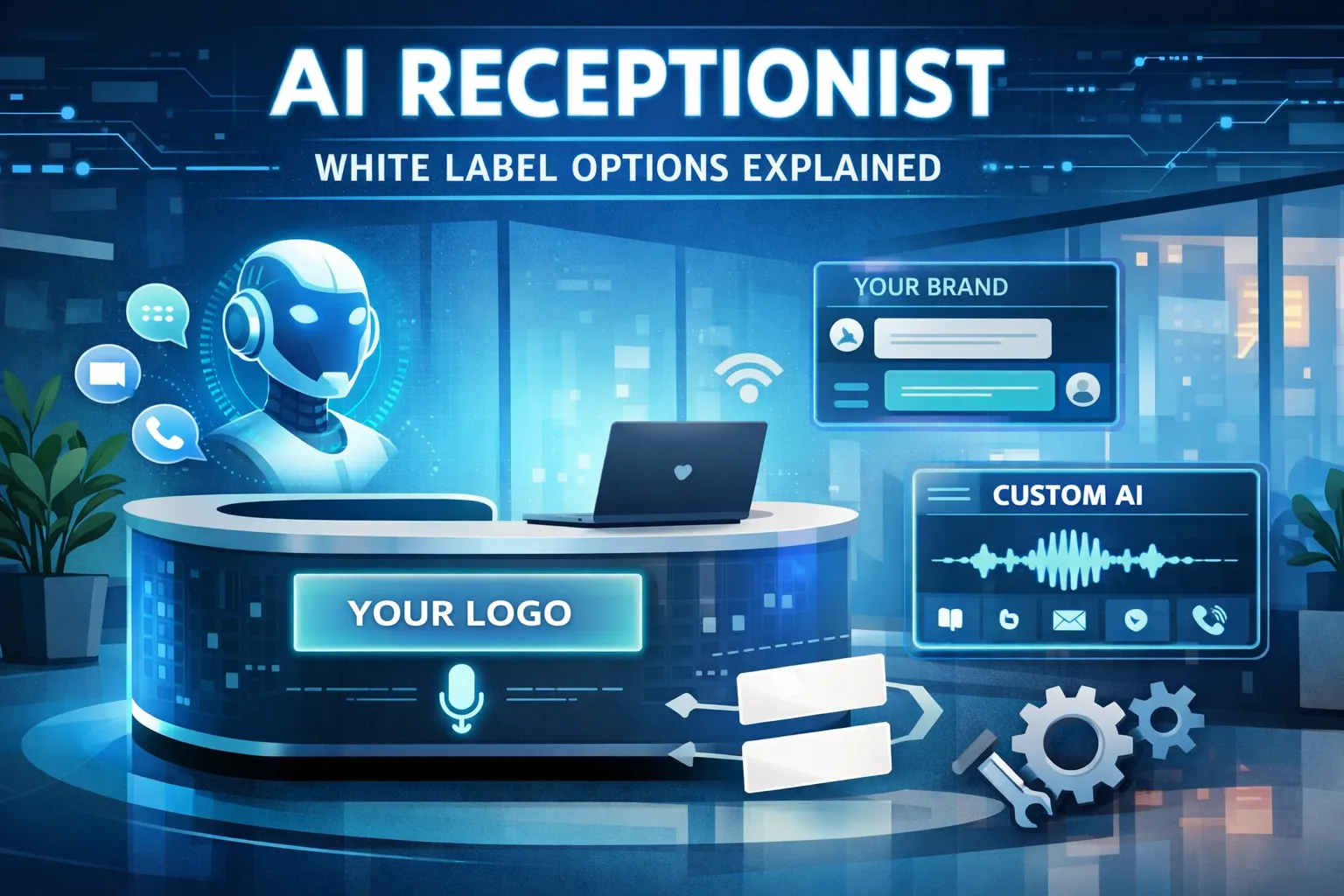
That’s exactly where an AI receptionist white label approach fits: you can sell (or use internally) a voice experience that answers, qualifies, routes, and books meetings in seconds—without hiring a full front desk team or building your own platform.
What Is An White Label AI Receptionist?
A white label AI receptionist is a label solution that lets you rebrand a ready-to-run AI receptionist as your own product or service. Under the hood, it uses conversational AI, voice AI, natural language processing (NLP), and large language models (LLMs) to understand user intent, respond naturally, and take action (like booking appointments or routing calls).
Unlike a basic IVR, it’s built for reception automation and AI customer service: it can interruptions, ambiguous questions, multilingual support, and follow-up questions—while keeping human-like latency so the caller doesn’t feel stuck in a “robot menu.”
Key elements typically include:
- brand customization (business name, call flows, tone, and voice)
- voice recognition and neural text-to-speech for natural conversations call routing rules and intelligent call routing for the right destination
- lead qualification questions for better lead conversion
- bi-directional calendar sync so bookings happen in real time
- crm integration to keep client management accurate across systems
- data privacy controls (including GDPR/HIPAA compliance)
- concurrency to handle multiple calls at once during peak volume
- optional live chat integration for multi-channel coverage
- remote receptionist coverage without staffing overhead
If you want a deeper primer, this breakdown of what is an ai receptionist helps clarify how modern voice systems differ from legacy phone trees.
AI Receptionist White Label vs Traditional Reception: Key Differences
| Capability | receptionist / answering service | AI receptionist white label |
|---|---|---|
| Availability | Limited to office hours or staffing | 24/7 call coverage with concurrency |
| Speed to respond | Depends on staffing and queues | instant lead response (no waiting) |
| Consistency | Varies by agent and training | consistent scripts + policy rules |
| Call handling | One caller per agent | many callers at once (concurrency) |
| Booking | Often manual callbacks | real-time booking via bi-directional calendar sync |
| Lead capture | Notes can be incomplete | structured lead qualification + CRM fields |
| CX quality | Great on a good day, inconsistent at scale | stable customer experience (CX) with human-like latency |
| Compliance Training-dependent | configurable data privacy controls (GDPR/HIPAA compliance) | |
| Cost | grows with headcount | reduces operational overhead with predictable pricing |
The Explanations of AI Receptionists White Label Options
White label options aren’t “one size fits all.” Some are built for simple call routing; others are built for appointment setting, lead generation, and deep client management across CRMs. Below is a practical map of the most common options you’ll see—and how to choose based on outcomes (conversion, overhead, CX), not just features.
Option 1: Call answering + branded greeting (baseline white label)
This is the entry-level white label setup: callers get a branded greeting, the system collects basic details, and routes calls based on simple rules. It’s still valuable because it cuts operational overhead by capturing every inbound lead—even after hours—and it gives you a remote receptionist presence without staffing gaps. Many providers package this as a resellable white label answering service for agencies that want to start selling quickly without heavy integration work.
Option 2: Intelligent call routing (departments, locations, urgency)
Here, intelligent call routing goes beyond “Press 1 for Sales.” The voice AI uses user intent to identify what the needs (“I need to reschedule,” “emergency leak,” “billing question”) and routes accordingly—often reducing and repeat calls. This can also include fail logic: if a rep doesn’t answer, route to a backup team, then capture details for a callback. If you’re mapping this into a product package, it often aligns with an automated call routing system offer because routing outcomes are easy to measure (fewer missed calls, faster response, better CX).
Option 3: AI appointment booking (real-time scheduling)
This option is where white labeling becomes a revenue engine: the AI receptionist handles booking directly during the call. Instead of “we’ll call you back,” the system checks availability and confirms the slot instantly That depends on bi-directional calendar sync so times stay accurate and double-bookings don’t happen. For providers selling this outcome, it maps naturally to AI appointment booking because the value is tangible: more booked calls fewer delays, higher lead conversion.
Option 4: AI scheduling assistant for reschedules, cancellations, and waitlists
A strong white label package includes more than “new appointment created.” It handles reschedules, cancellations, and “earliest available” requests—without requiring staff involvement. It can also offer waitlist logic: if a slot opens, it can call or message qualified leads. If market is appointment-heavy, packaging it as an AI scheduling assistant makes sense because it reduces no-shows and keeps calendars full without manual back-and-forth.
Option 5: Lead qualification and routing to sales (not just message-taking)
Higher-performing systems conduct lead qualification in the conversation: budget range, timeline, location, service type, and urgency—then route “hot” leads to the right rep. This is where conversational AI and LLMs matter most: callers don’t speak in tidy form fields and the model must interpret intent, context, and constraints. If your goal is pipeline qualitynot call volume), the right package focuses on qualified appointments and reduced time wasted on bad-fit leads.
For a broader view on measurable outcomes, this guide on ai receptionist benefits connects common call-handling improvements to business results.
Option 6: CRM integration (Salesforce, HubSpot, GoHighLevel) for client management
White labeling becomes “stickier” when calls create structured data. With crm integration, the AI receptionist can create/update contacts, log call outcomes, attach qualification notes, and trigger follow-up tasks—so sales teams don’t live in spreadsheets. This also reduces operational overhead because the admin work doesn’t up after peak hours. When evaluating providers, confirm if they support CRM integration (Salesforce, HubSpot, GoHighLevel) and whether setup is supported through a dedicated integrations page like CRM integration rather than custom engineering every time.
Option 7: Sentiment analysis for escalations and save-the-call moments
Sentiment analysis helps the system detect frustration, confusion, or urgency—and respond with better CX moves: slower speech, clearer summaries, or immediate escalation. For example, if a caller says “I’ve called three times,” the system can route to a priority queue and capture context so the human agent isn’t starting cold. This option directly impacts customer (CX) and protects reputation, especially for businesses with high-stakes inbound calls.
Option 8: Multilingual support and accent handling (growth beyond one language)
Multilingual support is no longer “nice to have” in many markets. White label solutions that support multiple languages reduce missed opportunities and improve service accessibility, while voice recognition helps handle accents and noisy environments. The best ones keep human-like latency even when switching languages mid-call. If you operate across regions or support diverse callers, multilingual performance becomes part of your product promise—not an add-on.
If multilingual is central to your offer, this article on can ai receptionists handle multiple languages effectively can help you set realistic expectations for quality and coverage.
Option 9: Neural text-to-speech and “brand voice” control
Neural text-to-speech can sound natural enough that callers treat it like a trained receptionist, not a machine. In white label scenarios, “brand voice” becomes part of differentiation: tone, pacing, phrasing, compliance language, and service scripts all reflect your client’s brand customization needs. This improves CX and reduces caller drop-off—especially when the voice AI must ask several questions for lead qualification.
Option 10: Human handoff design (AI-first, human-when-needed)
A practical white label strategy is AI-first handling clean escalation paths. The AI receptionist should handle routine calls end-to-end, then hand off when the request is high-risk, emotionally charged, or policy-sensitive. This is where an AI phone assistant positioning works well, because the system acts as a first responder and triage layer before a human steps in; many businesses package this capability as an AI phone assistant to reduce frontline workload without removing humans from the loop.
Option 11: Compliance and data privacy (GDPR/HIPAA compliance) for regulated calls
If you sell into regulated industries, data privacy isn’t marketing—it’s a buying requirement. White providers should support secure storage, access controls, data retention policies, and configurable consent language. For healthcare-style scenarios, HIPAA-aligned handling matters; for EU audiences, GDPR workflows matter. This option is also about risk reduction: fewer manual errors, fewer exposed notes, clearer audit trails, and less compliance stress.
Option 12: Reporting, attribution, and ROI dashboards (prove the value monthly)
If you’re reselling, you need proof. Reporting should track lead conversion, missed-call recovery, appointment volume, call outcomes, and response time. When you can show “instant lead response reduced abandonment” or “concurrency prevented busy signals,” renewals become easier. Look for analytics that connect calls to booked, not just call counts—especially for agencies packaging voice AI as a monthly retainer.
What Industries Benefited By White Label AI Receptionist?
White label works best where inbound calls are, time-sensitive, and tied directly to revenue. Here are common high-ROI fits:
- For marketing agencies, a white label AI receptionist becomes a sellable intake engine for clients—capturing leads 24/7, improving lead generation, and pushing structured data into CRMs.
- For legal services & law firms, intelligent call routing and data privacy controls protect sensitive calls while driving consultations through consistent lead qualification.
- For private healthcare clinics, appointment setting plus reminders reduces no-shows and supports patient engagement workflows without adding front-desk strain.
- For med spas & aesthetic clinics, instant lead response matters because leads shop fast—real-time booking and follow-ups reduce drop-offs and keep calendars full.
- For home services, after-hours calls often mean urgent jobs; voice AI with concurrency prevents missed opportunities and routes emergencies correctly.
Which White Label AI Receptionist Provider Should You Choose?
Choosing a provider isn’t about collecting features—it’s about protecting conversion and reputation while lowering operational overhead.
The provider checklist (what to validate)
- Conversational quality: does it reliably understand user intent with natural dialogue?
- Call handling performance: human-like latency, interruption handling, and high concurrency
- Appointment capability: bi-direction calendar sync with real conflict checking
- Lead qualification flexibility: custom questions, routing rules, and escalation paths
- CRM integration: Salesforce, HubSpot, GoHighLevel support plus reliable field mapping
- Intelligent call routing: departments, locations, priority leads, and fallback logic
- Data privacy: GDPR/HIPAA compliance readiness based on your market
- Brand customization: white label console, sub-accounts, scripts, and voice options
- Support and iteration speed: can you adjust scripts quickly as you learn?
Where The DBT AI fits (white label built for outcomes)?
The DBT AI is built specifically for businesses and agencies that want a dependable AI appointment setter and 24/7 AI receptionist they can present as a real operational, not a “cool demo.” It combines voice AI and natural language processing (NLP) to handle calls end-to-end, and it’s designed to missed calls, improve lead conversion, and lower operational overhead.
When you’re ready to evaluate specifics, reviewing The DBT AI’s features is useful because it maps directly to the real buying criteria—calendar sync, routing, qualification, and CX performance. If your white label offer depends on reliable data flow, app integration is where CRM and workflow compatibility becomes clear.
For teams that want to package it as a core service page, this is also where an AI receptionist offering can align with your positioning and client expectations.
Conclusion
The AI receptionist white label market is moving toward deeper intent handling, better sentiment analysis, and more natural neural text-to-speech—while buyers increasingly demand measurable ROI, stronger data privacy, and tighter crm integration. The winners won’t be the loudest tools; they’ll be the ones that consistently book meetings, qualify leads, and protect customer experience (CX) at scale.
If you want to see what a branded, production-ready setup looks like for your agency or business, you can schedule a trial and evaluate call flows, accuracy, and lead qualification in real scenarios.
Frequently Asked Questions (FAQs)
How does an AI receptionist white label solution differ from a standard answering service?
A standard answering service relies on humans and fixed staffing, so performance varies with volume and training. A white label AI receptionist uses conversational AI and NLP to handle many calls at once (concurrency), keep responses consistent, and book appointments directly with calendar sync—under your branding.
Can a white label AI receptionist book appointments directly on my calendar?
Yes—if the provider supports bi-directional calendar sync, the system can check availability in real time, confirm a slot during the call, and prevent double-booking. This is a key requirement if appointment setting is part of your ROI promise### What CRMs can white label AIists integrate with?
serious providers offer crm integration options such as, HubSpot and GoHighLevel. The key is whether the system can write structured fields (lead source, notes, appointment details) and trigger workflows reliably.
Is a white label AI receptionist secure and compliant for sensitive calls?
It can be, depending on implementation. Look for strong data privacy controls, encrypted storage, access logging, and support for GDPR/HAA compliance if you serve regulated industries like healthcare or legal services.
What should I test in a demo before reselling a white label AI receptionist?
Test real call scenarios: interruptions, unclear requests, rescheduling, angry callers (sentiment analysis and escalation how fast it responds (human-like latency). Also test how lead qualification data lands in your CRM and whether the booking flow works flawlessly during peak volume.