Every missed call is a missed opportunity, and for service-based businesses, this silent revenue leak is estimated to cost the industry billions annually. The traditional solution—hiring more staff—is becoming financially unsustainable. With the average receptionist salary ranging between $35,000 and $50,000 per year, plus benefits and taxes, business owners face a difficult trade-off between operational overhead and customer experience (CX). This is where automation shifts the paradigm.
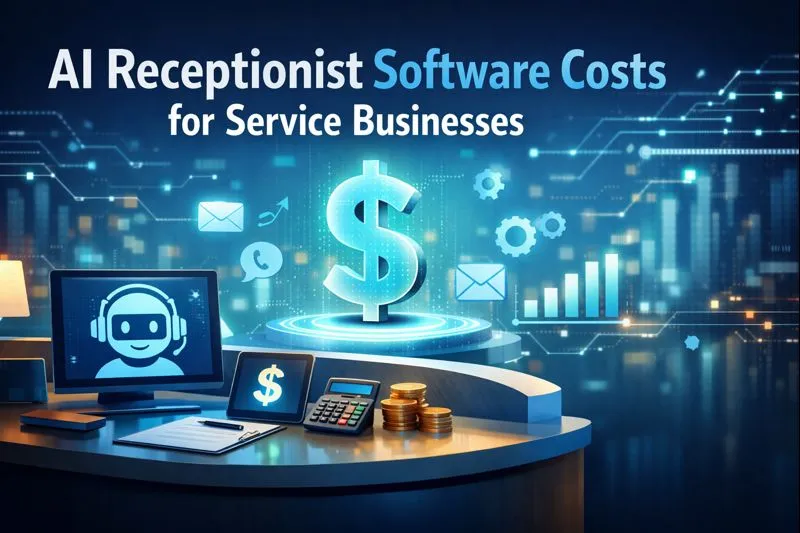
AI receptionist software costs for service businesses are a fraction of the price of human labor, typically ranging from $25 to $500 per month depending on call volume and complexity. Unlike human agents who are limited by shift hours and concurrency, AI solutions offer 24/7 availability and instant lead response. By leveraging conversational AI and large language models (LLMs), these systems do not just answer calls; they understand user intent, filter spam, and integrate with your CRM to streamline operations.
What Is An AI Receptionist Software?
An AI receptionist is more than just a digital answering machine. It is a sophisticated software solution powered by natural language processing (NLP) and neural text-to-speech technologies that allows computers to converse with humans in a natural, fluid manner. The primary goal is to handle inbound communications, execute lead qualification, and manage scheduling without human intervention.
These systems utilize intelligent call routing to direct queries to the right department or handle them entirely through automation. For example, when a potential client calls to book a service, the AI checks the calendar via bi-directional calendar sync, offers available slots, and confirms the appointment in real-time. If you want to understand the foundational technology deeper, you can read more about what is an ai receptionist and how it functions as the first line of defense for your business. The result is a system that mimics human-like latency and empathy but operates with the efficiency of a machine.
| Feature | Traditional Receptionist | AI Receptionist Software |
|---|---|---|
| Monthly Cost | $2,500 – $4,500 (Salary + Overhead) | $25 – $500 (Subscription) |
| Availability | 40 hours/week (9-5 only) | 168 hours/week (24/7) |
| Concurrency | 1 call at a time | Unlimited simultaneous calls |
| Response Time | High (hold times common) | Instant (0 wait time) |
| Training Time | 2-4 weeks | Immediate deployment |
| Data Entry | Manual (prone to error) | Automated CRM integration |
How AI Receptionist Software Costs for Service Businesses Are Calculated?
When evaluating AI receptionist software costs for service businesses, it is essential to look beyond the sticker price. The total cost of ownership involves various components, from initial setup to ongoing usage fees. Understanding these variables ensures you select a solution that provides high ROI rather than unexpected expenses.
Subscription Fees
The most visible component of the cost structure is the monthly or annual subscription fee. Most providers operate on a SaaS (Software as a Service) model. Entry-level plans often start around $25 to $99 per month. These usually cover a. This fixed cost is significantly lower than a human salary, providing a predictable expense line item.
Setup Expenses
While many modern platforms are “plug-and-play,” some require setup expenses. This can range from $0 to $1,000 depending on the complexity of your workflow. The costs usually cover the provisioning of phone numbers, porting existing business lines, and the initial configuration of the AI’s personality and knowledge base. However, many providers, including The DBT AI, aim to minimize these friction points.
If you utilize a virtual receptionist service or higher tier subscription requirements. This allows for CRM integration with platforms like Salesforce, HubSpot, and GoHighLevel. When the AI captures lead data, it pushes it directly into your pipeline. Without this, you are stuck with manual data entry, defeating the purpose of automation. You can review how seamless app integration works to justify this potential cost component.
Customization Costs
Generic scripts work for general inquiries, but specific industries often require tailored responses. Customization costs involve programming the AI to understand niche terminology—whether that is legal jargon for a law firm or medical procedures for a clinic. This might involve “prompt engineering” fees or higher tier plans that allow for deep customization of the LLMs. Advanced customization ensures the AI adheres to your brand voice and handles complex logic, such as pre-qualifying leads based on specific criteria like budget or timeline.
Training Costs
Unlike humans who require weeks of shadowing and training, AI training costs are generally low or non-existent in monetary terms but require a time investment. You “train” the AI by uploading knowledge bases, FAQs, and past call transcripts. Some premium providers offer “white-glove” onboarding where their team trains the AI for you, costing between $200 and $1,000. However, once trained, the AI retains that knowledge indefinitely without retraining, unlike high-turnover human staff.
Licensing Fees
If you are running a franchise or a multi-location business, you may encounter per-location licensing fees. This structure ensures that each branch has its own dedicated line and calendar configuration while feeding data into a central corporate dashboard. While a single license might cost $50/month, bulk licensing often comes with discounts. This is particularly relevant for businesses using a white label answering service to resell the technology or deploy it across a large network.
Monthly Charges for Usage
Many AI pricing models are hybrid: a base subscription fee plus usage costs. Usage is typically billed per minute of conversation, ranging from $0.05 to $0.20 per minute. This variable cost is critical for service businesses with seasonal spikes. For instance, an HVAC company might see call volume triple in the summer. Paying for usage ensures you only pay for the value you receive. It is vital to calculate your average monthly call minutes to estimate this accurately and avoid surprises.
Implementation Costs
For larger organizations, implementation goes beyond basic setup. It involves mapping out the entire customer journey, setting up intelligent call routing trees, and ensuring the voice AI interacts correctly with other automated workflows. Implementation costs ($300–$800) might also cover testing phases to ensure human-like latency and accuracy before flipping the switch for the general public. Investing in proper implementation upfront prevents lost leads due to technical glitches later.
Update and Maintenance
Software is never static. Update and maintenance fees are often bundled into the subscription, covering improvements to the natural language processing engines and security patches. This ensures your system remains compliant with regulations like GDPR and HIPAA compliance. If you are using a self-hosted or highly custom solution, maintenance might be a separate line item ($50-$200/mo) to ensure the server uptime and API connections remain stable.
Per-User or Per-Seat Fees
Some platforms charge based on the number of team members who need access to the dashboard to review calls and listen to recordings. While the AI handles the calls, your sales team needs access to the data. Per-seat fees usually range from $10 to $30 per user. However, many ai phone answering service providers offer unlimited team access to encourage collaboration and transparency within the organization.
Call Volume Scaling
As your business grows, your AI costs will scale, but far less aggressively than hiring humans. Scaling costs usually involve moving to a higher tier that offers bulk minute discounts. The beauty of AI is the concept of concurrency—the ability to handle infinite calls at once. You do not need to pay for a second or third receptionist line; you simply pay for the aggregate minutes used. This scalability is a massive advantage for businesses looking to expand without increasing operational overhead.
Add-On Feature Costs
Finally, consider add-ons. Features like multi-language support, SMS follow-ups, or dedicated toll-free numbers may carry extra costs ($5–$50/mo). For example, a bilingual ai receptionist allows lawyers to focus on billable hours rather than administrative intake.
What Industries Benefited By AI Receptionist Software?
Healthcare and Medical
Clinics face high volumes of scheduling calls. An AI system handles HIPAA-compliant appointment booking and reminders, drastically reducing no-shows. By using automation for private healthcare clinics, staff can focus on patient care rather than the phone.
Home Services
Plumbers, electricians, and HVAC technicians are often in the field and cannot answer the phone. If a customer has a leak, they will call the next number if you don’t answer. AI ensures home services professionals capture that business 24/7, booking jobs directly into their dispatch software.
Med Spas and Aesthetics
High-ticket service providers require a premium experience. An ai appointment booking system for med spas & aesthetic clinics can answer questions about procedure pricing and recovery times, securing the booking when the client’s intent is highest.
Agencies and Consulting
For marketing agencies and coaches & consultants, qualifying leads is crucial to avoid time-wasters. AI can ask pre-qualification questions regarding budget and authority before letting a lead book a discovery call.
Which AI Receptionist Software Provider Should You Choose?
When selecting a provider, you must weigh the **AI receptionist software costsceptionist/best-ai-answering-service) that integrates seamlessly with your existing tools.
The DBT AI stands out by focusing on tangible business outcomes: booked meetings and qualified leads. Our proprietary automation logic minimizes the “hallucinations” common in generic LLMs, ensuring your brand reputation is safe. We offer an all-encompassing AI receptionist solution that includes bi-directional calendar sync, intelligent call routing, and instant lead response capabilities.
Unlike competitors that hide behind complex implementation fees, The DBT AI provides a clear path to ROI. Our system is designed to reduce operational overhead while maximizing lead conversion. By leveraging our features, you are not just buying software; you are hiring a 24/7 employee that never sleeps, never takes a sick day, and improves with every interaction.
Conclusion
The trajectory of business communications is clear: automation is no longer optional; it is a competitive necessity. As technology advances, AI receptionist software costs for service businesses will continue to stabilize, offering even more advanced features like emotion detection and predictive analytics for the same price. By adopting this technology now, you position your business to capture more market share, reduce overhead, and provide a superior customer experience.
Schedule a trial with The DBT AI today and transform your missed calls into revenue.
Frequently Asked Questions (FAQS)
How much does an AI receptionist cost on average?
Most AI receptionist services range between $25 and $500 per month. The price variation depends on the number of minutes used, the complexity of the features (like CRM integration), and the level of customization required for your business.
Are there setup fees for AI receptionist software?
It varies by provider. Some charge a one-time setup fee ranging from $100 to $1,000 to configure scripts and port numbers, while others offer free onboarding or include it in the annual subscription to lower the barrier to entry.
Is an AI receptionist cheaper than a virtual assistant?
Yes, significantly. A virtual assistant typically costs between $1,500 and $3,000 per month and has limited working hours. An AI receptionist operates 24/7 for a fraction of that cost, usually under $300 for comparable call volumes.
Can AI receptionist software integrate with my calendar?
Absolutely. Most modern AI solutions offer bi-directional calendar sync with Google Calendar, Outlook, and specialized industry schedulers. This allows the AI to book appointments in real-time without double-booking.
What happens if the AI cannot answer a question?
If the AI encounters a query outside its training, intelligent call routing protocols take over. The call can be forwarded to a human staff member, or the AI can take a message and flag it for immediate follow-up, ensuring no inquiry is lost.