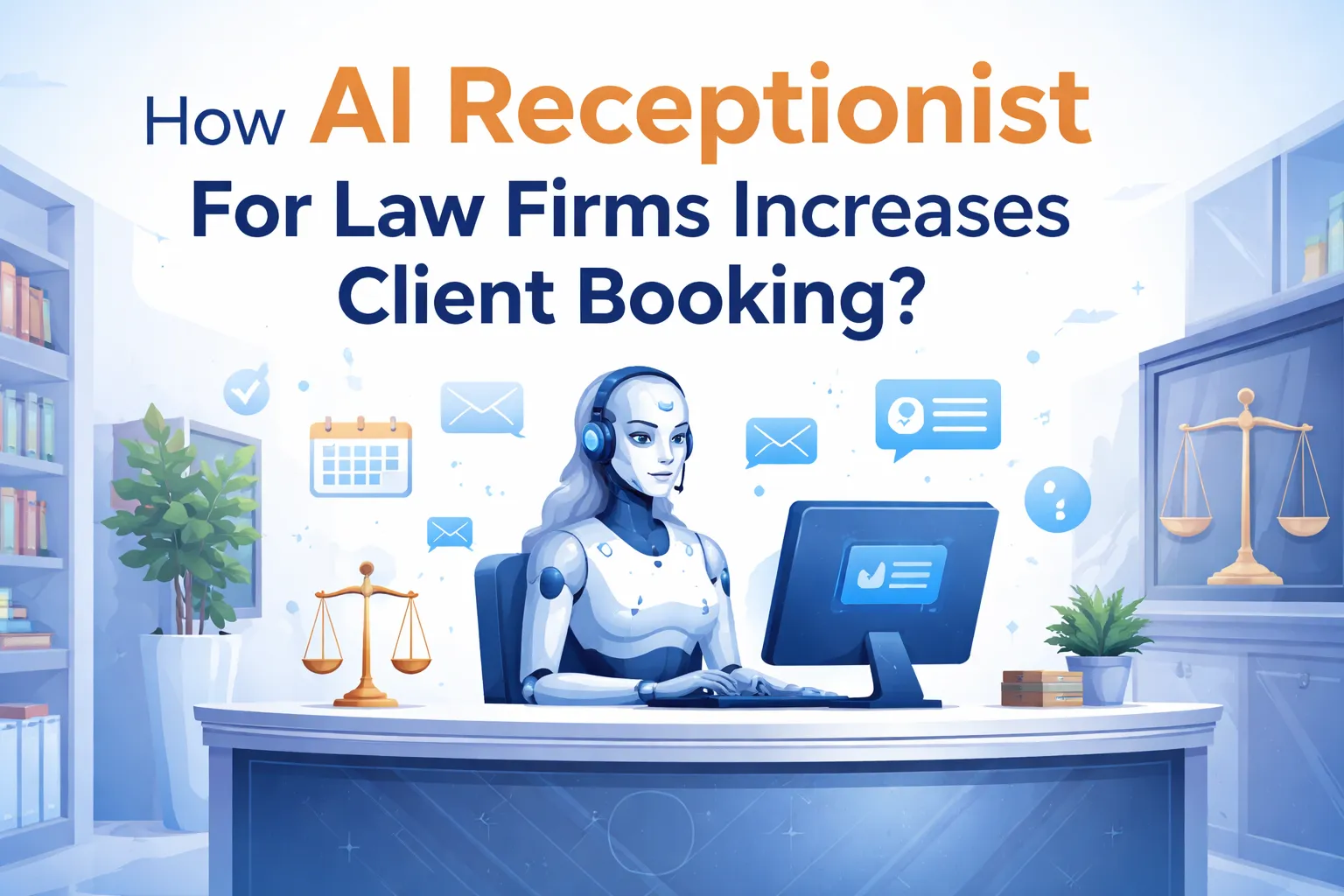
For a busy law practice, a ringing phone represents two opposing realities: a potential high-value case or a disruptive distraction during deep legal work. If you are in court, in a deposition, or simply focused on a brief, you cannot answer. If the call goes to voicemail, statistics suggest you have likely lost that lead to the next firm on Google.
The legal industry is governed by responsiveness. Clients seeking representation are often in distress or urgent need. They do not leave voicemails; they keep dialing until a human answers. This operational bottleneck is where an AI receptionist for law firms transforms the intake process. By moving beyond traditional answering services and deploying intelligent voice automation, firms can capture every lead, qualify clients instantly, and fill their calendars without lifting a finger.
What Is AI Receptionist For Law Firms?
An AI receptionist for law firms is a sophisticated voice automation solution driven by conversational AI and natural language processing (NLP). Unlike standard auto-attendants that force callers to press buttons (“Press 1 for intake”), an AI receptionist understands spoken language, detects user intent, and converses with callers just as a human paralegal or secretary would.
These systems utilize large language models (LLMs) to manage complex interactions. They can answer questions about your practice areas, screen potential clients based on your specific criteria, and integrate directly with your digital infrastructure. The technology provides a virtual front desk experience that is available 24/7, ensuring that your firm never misses a billable opportunity due to human capacity limits.
Comparison: AI Receptionist vs. Traditional Methods
To understand the return on investment, we must look at the operational overhead and performance metrics of AI solutions compared to traditional human staffing or outsourced call centers.
| Feature | Traditional / Human Receptionist | Outsourced Answering Service | AI Receptionist (The DBT AI) |
|---|---|---|---|
| Availability | 8 hours/day (Weekdays) | 24/7 (Often with hold times) | 24/7 (Instant pick-up) |
| Response Time | Variable (often on other lines) | 1–5 minutes | < 2 seconds |
| Concurrency | 1 call at a time | Limited by staffing levels | Unlimited simultaneous calls |
| Booking Speed | 3–5 minutes (manual entry) | Variable (often just message taking) | 30–60 seconds |
| Cost Efficiency | High (Salary + Benefits) | Moderate (Per minute billing) | High (90%+ cost reduction) |
| Accuracy | Subject to human error | Script-dependent | 99.9% consistency |
12 Ways AI Receptionist For Law Firms Increases Client Booking
Implementing this technology is not merely about answering phones; it is about systematically optimizing your conversion pipeline. Below are the specific mechanisms through which an AI receptionist for law firms drives appointment volume.
1. Zero-Wait Response Time
In the legal sector, speed to lead is the single most critical factor in conversion. If a potential client is calling about a DUI, a divorce, or an accident, they are in a state of high urgency. An AI phone answering service picks up instantly—usually within the first ring. By eliminating hold times and the frustration of navigating complex IVR menus, you significantly reduce the abandonment rate. When a client connects immediately, trust is established, and the likelihood of booking a consultation increases exponentially.
2. 24/7 After-Hours Capture
Legal issues do not adhere to a 9-to-5 schedule. A significant portion of inquiries occurs evenings and weekends when your office is closed. A traditional voicemail is a dead end, but a 24/7 call answering service powered by AI ensures that a caller at 11 PM receives the same level of service as one at 11 AM. The AI can conduct a full intake and book a consultation for the next morning, securing the client before your competitors even open their doors.
3. Intelligent Lead Qualification
Not every caller is a match for your firm. Spending time on low-quality leads drains resources. Through advanced NLP, the AI can ask specific qualifying questions—such as “When is your court date?” or “In which county did the incident occur?”—to determine if the lead fits your criteria. This lead qualification process ensures that only viable potential clients are directed to your calendar, protecting your attorneys’ valuable time.
4. Bi-Directional Calendar Sync
One of the most powerful features of modern voice AI is bi-directional calendar sync. The AI does not just take a message asking for a callback; it accesses your calendar in real-time to see available slots. It verbally offers these times to the caller (“I have an opening tomorrow at 10 AM or 2 PM, which works for you?”). Once the caller agrees, the AI appointment booking engine locks that slot instantly, preventing double-booking and removing the back-and-forth email tag.
5. Seamless CRM Integration
For a law firm, data is gold. An AI receptionist integrates with platforms like Salesforce, HubSpot, or legal-specific software like Clio. As the AI speaks with the client, it transcribes the conversation and populates the CRM fields automatically. This reduces manual data entry and ensures that when the attorney takes the meeting, they have the full context of the case. Effective app integration means your workflow remains uninterrupted while the database grows.
6. Removing Human Error and Emotional Fatigue
Receptionists often deal with emotionally charged clients, which can lead to burnout or abruptness that turns clients away. An AI maintains a professional, empathetic tone regardless of the caller’s mood or the volume of calls. By utilizing neural text-to-speech, the voice sounds natural and comforting, ensuring a consistent customer experience (CX) that reflects well on your brand. This consistency is a hallmark of a high-quality virtual receptionist service.
7. Handling Unlimited Concurrency
Marketing campaigns can sometimes be too successful, flooding your lines with calls. A human receptionist can handle only one conversation at a time, forcing others to voicemail. An AI system handles unlimited concurrency, meaning it can speak to 5, 50, or 500 callers simultaneously. This scalability is vital for mass tort firms or during aggressive ad spends, ensuring every dollar of marketing spend results in a conversation, not a busy signal.
8. Sentiment Analysis for Urgency Detection
Using sentiment analysis, the AI can detect the emotional state of the caller. If a caller sounds distressed or uses keywords indicating an emergency (e.g., “arrested,” “served papers”), the system can prioritize the notification to the attorney. This intelligent layering allows firms to act fast on high-stakes cases. A sophisticated AI phone assistant recognizes that not all calls are created equal.
9. Automated Follow-Ups and Reminders
Booking the appointment is only half the battle; ensuring the client shows up is the other. AI systems can automatically trigger SMS or email confirmations immediately after the call. Furthermore, they can send reminders 24 hours and 1 hour before the meeting. This automated cadence significantly reduces no-show rates, directly impacting the firm’s bottom line.
10. Cost Efficiency Reallocated to Growth
The operational overhead of a full-time in-house receptionist (salary, benefits, taxes) is substantial. An AI solution operates at a fraction of that cost. The savings generated can be reallocated to marketing or hiring additional legal staff. Using a cost-effective AI virtual receptionist software allows smaller firms to compete with larger entities by projecting a “big firm” presence without the big firm payroll.
11. Multilingual Capabilities
In an increasingly diverse society, language barriers can cost you clients. A human receptionist usually speaks one or two languages. An AI can instantly switch between dozens of languages based on the caller’s input. A bilingual AI receptionist expands your total addressable market, allowing you to serve non-English speaking communities effectively.
12. Data Privacy and Compliance
Law firms must adhere to strict confidentiality. Top-tier AI solutions are built with data privacy (GDPR/HIPAA compliance) in mind. Unlike outsourced call centers where turnover is high and data control is loose, AI systems process data securely within encrypted environments. This makes using an AI business phone system a secure choice for sensitive legal intake.
What Industries Benefited By AI Receptionist?
While the legal sector sees massive gains, the underlying technology drives efficiency across various service-based sectors.
- Legal Services & Law Firms: As discussed, the ability to perform legal case intake, screen clients, and sync with practice management software is revolutionary for legal services & law firms.
- Medical & Dental Clinics: Private practices face similar scheduling challenges. AI assists private healthcare clinics by handling appointment reminders and basic triage questions while maintaining patient privacy.
- Real Estate: Agents are often on the road showing properties. An AI ensures that every inquiry about a listing is answered immediately, qualifying the buyer before the agent returns the call. This is crucial for real estate agents who rely on speed.
- Marketing Agencies: Agencies run lead generation campaigns for clients. Using AI to immediately qualify and book leads generated from ads ensures high conversion rates for marketing agencies and their clients.
- Home Services: Plumbers, electricians, and HVAC technicians cannot answer phones while working. An AI captures the job details and schedules the service call, keeping the pipeline full for home services providers.
Which AI Receptionist Provider Should You Choose?
Selecting the right provider is critical. You need a system that offers more than just a “talking chatbot.” You require low latency, human-like voice quality, and robust integration capabilities.
When evaluating an AI receptionist platform, look for these specific attributes:
- Neural Text-to-Speech: Does the voice sound human, or does it sound robotic?
- Latency: Is the response instant, or is there an awkward pause?
- CRM Native Integrations: Does it connect easily with your existing tech stack?
- Customization: Can you tweak the prompt to match your firm’s specific script and tone?
The DBT AI Advantage
At The DBT AI, we specialize in intelligent call routing and high-fidelity voice automation. Our system is designed to handle the nuance of legal intake, offering bi-directional calendar sync that actually works. We understand that in law, every missed call is missed revenue.
To see the impact on your firm’s efficiency, let us demonstrate The DBT Ai and show you how to automate your appointment setting completely.
Conclusion
The legal landscape is competitive, and client expectations for immediate service are at an all-time high. The traditional model of voicemail or 9-to-5 reception is no longer sufficient to capture maximum revenue. An AI receptionist for law firms offers a scalable, efficient, and cost-effective solution to the age-old problem of missed calls.
By leveraging conversational AI, firms can ensure that every lead is engaged, qualified, and booked into the calendar instantly. The technology has moved beyond novelty—it is now a fundamental tool for operational efficiency.
Future trends indicate that AI will soon handle even more complex legal triage, further blurring the line between digital and human assistance. To stay ahead of this curve and stop losing leads to voicemail, schedule a trial with The DBT AI today.
Frequently Asked Questions (FAQS)
Can an AI receptionist integrate with my existing legal software like Clio?
Yes, modern AI receptionists are designed with API capabilities to integrate seamlessly with popular legal CRMs and practice management tools. This ensures that when the AI phone assistant captures client details, the data is automatically logged into your existing workflow without manual data entry.
Is the AI conversation secure and compliant with attorney-client privilege?
Data privacy is paramount in legal tech. Reputable AI providers prioritize GDPR and HIPAA compliance, using encrypted channels to process voice data. Unlike human outsourced services where data leaks can occur, an automated system processes information strictly according to programmed security protocols.
How does the AI handle complex legal questions it doesn’t know the answer to?
The AI is trained on your specific knowledge base, but it also has safety guardrails. If a caller asks a complex legal question that requires an attorney’s advice, the AI is programmed to explain that it is an intake assistant and will flag the query for an attorney to review. This ensures you maintain professional standards while still capturing the lead using a virtual receptionist for law firms.
Will my clients know they are talking to a robot?
Advanced solutions utilize neural text-to-speech technology and low-latency processing to create a conversational experience that is nearly indistinguishable from a human. While the goal is efficiency, the empathetic tone ensures clients feel heard and respected, which is why many choose the best AI answering service available.
Can the AI receptionist handle calls after business hours?
Absolutely. One of the primary benefits is 24/7 availability. The system never sleeps, takes breaks, or calls in sick. Whether a client calls at 2 AM or on a Sunday, the 24/7 call answering service will handle the inquiry, qualify the lead, and book the appointment for you.