Imagine this: It’s 8:00 PM on a Friday. A potential client calls your office with an urgent inquiry. Instead of a busy signal or a voicemail black hole, they are greeted by a friendly, professional voice that answers their questions, qualifies their intent, and books a meeting directly into your calendar. This isn’t science fiction—it is the new standard of customer experience (CX).
For businesses today, the cost of missing a call is often the cost of missing a deal. Traditional support models—limited by human fatigue, operational hours, and rising labor costs—are rapidly being augmented by intelligent systems.
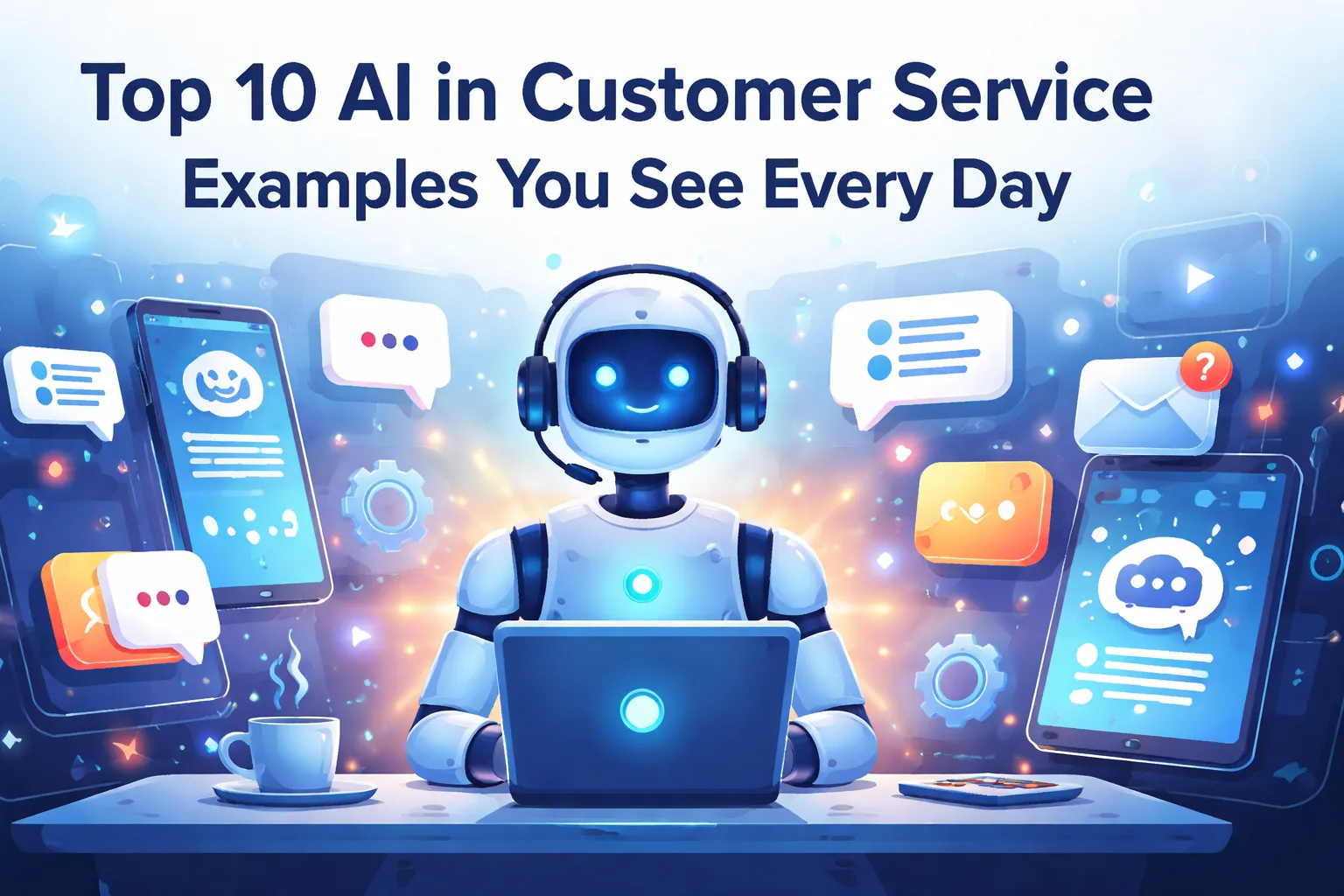
In this guide, we will explore the Top 10 AI in customer service examples that are reshaping how businesses interact with consumers, reducing operational overhead, and driving revenue.
What Is AI in Customer Service?
AI in customer service refers to the deployment of technologies like conversational AI, natural language processing (NLP), and large language models (LLMs) to automate and enhance customer interactions. It is not just about replacing human agents; it is about augmenting their capabilities to deliver human-like latency and empathy at scale.
From a simple chatbot answering FAQs to complex neural text-to-speech systems handling phone calls, AI ensures that user intent is understood and acted upon instantly, 24/7.
AI vs. Traditional Customer Service: A ROI Comparison
To understand the shift, let’s look at the efficiency gap between traditional human-only support and AI-augmented systems.
| Feature | Traditional Support | AI-Powered Support |
| Availability | 9 AM – 5 PM (Business Hours) | 24/7/365 |
| Response Time | Minutes to Hours (Wait Times) | Instant (< 1 second) |
| Concurrency | 1 Agent = 1 Customer | Infinite simultaneous interactions |
| Cost Per Interaction | High (Salary, Benefits, Training) | Low (Fraction of human cost) |
| Data Handling | Manual entry (Prone to error) | Automated CRM integration |
| Scalability | Slow (Hiring & Training lag) | Instant (Software scalability) |
10 Best AI in Customer Service Examples You See Every Day
We encounter AI in customer service examples daily, often without realizing it. These applications range from subtle predictive text to fully autonomous voice agents. Below are the top 10 examples demonstrating how this technology drives lead conversion and improves customer experience (CX).
1. The 24/7 AI Receptionist (Voice AI)
The most rapidly growing application is the AI receptionist. Unlike old IVR systems (“Press 1 for Sales”), modern voice AI uses natural language processing (NLP) to hold fluid, bi-directional conversations. For example, when you call a modern dental clinic after hours, you might speak to an AI receptionist that can check the doctor’s calendar, answer questions about insurance, and book your slot.
This technology eliminates the “phone tag” game. By utilizing bi-directional calendar sync, the AI ensures no double bookings occur. It empowers businesses to capture every lead, regardless of time, significantly reducing operational overhead while maintaining a professional front.
2. Intelligent Chatbots for Instant Tier-1 Support
You have likely seen the chat bubble in the bottom right corner of almost every SaaS or e-commerce website. These are rarely simple scripts anymore. Advanced chatbots utilize LLMs to understand context. If you ask a banking bot, “Why was I charged $15?”, it doesn’t just list fees; it securely checks your transaction history and identifies the specific charge.
These bots handle up to 80% of routine queries—like password resets or shipping updates—freeing up human agents for complex issue resolution. This tier-1 automation is a prime example of AI receptionist benefits extending beyond voice into text-based interfaces.
3. Predictive Customer Support (The “Netflix” Effect)
Just as streaming services predict what you want to watch, AI in customer service predicts what you need help with. By analyzing user intent and browsing behavior, AI can proactively offer assistance.
For instance, if a user spends a long time on a checkout page and repeatedly triggers an error, predictive analytics can trigger a pop-up: “It looks like you’re having trouble with payment. Would you like to use a different card?” This proactive intervention prevents cart abandonment and improves lead conversion rates without the user ever having to initiate a support ticket.
4. Automated Appointment Scheduling
Scheduling is a massive productivity drain. AI appointment booking systems solve this by integrating directly with calendars. Whether via email, SMS, or voice, the AI negotiates a time slot.
Imagine a user engaging with an AI scheduling assistant via SMS. The user says, “I’m free next Tuesday afternoon.” The AI parses “next Tuesday afternoon,” cross-references the agent’s availability, and replies, “I have 2:00 PM and 4:30 PM open on Tuesday the 12th. Which works for you?” Once confirmed, it sends a calendar invite and syncs with the CRM.
5. Sentiment Analysis for De-escalation
Sentiment analysis acts as an emotional thermometer. In a live chat or call, AI analyzes word choice, tone, and typing speed to detect frustration. If a customer screams “unacceptable” or types in all caps, the AI flags the interaction as “High Risk.”
This triggers intelligent call routing, instantly transferring the customer to a senior human manager. The manager receives a “whisper” or screen pop explaining, “Customer is angry about a delayed refund,” allowing them to de-escalate immediately. This fusion of AI monitoring and human empathy is critical for customer experience (CX).
6. Multilingual Real-Time Translation
Global businesses face a language barrier that usually requires hiring native speakers for every region. AI in customer service examples now includes real-time translation. A customer in Tokyo can type in Japanese, and the support agent in New York sees the text in English.
When the agent replies in English, the customer sees Japanese. This extends to voice as well, where neural text-to-speech can synthesize responses in the caller’s native language. A bilingual AI receptionist ensures you never lose a lead simply because of a language gap.
7. Smart Email Triage and Auto-Drafting
Support teams are often drowned in email volume. AI tools now scan incoming emails, tag them by topic (e.g., “Billing,” “Technical Bug,” “Feature Request”), and route them to the correct department.
Furthermore, generative AI can draft a response for the agent to review. If a customer asks about pricing tiers, the AI drafts a polite email detailing the plans, pulling current data from the company’s knowledge base. This reduces the average handling time (AHT) from minutes to seconds, a key feature of any robust AI business phone system.
8. Self-Service Portals with AI Search
Gone are the days of searching a FAQ page and getting zero results. Modern self-service portals use semantic search (powered by NLP) rather than keyword matching.
If a user searches “my internet is slow,” the AI understands they are looking for “troubleshooting connectivity issues” and presents a step-by-step interactive guide. By solving the problem without an agent, companies drastically reduce ticket volume. This capability is often integrated into an online phone answering service to deflect routine calls.
9. Voice Biometrics for Security
Verifying identity is a friction point. “What is your mother’s maiden name?” is insecure and annoying. AI voice biometrics analyzes hundreds of unique voice characteristics (pitch, cadence, tone) to verify a caller’s identity in seconds.
Banks and insurance companies use this to authenticate users passively as they speak. It enhances data privacy and security while speeding up the interaction. This is a crucial layer of trust for any virtual receptionist service handling sensitive data.
10. Proactive Outbound Reminders & Follow-ups
Customer service isn’t just reactive; it’s proactive. AI systems can trigger outbound calls or SMS for appointment reminders, payment renewals, or post-service feedback.
For example, a virtual receptionist for law firms might call a client to remind them to bring specific documents to their upcoming consultation. If the client answers, the virtual receptionist for law firms confirms the attendance. If they don’t answer, it leaves a voicemail and updates the CRM integration status to “Left Voicemail,” ensuring the legal team focuses on law, not admin.
What Industries Benefit from AI Receptionists?
While every sector can leverage automation, service-based industries with high call volumes and high lead values see the most immediate ROI.
Real Estate
Agents are often on the road, showing properties. A missed call from a potential buyer can mean losing a commission. By implementing The DBT AI, real estate agents can ensure every inquiry about a listing is answered instantly, viewing times are booked, and lead details are synced to their CRM.
Legal Services
Law firms deal with sensitive client intake and billable hours. Answering phones is a non-billable administrative task. Utilizing intelligent call routing, legal services & law firms can filter existing clients to their attorneys while new leads are qualified by the AI, ensuring high-value cases are prioritized.
Healthcare & Dental
Clinics face a high volume of rescheduling and FAQs. An AI-powered receptionist handles these HIPAA-compliant interactions efficiently. Private healthcare clinics use voice AI to manage patient flow, reducing the burden on front-desk staff and minimizing no-show rates through automated reminders.
Home Services
Plumbers, HVAC technicians, and electricians are working with their hands, not sitting by a phone. Yet, customers call when they have an emergency. A 24/7 call answering service is vital here. Home services businesses use AI to dispatch emergency calls immediately while scheduling routine maintenance for later dates.
Which AI Receptionist Provider Should You Choose?
Selecting the right provider is critical. The market is flooded with basic chatbots, but true enterprise-grade voice automation requires specific capabilities.
Key Qualities to Look For
- Human-Like Latency: The AI must respond instantly. Delays of even 2 seconds break the illusion of conversation.
- CRM Integration: It must connect with Salesforce, HubSpot, or GoHighLevel. Data silos kill efficiency.
- Customizable Logic: Can it handle complex “if/then” scenarios specific to your business?
- Data Privacy: Ensure strict adherence to GDPR and industry-specific regulations.
Why The DBT AI?
At The DBT AI, we specialize in conversational AI that goes beyond simple scripts. Our AI Appointment Setter and 24/7 AI Receptionist are designed to mimic the best human agents.
We offer bi-directional calendar sync to prevent conflicts and neural text-to-speech that sounds indistinguishable from a human voice. Whether you need a white label answering service for your agency or a direct solution for your clinic, our logic adapts to your workflows.
Explore how our intelligent call routing works by checking out The DBT AI features. If you are ready to see how it fits into your tech stack, review our app integration capabilities.
Conclusion
The AI in customer service examples we have discussed are not future concepts; they are the current competitive advantage. From sentiment analysis that saves relationships to AI appointment booking that fills calendars, automation is the key to scaling customer experience (CX) without scaling costs.
As LLMs continue to evolve, we can expect even more personalized interactions and predictive analytics to become standard. The businesses that adopt these tools today will define the market standards of tomorrow.
Ready to automate your appointment setting and never miss a lead again?
Schedule a trial with The DBT AI today and experience the power of a fully automated front desk.
Frequently Asked Questions (FAQs)
What is the best example of AI in customer service?
One of the most impactful examples is the AI voice receptionist. It combines voice recognition, NLP, and CRM integration to handle real-time phone conversations, qualify leads, and book appointments autonomously, effectively replacing the need for a traditional call center for tier-1 tasks.
Will AI replace human customer service agents?
No, AI is designed to augment humans, not replace them entirely. While AI handles repetitive tasks like FAQs and scheduling (automating up to 80% of volume), complex emotional issues and high-stakes negotiations still require human empathy and judgment. AI allows humans to focus on these high-value interactions.
How does AI sentiment analysis improve customer support?
Sentiment analysis monitors the emotional tone of a conversation in real-time. If it detects anger or frustration, it can automatically route the ticket to a senior agent or suggest empathetic responses to the current agent, preventing churn and improving the overall customer experience (CX).
Is AI in customer service expensive to implement?
Initially, there may be setup costs, but the ROI is often realized within months. By reducing the need for large support teams and available 24/7, AI solutions like automated call answering service drastically lower the Cost Per Contact (CPC) compared to traditional human staffing.
Can AI customer service handle multiple languages?
Yes, modern conversational AI supports multilingual support via real-time translation and neural speech generation. This allows businesses to scale globally without hiring native speakers for every region, ensuring consistent support quality across all markets.