The sound of a ringing phone during a Friday night dinner rush is often the sound of lost revenue. Staff are busy seating guests, pouring drinks, or running food, leaving the phone to ring out. Industry data suggests that restaurants miss between 20% to 30% of incoming calls during peak hours, resulting in lost reservations and revenue averaging $500 to $2,000 daily per location.
The solution isn’t hiring more staff to stand by the phone; it is deploying intelligent automation. An AI receptionist for restaurants steps in as a digital workforce, using voice AI to capture every inquiry, book tables instantly, and drive repeat business through superior service consistency. By eliminating hold times and answering immediately, restaurant owners can stop leaving money on the table.
What Is AI Receptionist for Restaurants?
An AI receptionist for restaurants is a sophisticated voice-powered system that utilizes conversational AI and natural language processing (NLP) to handle inbound calls exactly like a human front desk agent would, but with infinite capacity. Unlike the frustrating, robotic IVR systems of the past (“Press 1 for hours”), these systems use large language models (LLMs) to understand context, accents, and complex requests.
The primary function of this technology is digital front desk automation. It manages reservation management, answers specific questions about dietary restrictions via menu browsing, and executes lead Qualification to distinguish between a vendor call and a paying customer. Advanced systems utilize voice recognition to offer contactless check-in and handle scheduling automation without human intervention.
| Capability | AI for Restaurants | Traditional Phone/Human Host |
|---|---|---|
| Availability | 247, including holidays and off-hours | Limited to staffed hours; calls go to voicemail |
| Call Handling Capacity | 100+ concurrent calls; no busy signals | 1- at once; others hear a busy tone |
| Reservation Accuracy & Sync | Real-time, error-free booking with bi-directional calendar sync | Manual entry prone to double-booking and |
| No-Show Reduction | Automated SMS/voice reminders; up to % confirmation rates2] | Inconsistent manual follow-up; industry average of 30-40% no-shows |
| ** ()** | Predictable $50 – $200 operational overhead | $2,000 – $5,000+ in salary, benefits, and training |
| Upsell & Customer Engagement | Actively suggests specials via voice; guides menu browsing | Hosts often lack time or training for effective upselling |
| Data & Insights | Built analytics and reporting on call sources and conversion | Minimal to no tracking; are anecdotal |
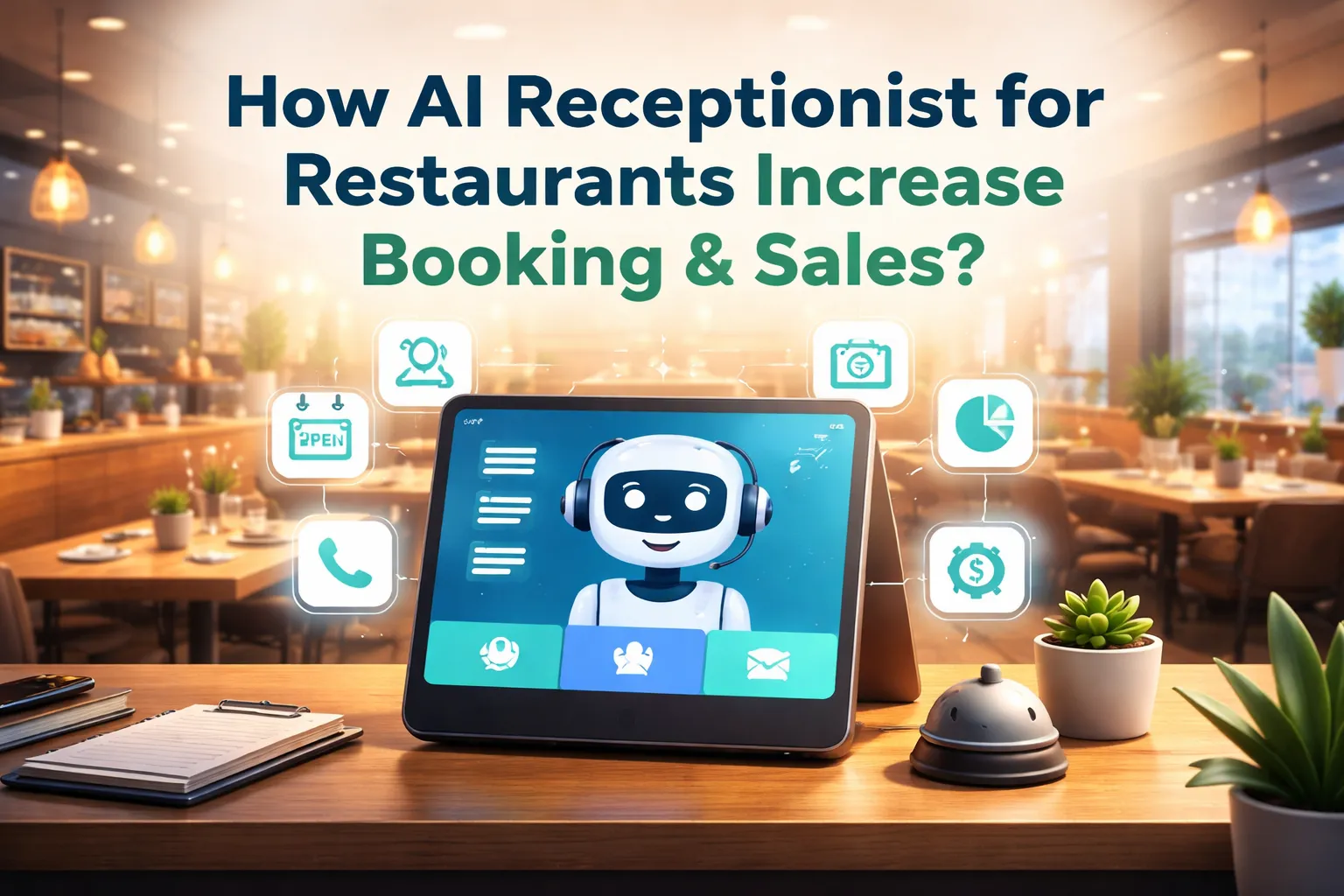
12 Ways AI Receptionist for Restaurants Increase Booking & Sales
Deploying an AI receptionist transforms your phone line from a bottleneck into a 24/7 sales engine. By combining intelligent call routing with instant lead response, these systems capture the demand that human staff physically cannot handle. The following sections detail exactly how this technology drives a confirmed 20-40% uplift in bookings and a 15-25% increase in sales.
1. Captures 100% of Missed Revenue Opportunities
The primary driver of increased sales is simple math: you cannot book a table if you do not answer the phone. During peak service, floor staff prioritize the guests in front of them, letting the phone ring. An AI phone answering service answers every call on the first ring, regardless of volume. By capturing the 30% of calls that usually go to voicemail (where 80% of callers hang up), restaurants immediately see a topline revenue increase. This ensures that high-value group bookings are never lost to a competitor simply because their line was open.
2. Automates Reservation Management with Precision
Manual booking errors result in double-booked tables and angry guests. AI systems utilize bi-directional calendar sync to read your table availability in real-time. When a customer asks for a table for four at 7 PM, the AI checks the slot, books it, and instantly removes that inventory from platforms like OpenTable or Resy. This seamless reservation management ensures maximum table utilization without the risk of overbooking, optimizing revenue per square foot.
3. Drastically Reduces No-Shows with Smart Confirmations
No-shows cost the hospitality industry billions annually. An AI receptionist for restaurants proactively manages this by sending automated SMS or voice reminders. If a guest needs to cancel, the AI handles the cancellation immediately and re-opens the slot for new bookings. This dynamic management helps reduce no-show rates by up to 40%, ensuring that your kitchen isn’t prepping food for empty tables.
4. Increases Ticket Size via Voice-Guided Upselling
Human hosts often forget to mention specials during a busy phone rush. An AI agent follows a strict script designed for sales. When a guest calls to book, the AI can utilize sentiment analysis to gauge the caller’s mood and suggest add-ons, such as “Would you like to pre-order a bottle of champagne for the table?” or “We have a chef’s tasting menu available.” This consistent suggestive selling during the menu browsing phase increases the average order value before the guest even walks through the door.
5. Manages Peak-Hour Queue and Waitlists
During a busy Friday rush, managing a paper waitlist or a buzzer system is chaotic. AI facilitates queue management by allowing walk-ins or callers to join a virtual waitlist via voice command. The system then sends text updates regarding table readiness. This keeps the entryway clear, reduces stress for the host stand, and prevents guests from leaving due to uncertain wait times, thereby retaining revenue that might otherwise walk out the door.
6. Supports Global Clientele with Multi-Language Support
For restaurants in tourist-heavy cities, language barriers can prevent bookings. A bilingual AI receptionist can instantly detect the language spoken by the caller—whether it is Spanish, French, or Mandarin—and switch fluently to complete the reservation. By removing the language barrier, restaurants can capture international reservations that a monolingual staff member would struggle to secure, effectively expanding the total addressable market.
7. Provides Instant Lead Response for Private Dining
Private dining and event bookings are high-ticket items, often worth thousands of dollars. However, these inquiries often sit in voicemail inboxes for days. An AI appointment booking agent can instantly qualify these leads by asking about party size, budget, and dates. It can then schedule a meeting with the event manager or provisionally hold the date, shortening the sales cycle and preventing the lead from calling another venue.
8. Enhances Customer Experience via Personalization
Using LLMs and CRM integration (Salesforce, HubSpot, GoHighLevel), the AI remembers repeat callers. If a regular customer calls, the system can greet them by name: “Welcome back, Mr. Smith. Would you like your usual table by the window?” This level of customer engagement builds intense loyalty. Repeat customers spend 67% more than new ones, making this personalization a direct driver of long-term revenue.
9. Collects Actionable Feedback and Sentiment Data
Post-dining follow-up is rare in casual dining, but AI makes it scalable. The system can send a text or make a brief call to ask about the dining experience. Using sentiment analysis, it can identify unhappy customers before they post a negative review online. Saving a reputation prevents revenue loss, while positive feedback collection boosts SEO rankings, driving more organic traffic and sales.
10. Optimizes Staff Allocation and Labor Costs
Operational efficiency is a form of profit. By offloading 100% of phone duties to an automated call answering service, you free up your front-of-house staff to focus on high-value tasks like table service and upselling wine. This reduces operational overhead and improves the customer experience for seated guests, leading to higher tips, better staff retention, and faster table turnover.
11. Enables Contactless Check-In and Status Updates
In a post-pandemic world, efficiency and hygiene remain priorities. Voice recognition allows guests to call from the parking lot to check in. The AI manages the flow, alerting them when their table is sanitized and ready. This smooth logistical flow prevents overcrowding in the lobby and streamlines the seating process, allowing the kitchen to pace tickets more effectively and turn tables faster.
12. Delivers Data-Driven Analytics for Marketing
Traditional phone lines provide zero data. An AI system provides detailed analytics and reporting on call volumes, peak call times, and conversion rates. Understanding that you receive 50 missed calls between 5 PM and 6 PM allows you to adjust staffing or marketing strategies. You can track exactly which marketing channels are driving phone inquiries, allowing for better allocation of ad spend and a higher ROI on marketing efforts.
What Industries Benefited By AI Receptionist?
While restaurants see immediate benefits in table management, the underlying technology of conversational AI and neural text-to-speech drives efficiency across various service sectors.
- Healthcare: Private healthcare clinics utilize these systems to handle appointment reminders and patient intake questions, ensuring strictly confidential data privacy (GDPR/HIPAA compliance) while reducing administrative bloat.
- Legal: Legal services & law firms use AI to screen callers, differentiating between urgent new case inquiries and administrative calls, ensuring attorneys only speak to qualified leads.
- Beauty & Wellness: Med spas & aesthetic clinics leverage booking automation to fill slots for treatments, often requiring complex scheduling rules that AI handles effortlessly.
- Professional Services: Marketing agencies and coaches & consultants deploy AI to manage their calendars, syncing client meetings across time zones without the back-and-forth email tag.
- Maintenance: Home services businesses use AI to dispatch technicians and quote jobs instantly, capturing emergency service requests 24/7.
Which AI Receptionist Provider Should You Choose?
When selecting a provider, restaurant owners must prioritize human-like latency, robust CRM integration, and the ability to handle natural language processing effectively. The voice must sound natural, not robotic, to maintain the hospitality vibe.
The DBT AI offers a premier solution tailored for high-touch industries. Our platform provides seamless app integration with major booking platforms and CRMs. We specialize in creating a 24/7 AI Receptionist that does more than just answer calls—it understands user intent.
With The DBT AI, you get access to advanced features like sentiment analysis and intelligent call routing. Our system is designed to act as a full AI phone assistant, capable of understanding complex menu queries and managing bookings autonomously. For a deeper look at how our technology functions, you can read about our AI receptionist capabilities for booking management or explore the specifics of our AI receptionists operation.
Conclusion
The era of the unanswered phone signaling a busy, successful restaurant is over; today, it signals lost revenue. The integration of large language models and scheduling automation allows venues to capture every dollar of demand, regardless of staff availability. Future trends indicate that predictive analytics will soon allow these systems to forecast dining rushes and automate staffing suggestions.
To stay competitive and maximize your revenue per seat, you must ensure your digital front door is always open. Let us demonstrate The DBT Ai and show you how to recover the 20% of revenue currently lost to missed calls.
Schedule a trial today to transform your restaurant’s operational efficiency.
Frequently Asked Questions (FAQs)
How much does an AI receptionist for restaurants cost compared to human staff?
An AI receptionist typically costs between $100 to $300 per month depending on call volume and features. In contrast, hiring a full-time human receptionist can cost upwards of $3,000 monthly when factoring in wages, taxes, and benefits. The ROI is usually realized within the first month through recovered bookings.
Can the AI system integrate with my existing reservation software?
Yes, most advanced AI receptionists offer app integration with popular reservation platforms like OpenTable, Resy, and Toast. They utilize bi-directional calendar sync to read real-time availability and write new bookings directly into your system, preventing double-bookings.
What happens if the AI cannot understand a caller’s request?
While modern NLP is highly accurate, edge cases exist. In these scenarios, the system utilizes intelligent call routing to gracefully transfer the call to a human staff member. The AI can also send a transcript or recording of the conversation to management for review.
Is it difficult to set up an AI receptionist for a restaurant?
Setup is generally quick and requires no hardware installation. It involves configuring your menu knowledge base, defining booking rules, and forwarding your existing phone number to the AI business phone system. Most restaurants can be live within 24 to 48 hours.
Will an AI receptionist sound robotic to my customers?
Leading providers utilize neural text-to-speech technology that creates hyper-realistic voices with human-like intonation and latency. Most customers are unable to distinguish the AI from a human during standard reservation interactions, preserving the high-quality customer experience.