For a busy dental practice, a missed call is often a missed opportunity for a high-value procedure. Statistics suggest that dental clinics lose nearly 15% of potential appointments simply because the phone lines are busy, the front desk is overwhelmed, or the patient calls after hours. In an industry where patient trust and immediate responsiveness are paramount, relying solely on manual administrative workflows is becoming a liability.
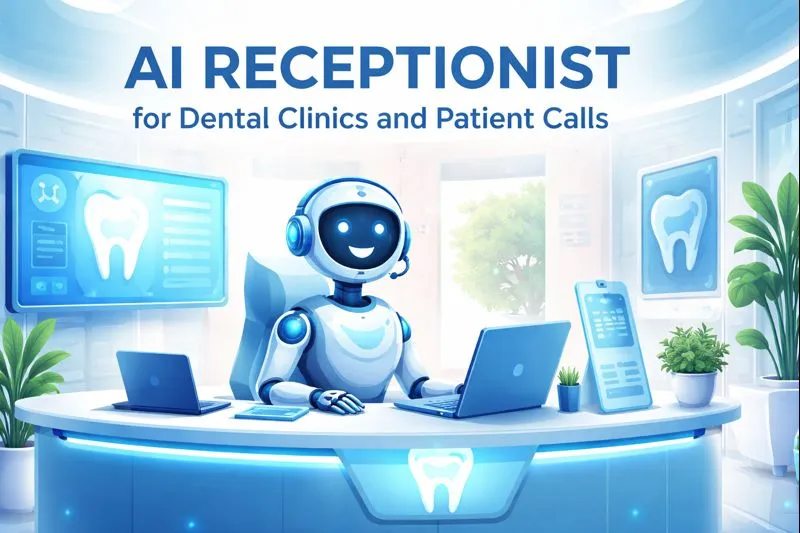
Implementing an AI receptionist for dental clinics is no longer a futuristic concept; it is a practical standard for modern practices aiming to secure revenue and improve patient satisfaction. By leveraging advanced conversational AI and natural language processing (NLP), these systems manage the entire inbound communication flow, ensuring that every patient feels heard, regardless of when they call.
What Is A AI Receptionist for Dental Clinics?
An AI receptionist for dental clinics is a specialized voice AI solution designed to handle patient interactions with human-like latency and empathy. Unlike improved IVR systems that force callers to press buttons, these agents utilize large language models (LLMs) to understand spoken language, detect user intent, and execute complex tasks.
This technology goes beyond simple call answering. It functions as a comprehensive appointment management tool, capable of accessing your practice management software (PMS) to book, reschedule, or cancel visits in real-time. By integrating neural text-to-speech, the AI provides a natural, calming voice—essential for patients who may already be anxious about visiting the dentist.
To understand the operational impact, consider the difference between a standard human workflow and an AI-driven approach:
| Feature | The DBT AI Receptionist | Traditional Human Receptionist |
|---|---|---|
| Availability | 24/7/365 (Nights, Weekends, Holidays) | 40 hours/week (Business hours only) |
| Concurrency | Unlimited (Handles 100+ calls at once) | 1 call at a time (leads to hold times) |
| Response Time | Instant (< 1 second) | Variable (Average 2 minutes hold time) |
| Cost Efficiency | Fixed low monthly cost | Salaries, benefits, training, turnover |
| Data Accuracy | 100% (Automated entry) | Susceptible to manual entry errors |
| Calendar Sync | Real-time Bi-directional sync | Manual entry required |
How AI Receptionist for Dental Clinics Transform Patient Interactions and Operations?
The integration of dental office automation into daily workflows fundamentally changes how a clinic operates. It shifts the focus of your front desk staff from being call center agents to being patient care coordinators. By handling the repetitive, high-volume tasks, an AI receptionist for dental clinics allows your human team to focus on the patients physically present in the office.
Below is a detailed breakdown of how this technology optimizes clinic workflow and patient engagement.
1. Eliminating Missed Calls and Revenue Leakage
The primary driver for adopting voice AI is the elimination of missed calls. Operational overhead increases significantly when staff must spend hours returning voicemails—many of which result in “phone tag” or lost leads. An automated call answering service ensures that every inquiry is captured instantly. Whether a patient calls at 2 PM on a Tuesday or 10 PM on a Sunday, the AI captures the lead, qualifies the intent, and secures the booking.
2. Intelligent Appointment Scheduling via Bi-Directional Sync
The core value of this technology lies in its ability to write directly to your calendar. Through bi-directional calendar sync, The DBT AI checks availability in real-time. It understands procedure durations (e.g., 60 minutes for a root canal vs. 30 minutes for a cleaning) and books the slot accordingly. This seamless patient scheduling software capability prevents double-booking and ensures the calendar remains optimized without human intervention.
3. Reducing No-Show Rates with Proactive Management
No-shows are a significant drain on dental revenue. While standard SMS reminders help, they are passive. An AI receptionist for dental clinics can manage automated patient communication more aggressively. It can handle incoming calls from patients wishing to reschedule and immediately offer that newly opened slot to a patient on the waitlist. This dynamic management helps maintain high utilization rates. The logic for efficiency gain ($E$) can be modeled as:
E = (Confirmed Appointments + Backfilled Slots) ÷ Total Available Hours
By maximizing the numerator, the AI directly impacts profitability.
4. Advanced Triage and Emergency Handling
Not all dental calls are routine cleanings; some are acute emergencies requiring immediate attention. Advanced healthcare chatbot integration within the voice AI allows the system to recognize urgent keywords (e.g., “severe pain silos create inefficiencies. A robust AI phone assistant integrates directly with platforms like Salesforce, HubSpot, or industry-specific tools like Dentrix and Eaglesoft. When the AI speaks with a patient, it mornings often bring a surge of calls that a single receptionist cannot handle. This leads to long hold times and frustrated patients. Voice AI offers infinite concurrency. It can handle five, ten, or fifty calls simultaneously. This scalability is vital for clinic workflow optimization, ensuring that during peak marketing campaigns or seasonal rushes, your lead conversion rates do not suffer due to bandwidth limitations.
7. Consistency in Brand Voice and Scripting
Human receptionists have bad days; AI does not. An AI auto attendant ensures that every caller receives the same high standard of service. The greeting is always professional, the information provided is always accurate, and the tone is always empathetic. This consistency builds trust and reinforces the professional image of the clinic, which is crucial for patient data management and trust-building.
8. Cost Reduction and Resource Allocation
Hiring, training, and retaining front desk staff is expensive. By deploying a virtual receptionist service, clinics can significantly reduce labor costs. This does not necessarily mean firing staff but rather repurposing them for revenue-generating tasks like treatment presentation or insurance coordination. The ROI is realized through both cost savings and the increased revenue from captured missed calls.
9. Handling Insurance Verification and FAQs
A large portion of front desk time is consumed by repetitive questions: “Do you take Delta Dental?”, “Where are you located?”, “Are you open Saturdays?”. An AI business phone system is trained on your specific knowledge base. It answers these queries instantly, satisfying the caller’s needs without interrupting clinical staff. It can also perform preliminary insurance data collection, streamlining the intake process.
10. Privacy and Compliance (HIPAA/GDPR)
In healthcare, data privacy is non-negotiable. Leading AI solutions are built with GDPR and HIPAA compliance at their core. Calls are encrypted, and sensitive patient data is handled with strict security protocols. Unlike a temp worker who might mishandle a file, an AI operates within strict, pre-defined security boundaries, ensuring telehealth support systems and data logs remain secure.
How AI Receptionist for Dental Clinics Transform Healthcare Industry
The adoption of AI in dentistry mirrors a larger trend across the healthcare sector: the shift toward patient-centric automation. By removing the friction of scheduling and administrative hurdles, clinics improve access to care.
Patients today expect the same digital convenience in healthcare that they receive in retail or banking. Digital receptionist tools meet this expectation by providing instant gratification—booking an appointment the moment they remember they need one, not just when the office is open. This shift also impacts staff retention; by removing the stress of ringing phones, the clinical environment becomes calmer and more focused on-based sectors.
- Legal: Law offices utilize a virtual receptionist for law firms to handle client intake and screen potential cases 24/7.
- Real Estate: High-performing real estate agents use AI to qualify buyer leads instantly and schedule viewings without manual back-and-forth.
- Medical Aesthetics: Busy med spas & aesthetic clinics rely on AI to book consultations and manage deposit policies for high-ticket treatments.
- Home Services: Companies in plumbing and HVAC use home services AI automation to dispatch technicians and capture emergency repair requests after hours.
- Marketing: Agencies managing campaigns for clients use marketing agencies specific AI tools to ensure that leads generated by ads are contacted and qualified immediately, maximizing ad spend ROI.
Which Dental AI Receptionist Provider Should You Choose?
When selecting a provider, look beyond basic call answering. You need a system that understands the nuance of dental terminology and integrates with your specific ecosystem.
The DBT AI is engineered specifically for high-stakes appointment setting. Our platform offers a robust AI receptionist for dental clinics that combines:
- Conversational Intelligence: Our AI understands context, not just keywords, ensuring smooth handling of complex patient queries.
- Seamless Integrations: We connect with major CRMs and calendars to ensure your workflow remains uninterrupted.
- Rapid Deployment: Setup is fast, minimizing downtime for your practice.
We focus on lead Qualification and intelligent call routing, ensuring that your team only deals with high-value interactions while the AI handles the volume. For practices looking to scale, our white label answering service options allow seamless branding integration.
Conclusion
The dental industry is evolving, and patient expectations for speed and convenience are at an all-time high. An AI receptionist for dental clinics is the bridge between operational efficiency and superior patient experience. By automating the appointment process, ensuring 24/7 availability, and reducing administrative overhead, practices can secure their bottom line while improving the quality of care.
Future trends indicate that AI scheduling assistant capabilities will only become more predictive, helping clinics fill gaps before they even occur. Now is the time to modernize your patient access strategy.
Ready to stop missing patient calls? Schedule a trial and let us demonstrate how The DBT AI can transform your front desk.
Frequently Asked Questions (FAQs)
How much does an AI receptionist cost compared to a human?
An AI receptionist typically costs a fraction of a full-time employee’s salary. While a human receptionist may cost $30,000 to $40,000 annually plus benefits, a [best AI answering prioritize data privacy. The systems are designed to be HIPAA compliant, ensuring that all patient health information (PHI) discussed during calls is encrypted and stored securely, reducing the risk of human error associated with manual data handling.
Can the AI handle multiple languages?
Absolutely. One of the major advantages of neural text-to-speech and NLP is the ability to communicate in multiple languages. This ensures your clinic can effectively serve a diverse patient demographic without needing to hire multilingual staff for every shift.
What happens if the AI cannot answer a question?
Through intelligent call routing, if the AI encounters a complex query or a frustrated caller (detected via sentiment analysis), it can gracefully transfer the call to a specific human staff member or take a detailed message for immediate follow-up.
Will patients know they are talking to a robot?
Modern voice AI is incredibly advanced, featuring human-like latency, pauses, and intonation. While transparency is key, many patients find the interaction so natural that the distinction is minimal. The primary focus is on speed and efficiency, which patients value highly.