Missed calls are expensive—but mishandled payments are worse. If your team is rushing to answer phones, qualify leads, and book appointments, it’s easy for a caller to say, “Can I pay my deposit now?” and suddenly you’re dealing with cardholder data security, payment security, and financial regulations—often without a documented process. That’s where the topic of AI receptionists pci compliance credit card details becomes business-critical: it’s not only about booking faster, it’s about handling sensitive payment info in a way that supports regulatory compliance and risk management while protecting customer experience (CX).
This guide explains what PCI DSS standards mean for automated reception and how modern conversational AI and voice AI flows can take payment intent without exposing credit card data protection to unnecessary risk—especially when paired with secure transactions, data encryption, identity verification, and privacy standards.
What Is An AI Receptionists PCI Compliance?
PCI DSS standards (Payment Card Industry Data Security Standard) are a set of requirements designed to reduce payment fraud and protect credit card data protection when cardholder data is processed, transmitted, or stored. When a business uses an AI receptionist for customer service automation, PCI scope can expand quickly if the system collects Primary Account Numbers (PAN), CVV, or other sensitive authentication data.
In practice, “AI receptionist PCI compliance” means your automated reception workflow is designed so that:
- Cardholder data does not get stored in call recordings, transcripts, or CRM notes.
- Payment capture is handled through approved secure transactions methods (often via tokenization or a compliant payment provider).
- Access, audit, and retention policies follow privacy standards and regulatory compliance expectations.
- Operational overhead is reduced without creating a new security gap.
If you’re new to the fundamentals of what an AI receptionist is and what it replaces, this overview on what is an ai receptionist provides a helpful baseline before diving into payment handling.
AI Receptionists vs Traditional Phone Answering: PCI Risk & Operations
The PCI issue isn’t “AI vs humans”—it’s whether your process accidentally captures sensitive data in places it shouldn’t (recordings, email, spreadsheets, CRM notes). Here’s a practical comparison:
| Factor | AI receptionist (PCI-aware design) | Traditional receptionist / answering team |
|---|---|---|
| Capturing card details | Can route to compliant payment path (DTMF/pay link/tokenization) | Often manually writes or repeats details |
| Call recordings | Can/redact during payment flow | Frequently recorded end-to-end, increasing scope |
| Consistency | Enforces scripts and user intent-based flows | Varies by agent, training, fatigue |
| Audit trails | Structured logs for risk management | Notes may be incomplete or inconsistent |
| Concurrency | Handles many calls at once with human-like latency | Limited by staffing and queues |
| Operational overhead | Lower once configured | Ongoing hiring, training, QA |
| Lead conversion | Faster instant lead response reduces drop-off | Slower response during peaks |
When done correctly, voice recognition and natural language processing (NLP) can identify user intent (“I want to pay now”) and route that moment into a compliant flow rather than letting sensitive data spill into unprotected systems.
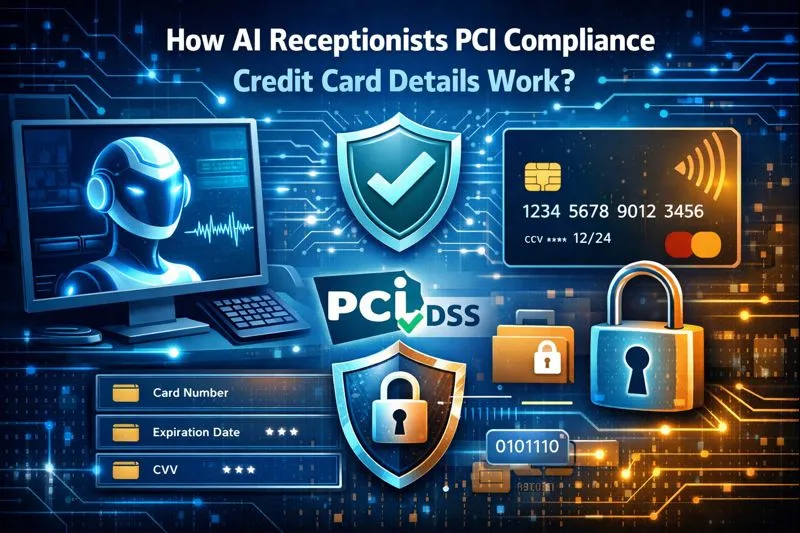
How AI Receptionists PCI Compliance Credit Card Details Work?
A PCI-safe voice AI payment experience is built on one idea: reduce exposure of card data while still completing the business goal (deposit collected, appointment confirmed, lead qualified). Below is a practical framework for how AI receptionists pci compliance credit card details handling typically works, with real-world controls you should expect.
1) Detect payment intent without collecting PAN by default
An AI receptionist uses conversational AI natural language processing (NLP) to interpret user intent like “pay my copay,” “leave a deposit,” or “charge the card on file.” The key is that the system doesn’t immediately ask for full card details. Instead, it confirms the amount, purpose, and payer identity first to reduce accidental data capture and support identity verification.
If you’re evaluating capabilities beyond basic call pickup, the booking and intake patterns described in ai receptionist capabilities for booking managemen mirror how intent detection can trigger secure payment steps.
2) Keep sensitive data out of the transcript
Large language models (LLMs) are powerful for dialogue, but PCI DSS standards require strict handling of sensitive data. A safer design is to prevent the AI from storing or displaying raw card numbers in conversation logs, summaries, or ticket notes. Many compliant systems implement redaction rules (masking digits) and “no-store” handling so credit card data protection is preserved.
When your workflows are built for real phone interactions rather than chat-only, the patterns covered in ai phone receptionist help explain why transcript controls matter more in voice channels.
3) Use DTMF or secure handoff for card entry
The most common PCI-friendly approach is to avoid spoken card numbers and route callers to enter card details via keypad tones (DTMF) or a secure payment page link sent by SMS/email. This supports payment security by limiting what’s exposed to automated systems, agents, and recordings.
For businesses that want end-to-end automation, The DBT AI’s AI phone answering service model supports the operational concept: the caller gets immediate help, but payment steps can be routed through a safer path.
4) Tokenization: store a token, not the card number
To reduce PCI scope and strengthen digital security, a compliant architecture typically uses tokenization: the payment provider returns a token that represents the card. Your business systems store the token, not the PAN. This supports secure transactions and risk management while allowing later charges (where permitted) without re-collecting card details.
When payment status needs to appear sales workflows, connecting the automation with CRM integration reduces manual copying that can create compliance issues.
5) Pause recording and prevent replay exposure
Call recording is a common compliance trap: if recordings capture PAN/CVV, your obligations expand significantly. A strong PCI design uses recording pause/resume or redaction during payment capture, and applies retention controls aligned with privacy standards.
If you’re mapping how modern AI receptionists handle high volumes while still following policies, the operational view in ai receptionists operation is useful for thinking about recording, logs, and governance at scale.
6) Encrypt data in transit and control access in storage
Data encryption matters at two layers:
- In transit (between voice platform, AI services, and your backend)
- At rest (logs, metadata, outcomes)
PCI DSS standards also require least-privilege access: only staff who need payment outcomes should see them, and nobody should see raw card data. This reduces operational overhead from security incidents while improving customer experience (CX) through fewer payment errors.
For a practical view of what businesses look for in tooling, ai receptionist software highlights evaluation criteria that often connect directly to digital security.
7) Use identity verification before processing payment
For deposits, copays, retainers, or card-on-file charges, identity verification helps reduce chargebacks and fraud. A voice AI flow can confirm known attributes (name, DOB for healthcare with appropriate controls, booking ID, one-time passcode) before initiating a payment step. Voice recognition can support caller continuity, but PCI compliance still depends on how payment data is handled, not just who is speaking.
Where calls need to be routed to the right person for approvals, an automated call routing system approach reduces risk by limiting who can touch payment-related workflows.
8) Reduce “PCI sprawl” across CRM and calendars
Payment conversations often end with “Book me for Tuesday and charge my card.” Without guardrails, teams paste payment notes into CRMs, calendars, or Slack—creating uncontrolled storage of sensitive data. A compliant design stores only what’s needed (payment status, receipt ID, token reference) and uses bi-directional calendar sync to confirm bookings without embedding card detailsWhen you connect scheduling outcomes to your systems, referencing The DBT AI’s features is relevant because secure workflow design depends on how scheduling, routing, and data capture are configured together.
9) Handle exceptions safely (fail closed, not open)
If the caller insists on reading card numbers aloud, the best practice is to guide them to a safer method (DTMF or a payment link). If systems fail (timeout, provider down), the flow should “fail closed”: collect no card data and route to an approved fallback, which protects cardholder data security.
This is especially important for teams relying on instant lead response—fast shouldn’t mean risky.
10) Maintain audit trails for compliance and dispute handling
PCI DSS standards and broader regulatory compliance typically require that businesses can prove what happened: who initiated payment, what method was used, and what was stored. AI systems can log structured events (intent detected, link sent, payment confirmed) without logging sensitive card details. That makes disputes, refunds, and incident response faster—supporting both payment security and customer experience (CX).
If you want an example of how voice-driven automation affects customer outcomes, ai receptionist customer service connects CX gains to process consistency.
11) Control concurrency without increasing exposure
One advantage of voice AI is concurrency: handling multiple calls at once with human-like latency. But PCI risk can rise if concurrent sessions lead to cross-talk, misrouting, or logging mistakes. A PCI-aware design isolates sessions and applies the same redaction/token rules per call, while intelligent call routing sends high-risk cases (billing disputes, chargeback threats) to a trained human.
For businesses moving from basic auto-attendants to real automation, an AI auto attendant can be part of the front door, but payment steps still need explicit safeguards.
12) Apply privacy (GDPR/HIPAA compliance) where relevant
PCI compliance is about payment data, but many calls contain personal data too. Depending on your industry, you may also need GDPR/HIPAA compliance controls for data privacy. For example, a private clinic may discuss appointment details and payments in the same call. Strong privacy standards reduce overall risk management complexity and prevent “compliance collisions” where one department’s process breaks another’s rules.
If your fields heavy call volume beyond business hours, a 24/7 call answering service model is valuable—but only if privacy and payment controls remain consistent at 2 PM and 2 AM.
What Industries Benefited By AI Receptionist?
Any business that collects deposits, copays, retainers, or card-on-file payments can benefit—especially where missed calls reduce lead conversion and where operational overhead makes it hard to staff phones.
Here are industries where PCI-safe automated reception can directly impact revenue and risk:
- For private healthcare clinics, payment collection often overlaps with patient engagement and reminders, which is why private healthcare clinics benefit from automated intake that respects GDPR/HIPAA compliance and payment security.
- For legal services & law firms, retainers and consultation fees are common, and legal services & law firms often need tight identity verification and audit trails to reduce disputes.
- For home services, deposits and scheduling happen quickly after a lead calls, so home services gain from instant lead response without letting credit card details leak into unapproved notes.
- For med spas & aesthetic clinics, high lead volume plus deposits makes med spas & aesthetic clinics a strong fit for voice AI that manages concurrency and call routing during peaks.
Which AI Healthcare Receptionist Provider Should You Choose?
When payment data enters the conversation, “good voice quality” is not enough. You want a provider that supports both customer service automation and real regulatory compliance outcomes.
Qualities to look for
- PCI-aligned payment handling: tokenization, DTMF/pay-link workflows, and prevention of storing PAN/CVV in logs
- Strong data encryption practices and clear retention controls
- Intelligent call routing for billing edge cases and escalation paths
- CRM integration (Salesforce, HubSpot, GoHighLevel) without dumping sensitive data into notes
- Bi-directional calendar sync to confirm appointments without embedding payment data
- Lead Qualification with sentiment analysis to identify high-risk conversations (angry callers, charge disputes)
- Support for concurrency with human-like latency so busy clinics don’t miss revenue opportunities
- Documented approach to data privacy (GDPR/HIPAA compliance) where required
Where The DBT AI Fits?
The DBT AI is built for AI Appointment Setter and 24/7 AI Receptionist outcomes—booking meetings in seconds protecting the process around sensitive moments like payments. When you want secure appointment outcomes to flow into your tools, The DBT AI’s app integration helps connect call results to your CRM while minimizing manual handling that often creates compliance gaps. If you’d like to see how this works in your intake and payment flow, you can schedule a trial and walk through a PCI-aware call scenario end-to-end.
Conclusion
PCI expectations are not slowing down, and voice channels are becoming a bigger target as more payments happen over the phone. The future trend is clear: businesses will adopt conversational AI and voice AI that can interpret user intent and complete workflows, but only the solutions that treat payment security, data encryption, and credit card data protection as-class requirements will scale safely.
If you’re evaluating AI receptionists pci compliance credit card details for your business, the key is to choose a design that avoids storing sensitive card data, routes payments through compliant methods, and keeps audit trails strong without increasing operational overhead. To see what that looks like in a real call flow, book a quick demo and let us demonstrate The DBT Ai.
Frequently Asked Questions (FAQS)
Can an AI receptionist take credit card payments over the phone and still follow PCI DSS standards?
Yes—if the system is designed to prevent storage of PAN/CVV in transcripts and recordings, and routes payment capture through compliant methods like DTMF entry or a secure payment link, often backed by tokenization for secure transactions.
Does PCI compliance mean my business will never hear or store card numbers?
PCI DSS standards don’t ban hearing card numbers, but they strongly shape what you can record, store, and access; a safer approach is to design automated reception so card details are not spoken and never stored, which reduces risk management burden.
What’s the biggest PCI risk with AI receptionists?
The biggest risk is accidental storage—card numbers appearing in call recordings, transcripts, CRM notes, or analytics logs PCI-safe designs focus on credit card data protection through redaction, controlled routing, and strict retention rules.
How do AI receptionists verify identity before taking a payment?
Common approaches include confirming booking details, sending a one-time passcode, verifying known customer attributes, and using voice recognition as a supporting signal, while still keeping payment handling separate from identity checks for data privacy.
Do I still need humans if I use an AI receptionist for payments?
Often yes, but for exceptions—not routine calls; intelligent call routing can send complex billing disputes or high-sentiment calls to a trained agent while the AI handles standard scheduling, lead Qualification, and payment-link workflows with instant lead response.