Healthcare practices lose an average of $150,000 annually from missed calls alone. Picture this: a patient experiencing chest pain calls your cardiology clinic at 7 PM, but reaches voicemail. They hang up and drive to the emergency room instead. Another scenario—a busy mother calls during her lunch break to schedule her daughter’s pediatric checkup, waits five minutes on hold, then gives up and books with a competitor online.
These aren’t isolated incidents. They happen hundreds of times daily across healthcare practices nationwide. Traditional reception models create bottlenecks that cost practices revenue, frustrate patients, and overwhelm administrative staff who spend 70% of their time on phone management rather than patient care.
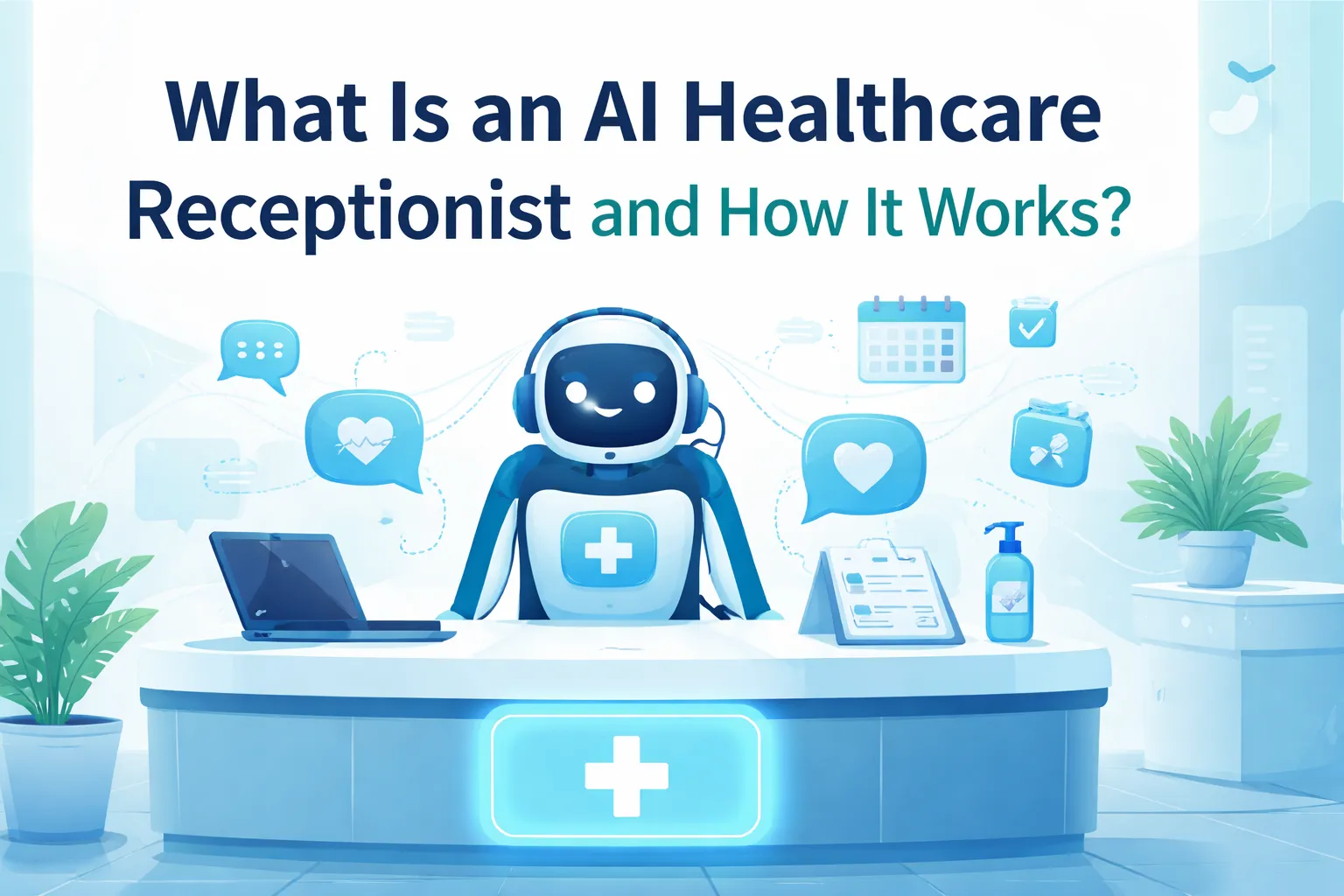
Enter the AI healthcare receptionist—a conversational AI system that answers every call instantly, qualifies patients intelligently, and books appointments directly into your practice management system. No hold times. No missed opportunities. No human limitations constraining patient access to care.
What Is An AI Healthcare Receptionist?
An AI healthcare receptionist is an intelligent voice automation system powered by natural language processing (NLP) and large language models (LLMs) designed specifically for healthcare environments. Unlike basic automated phone systems that frustrate callers with rigid menu trees, an AI healthcare receptionist conducts natural conversations, understands medical terminology, and handles complex patient interactions with human-like comprehension.
The system operates 24/7, processing patient calls through advanced voice AI technology that recognizes speech patterns, interprets user intent, and responds conversationally. It’s engineered for healthcare compliance, maintaining HIPAA standards while delivering medical appointment scheduling, patient intake automation, and healthcare customer service functions that traditionally require human staff.
Core capabilities include:
- Instant call answering with zero hold times across unlimited concurrent calls
- Medical terminology recognition for accurate symptom documentation and triage
- Bi-directional calendar sync with practice management systems for real-time appointment booking
- Automated patient reminders via multiple communication
- Insurance verification and eligibility pre-checks during initial calls
- Multi-language support serving diverse patient populations
- Intelligent call routing to appropriate departments or specialists based on patient needs
- Appointment management software integration with Epic, Cerner, athenaHealth, and cloud-based platforms
- Patient communication system that maintains context across multiple touchpoints
The technology replaces traditional reception bottlenecks with scalable automation that never sleeps, never takes breaks, and never lets patient calls go unanswered. This represents a fundamental shift from human-limited phone coverage to AI-powered patient access that operates at the speed and scale healthcare demands.
How An AI Healthcare Receptionist Works?
Advanced Speech Recognition and Natural Language Processing
The foundation begins with sophisticated speech-to-text conversion that captures patient speech with medical-grade accuracy. When a patient calls saying “I need to see Dr. Rodriguez about my chronic migraines that are getting worse,” the system doesn’t just hear words—it identifies key medical entities ( provider preferences (Dr. Rodriguez), and urgency indicators (getting worse).
The NLP engine processes this input through healthcare-trained language models that understand medical context, terminology, and implicit needs. Unlike generic AI systems, healthcare-specific training enables the AI to differentiate between routine checkups and urgent concerns, automatically adjusting response protocols accordingly.
Neural text-to-speech technology generates responses that sound naturally human, eliminating the robotic tone that erodes patient confidence. The entire conversation happens with human-like latency, maintaining conversational flow that feels natural rather than mechanical-Time Patient Triage and Call Routing
Patient calls trigger immediate assessment algorithms that evaluate medical urgency within the first 30 seconds of conversation. The system analyzes spoken keywords, tone patterns, and explicit urgency markers to determine appropriate routing. A patient mentioning “severe chest pain” receives immediate escalation to clinical staff, while “routine physical exam” flows into standard scheduling workflows.
Intelligent call routing considers multiple variables simultaneously: provider specialization, current availability coverage, and appointment type requirements. The AI matches these factors against real-time calendar data to present optimal appointment options while patients remain on the line.
Sentiment analysis technology monitors patient emotional state throughout calls, adjusting communication tone and escalation triggers accordingly. Anxious patients receive more reassuring responses and faster routing to human staff when appropriate, while confident patients move efficiently through automated workflows.
Automated Patient Intake and Data Capture
Rather than forcing patients to complete paperwork in waiting rooms, the AI receptionist conducts comprehensive patient intake automation during the initial call. The system asks targeted questions about symptoms, medical history, current medications, allergies, and insurance details conversational language that feels natural rather than interrogational.
This data flows directly into electronic health records through secure API connections, eliminating manual transcription errors and reducing patient check-in time from 15-20 minutes to simple verification steps. Healthcare providers receive populate before appointments begin, enabling more focused clinical consultations.
The system maintains healthcare data security throughout the process, encrypting all patient information and maintaining HIPAA compliance through built-in privacy controls and audit trails.
Seamless Practice Management Integration
Modern AI healthcare receptionists integrate bidirectionally with appointment management software, reading real-time calendar availability while simultaneously updatingdules as appointments are booked. This prevents double-bookings and ensures accurate provider availability information throughout the day.
The system pulls patient data from practice management systems to personalize interactions—returning patients are greeted by name, their medical history informs routing decisions, and previous appointment patterns guide scheduling recommendations. This creates continuity that transforms transactional calls into relationship-building opportunities.
CRM integration captures every patient interaction, creating detailed records that support marketing analysis, patient communication preferences, and clinical workflow optimization. Healthcare teams gain visibility into call patterns, conversion rates, and patient satisfaction metrics that drive operational improvements.
Automated Follow-Up and Patient Engagement
Post-appointment booking, the system initiates automated patient reminders at strategictypically 48 hours, 24 hours, and 2 hours before appointments. These reminders are personalized and multi-channel: “Hello Maria, you have a cardiology appointment with Dr. Chen tomorrow at 3 PM. Please reply CONFIRM to verify or call us to reschedule.”
This automated patient reminder system reduces no-show rates by 25-30%, directly impacting clinic revenue and provider utilization. For practices where no-shows represent lost revenue and wasted clinical time, this feature alone often justifies the entire AI system investment.
The patient communication system continues engagement post-visit with satisfaction surveys, prescription reminders, and follow-up care scheduling, creating comprehensive patient lifecycle management that operates without human intervention.
Security and Compliance Architecture
Healthcare AI systems must meet stringent data protection requirements. AI healthcare receptionists maintaind-to-end encryption, access controls, and comprehensive audit trails that track every patient interaction.
Sensitive information—Social Security numbers, insurance details, medical conditions—is tokenized or encrypted during storage, accessible only to authorized systems through secure APIs. Regular security audits, penetration testing, and compliance reviews ensure ongoing protection of patient data.
The system maintains detailed logs of all patient interactions while stripping personally identifiable information for analytics and performance optimization, balancing operational insights with privacy protection.
Performance Monitoring and Continuous Improvement
Advanced analytics track key performance indicators: call volume, appointment booking rates, patient satisfaction scores, and conversion metrics. The system learns from successful interactions, continuously refining conversation flows and improving patient outcomes.
Machine learning algorithms analyze call patterns to identify optimization opportunities—peak call times, common patient questions, and successful booking data drives ongoing improvements to conversation logic and system teams receive detailed reporting on AI performance, patient feedback, and operational metrics that support data-driven decisions about clinic operations and patient experience improvements.
Multi-Provider Coordination and Specialization
For multi-provider practices, the AI manages across different specializations, provider preferences, and appointment types. The system understands that new patients need longer slots, follow-ups require specific provider continuity, and certain procedures demand specialized scheduling considerations.
The AI appointment booking system coordinates multiple variables simultaneously—provider schedules, room availability, equipment needs, and patient preferences—presenting optimal options without overwhelming patients with excessive choices.
Cross-referral management becomes the system coordinates appointments across multiple providers within the practice, ensuring patients receive comprehensive care coordination through single call interactions.
Integration with Health Information Technology
Modern healthcare operates through interconnected systems—EHRs, practice management platforms, billing systems, and patient portals. AI healthcare receptionists serve as intelligent middleware these systems through standardized healthcare APIs and HL7 protocols.
This integration enables real-time data synchronization across the entire healthcare technology stack, ensuring patient information remains current and accessible across all clinical and administrative systems. The result is reduced administrative burden and improved patient care coordination.
Comparing AI Healthcare Receptionists to Traditional Methods
| Feature | AI Healthcare Receptionist | In-House Staff | Outsourced Service |
|---|---|---|---|
| Availability | 24/7/365 instant response | Business hours only | Limited evening/weekend coverage |
| Call capacity | Unlimited concurrent calls | 2-4 calls maximum | Depends on staffing levels |
| Cost per appointment | $1-3 per booking | $12 fully loaded | $8-15 per call handled |
| Booking accuracy | 99%+ (direct system sync) | 93-97% (manual entry) | 88-95% (transcription delays) |
| Patient data capture | Automated EHR integration | Manual entry required | Delayed batch processing |
| No-show reduction | 25-30% via smart reminders | 10-15% inconsistent follow-up | 15-20% basic reminders |
| Response time | Instant (under 3 seconds) | Variable hold times | 30+ second wait typical |
| Medical terminology | Healthcare-trained NLP | Variable staff knowledge | Generic training only |
| HIPAA compliance | Built-in by design | Requires training/monitoring | Third-party liability risk |
| Scalability | Instant (no hiring delays) | Weeks/months to hire | Contract renegotiation required |
What Industries Benefited By AI Receptionist?
Private Healthcare Clinics and Dental Practices
Private healthcare clinics face intense scheduling complexity with multiple providers, varying appointment types, and precise timing requirements. An AI healthcare receptionist manages this complexity instantly, coordinating provider schedules while patients remain on the line. Dental practices particularly benefit from automated patient reminders, which reduce costly no-shows that directly impact per profitability.
The system handles routine scheduling, insurance-procedure follow-up calls, allowing clinical staff to focus entirely on patient care rather than administrative tasks.
Med Spas and Aesthetic Clinics
Med spas and aesthetic clinics operate on high-volume, conversion-focused models where every lea Aesthetic patients often call during evenings and weekends when traditional reception coverage is unavailable. An AI healthcare receptionist captures these after-hours leads, conducts intake conversations about aesthetic goals, and books consultations that might otherwise be lost to competitors.
The system can discuss treatment options, pricing packages, and preparation requirements, qualifying effectively clinical consultations.
Legal Services and Law Firms
Legal services require careful screening and intake management. An AI receptionist handles initial client calls, gathers case details, determines practice area alignment, and schedules appropriate attorney consult qualified leads receive immediate attention while filtering out cases outside firm’s expertise.
The system maintains attorney calendar coordination and manages complex scheduling requirements across multiple practice areas and court schedules.
Marketing Agencies and Professional Services
Marketing agencies need rapid lead response to capture high-intent prospects. An AI system answers immediately, qualifies project requirements, discusses service offerings, and books discovery appropriate team members. This instant response capability significantly improves lead conversion rates in competitive digital marketing environments.
The system can handle multiple service line inquiries and route calls based on project scope, budget, and timeline requirements.
Which AI Healthcare Receptionist Provider Should You Choose?
Selecting the right AI healthcare receptionist requires evaluating providers across several critical dimensions that directly impact patient experience and practice operations
Healthcare-Specific Design and Medical Terminology: Generic AI systems lack the contextual understanding healthcare demands. Look for platforms specifically trained on medical terminology, clinical communication patterns. The system should recognize medical urgency indicators and respond appropriately to patient concerns.
Comprehensive HIPAA Compliance: Your provider must demonstrate current HIPAA compliance with regular security audits, end-to-end encryption, and detailed audit trails. Request SOC 2 Type II certification and documented breach notification procedures. Healthcare data security cannot be an afterthought.
Native Practice Management Integration: The AI must connect seamlessly with your existing EHR and scheduling systems—Epic, Cerner, athenaHealth, Dentrix, or cloud platforms. Bi-directional synchronization is essential; one-way data transfer creates operational gaps and potential errors.
Advanced Natural Language Processing: Conversational quality directly impacts patient satisfaction. Test the system’s ability to handle interruptions, context shifts, and complex medical discussions. Poor NLP creates robotic interactions that patients reject.
Customization and Learning Capabilities: Your practice has unique terminology, provider preferences, and business rules. The AI should learn and adapt to your specific requirements rather than forcing you into generic workflows.
Comprehensive Analytics and Reporting: Visibility into call volume, booking conversion rates, patient satisfaction, and system performance is essential for optimization. The platform should provide detailed metrics tied to practice KPIs.
The DBT AI Advantage in Healthcare
The DBT AI delivers purpose-built healthcare automation that addresses the specific challenges facing medical practices today. Unlike generic call-answering services, The DBT AI is designed from the ground up for healthcare environments requiring precision, compliance, and patient-centric communication.
Healthcare-Grade Natural Language Processing: The DBT AI uses advanced large language models trained specifically on healthcare conversations, medical terminology, and clinical workflows. The system understands the difference between routine appointments and urgent concerns, automatically adjusting response protocols and routing decisions accordingly.
Built-In HIPAA Compliance: Rather than bolting privacy protection onto existing systems, The DBT AI incorporates healthcare data security into its core architecture. Patient information is encrypted end-to-end, access controls are granular, and comprehensive audit trails document every interaction without manual oversight.
Seamless Integration Ecosystem: The DBT AI features native bi-directional synchronization with major practice management platforms. Appointments booked through the AI appear in your calendar instantly, patient data flows directly into EHR systems, and scheduling changes sync in real-time across all platforms.
Proven Healthcare Results: Practices implementing The DBT AI for healthcare reception report measurable improvements: 35% increase in after-hours lead capture, 28% reduction in no-show rates through automated reminders, and 45% decrease in administrative phone time. These aren’t theoretical benefits—they’re documented outcomes from real healthcare practices.
24/7 Healthcare Support: Healthcare operations don’t pause at closing time. The DBT AI provides round-the-clock support with healthcare-specific escal and dedicated account management from teams familiar with clinical workflows.
Customizable Clinical Workflows: Rather than forcing practices into rigid scripts, The DBT AI allows complete customization of call flows, intake questions, and routing logic. Your AI receptionist adapts to your practice patterns, not the reverse.
To experience how’s patient communications, schedule a trial and see the system handle real patient calls in your healthcare environment.
Conclusion
Healthcare practices adopting AI healthcare receptionist technology gain immediate competitive advantages: zero missed calls, instant patient engagement, and automated workflows that reduce administrative overhead while improving patient satisfaction. The technology has evolved beyond simple call answering to comprehensive patient lifecycle management that operates with clinical-grade accuracy and compliance.
Looking ahead, AI healthcare receptionists will integrate more deeply with clinical systems, providing predictive analytics on patient needs, automated care coordination across providers, and personalized patient engagement that adapts to individual communication preferences. these systems now position themselves at the forefront of healthcare technology adoption.
The question isn’t whether AI healthcare receptionists will become standard—they already are in progressive practices. The question is whether your practice willd or follow in delivering the patient experience that modern healthcare consumers expect.
Ready to eliminate missed calls and transform your patient communications? Let us demonstrate The DBT AI and show you exactly how AI healthcare reception works in real practice environments.
Frequently Asked Questions (FAQs)
How does an AI healthcare receptionist handle emergencies?
An AI healthcare receptionist is programmed with emergency detection protocols that recognize urgent keywords like “chest pain,” “difficulty breathing,” or “emergency.” When emergency indicators are detected, the system immediately escalates to live clinical staff or provides emergency services contact information. The AI doesn’t diagnose or provide medical advice but ensures urgent situations receive appropriate immediate attention through predefined escalation procedures.
Can AI healthcare receptionists integrate with existing practice management software?
Yes, modern AI healthcare receptionists integrate natively with major practice management systems including Epic, Cerner, athenaHealth, Dentrix, and most cloud-based platforms. The integration is bi-directional, meaning appointments booked by the AI appear instantly in your calendar while the AI reads real-time availability to prevent double-bookings. Patient data captured during calls flows directly into EHR systems, eliminating manual entry.
Is patient data secure with AI healthcare receptionists?
AId for medical practices maintain HIPAA compliance through end-to-end encryption, access information is tokenized during storage and transmission, with data access limited to authorized systems only. Regular security audits and compliance monitoring ensure ongoing protection of sensitive medical information throughout all patient interactions.
How much does an AI healthcare receptionist cost compared to human staff?
AI healthcare receptionists typically cost $1-3 per appointment booked versus $12-18 per call for fully-loaded human receptionist costs. The total monthly investment ranges from $200-800 depending on call volume, compared to $3,000-6,000 monthly for equivalent human reception capacity. Additional savings come from reduced no-shows (25-30% improvement) and eliminated missed calls that previously represented lost revenue.
Can for diverse patient populations?
Yes, advanced AI healthcare receptionists support multiple languages with medical terminology recognition in each language. The system can conduct conversations in Spanish, detect language preferences automatically, or switch languages mid-conversation based on patient needs. This capability is particularly valuable for practices serving diverse communities where language barriers previously created patient access challenges.